
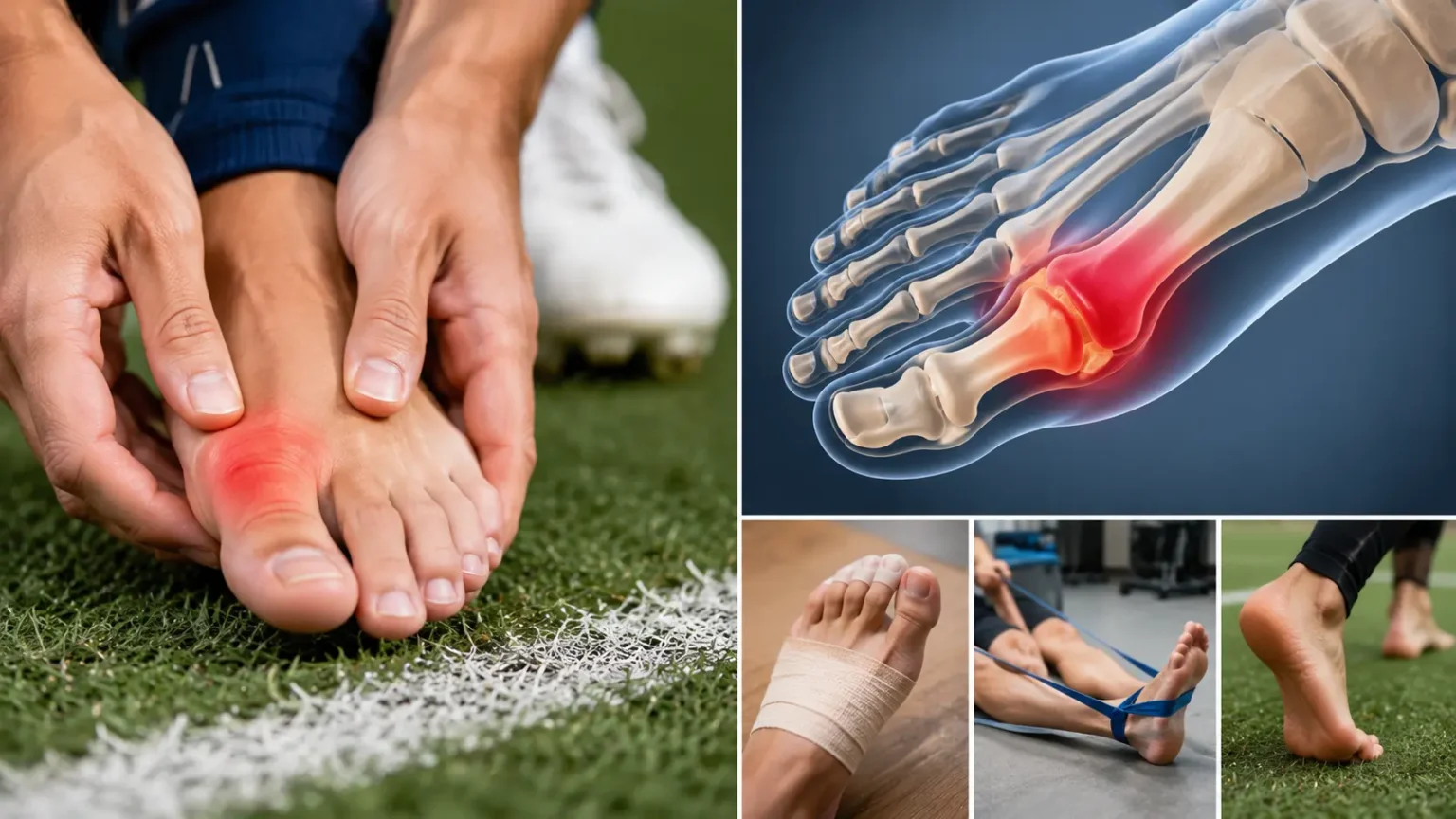

Turf Toe: Symptoms, Causes, Treatment and Recovery
Turf toe is a sprain of the main joint at the base of the big toe, medically known as the first metatarsophalangeal joint, or first MTP joint. It usually happens when the big toe is forced upward beyond its normal range while the front of the foot remains planted. The injury can stretch or tear the soft tissues underneath the joint, particularly the plantar plate and surrounding structures that help stabilize the big toe.
The injury is strongly associated with sports that involve sprinting, cutting, jumping, and pushing forcefully through the forefoot. Football players are commonly affected, but turf toe can also occur in soccer, basketball, wrestling, gymnastics, dance, and other activities that repeatedly load the big toe. Despite the name, the injury is not limited to artificial turf and can occur on many playing surfaces.
Symptoms can range from mild tenderness after activity to severe pain, swelling, bruising, and difficulty walking. Sports medicine professionals commonly classify turf toe into three grades based on how badly the supporting tissues have been damaged: a mild Grade 1 sprain, a partial Grade 2 tear, and a severe Grade 3 complete tear.
Most cases can be managed without surgery, especially mild and moderate injuries. Rest, protection of the joint, footwear modifications, temporary immobilization, and gradual rehabilitation are commonly used. Severe injuries may take several months to heal, however, and a small number require surgery when the joint is unstable or important structures have been significantly disrupted.
What Is Turf Toe?
Turf toe is a soft-tissue injury involving the structures surrounding the big toe joint. The joint connects the first metatarsal bone in the foot to the first bone of the big toe and plays an important role whenever you walk, run, jump, or push off the ground. The plantar plate beneath the joint helps prevent the toe from bending excessively upward.
The injury occurs when this joint is suddenly or repeatedly hyperextended. Imagine the front of your foot planted against the ground while your heel rises and another force pushes your body forward. If the big toe remains fixed while the rest of the foot moves, the toe can bend farther backward than its supporting tissues are designed to tolerate.
The resulting damage can range from microscopic stretching of the plantar structures to a partial or complete tear. Severe injuries may also involve surrounding ligaments, joint surfaces, or the small sesamoid bones underneath the first metatarsal head. That is why two athletes both diagnosed with turf toe can have dramatically different symptoms and recovery times.
Although the name sounds relatively harmless, turf toe can significantly affect athletic performance. The big toe provides substantial leverage during push-off, so pain or instability at this joint can interfere with sprinting, jumping, acceleration, cutting, and even ordinary walking. Early recognition and appropriate rehabilitation can help prevent a minor injury from becoming a persistent problem.
Why Is It Called Turf Toe?
The term “turf toe” became widely associated with athletes competing on artificial playing surfaces. Early artificial turf was often harder than natural grass, while some athletic footwear designed for those surfaces was relatively flexible through the forefoot. That combination allowed the toe to bend upward while the shoe provided limited resistance.
The injury is not caused exclusively by artificial turf, however. Athletes can develop the same hyperextension injury on natural grass, gym floors, wrestling mats, dance surfaces, or virtually anywhere the forefoot becomes fixed while the big toe bends backward.
Footwear remains relevant because shoes vary in how much they allow the forefoot to flex. Very flexible shoes can increase movement through the big toe joint, whereas shoes or inserts with greater forefoot stiffness can limit excessive extension in some situations.
Modern sports medicine therefore uses “turf toe” primarily as the name of the injury rather than as a statement about where it occurred. The underlying problem is damage to the plantar structures of the first MTP joint, regardless of whether the athlete was playing on artificial turf, natural grass, or another surface.
Common Turf Toe Symptoms
The most typical turf toe symptom is pain at the base of the big toe. The discomfort is often concentrated underneath or around the first MTP joint and may become particularly noticeable when the person pushes off the forefoot during walking, running, jumping, or climbing stairs.
Swelling can develop around the joint as injured tissues become inflamed. Mild injuries may produce only subtle puffiness, while more significant sprains can cause obvious swelling and bruising. Tenderness is often greatest around the plantar surface underneath the joint where the supporting tissues have been overstretched.
Movement can also become uncomfortable. Bending the big toe upward may reproduce the pain, and athletes sometimes notice reduced range of motion because swelling and tenderness make the joint feel stiff. Some people compensate by walking on the outside of the foot to avoid loading the painful big toe.
Severe turf toe may cause immediate intense pain and make it difficult to continue playing. An athlete may feel unable to push off normally or notice that the joint feels unstable. A Grade 3 injury represents complete disruption of the plantar plate and can require a much longer recovery than a simple Grade 1 sprain.
What Does Turf Toe Feel Like?
A mild turf toe injury may initially feel like soreness underneath the big toe rather than a dramatic injury. The athlete might finish training but notice increasing discomfort afterward, particularly when extending the toe or pushing through the front of the foot.
Moderate injuries tend to produce more obvious pain and swelling. Running, accelerating, changing direction, or rising onto the toes can become uncomfortable because those movements load the first MTP joint heavily. Walking may still be possible, but the person often changes their gait to protect the injured area.
A severe injury can feel sharp immediately when the toe is forced backward. The athlete may need to stop activity at once, and bruising or significant swelling may develop relatively quickly. Weight-bearing and push-off can become extremely difficult because the structures responsible for stabilizing the joint have been substantially damaged.
The sensation can sometimes be confused with a fracture, sesamoid injury, arthritis, or another cause of big toe pain. The mechanism of injury and physical examination are therefore important. Significant pain after sudden forced hyperextension should be evaluated rather than assumed to be simple soreness.
What Causes Turf Toe?
The classic cause is hyperextension of the big toe. This occurs when the toe remains planted while the heel lifts and the body moves forward. The forces are transferred through the plantar structures underneath the joint, which can stretch or tear when the movement exceeds their normal capacity.
Football is one of the sports most closely associated with the injury because players frequently accelerate from a crouched position, push through the forefoot, and experience contact from other athletes. A player may have the toe planted while another player lands on the back of the foot or leg, forcing the joint farther upward.
Soccer, basketball, rugby, wrestling, gymnastics, sprinting, and dance can create similar mechanics. Any sport involving repeated forefoot loading, sudden acceleration, jumping, or abrupt direction changes can place stress on the big toe joint.
Turf toe can also develop gradually rather than during one memorable incident. Repeated hyperextension over many training sessions may irritate the plantar structures until pain and stiffness begin interfering with performance. This type of repetitive stress can be easier to overlook because there may be no single moment when the athlete remembers getting hurt.
Who Is Most at Risk for Turf Toe?
Athletes involved in sports requiring explosive push-off are among those most likely to develop turf toe. Football running backs, receivers, linemen, and other players frequently use the big toe to generate force during acceleration and direction changes.
Soccer and basketball players are also vulnerable because these sports involve sprinting, cutting, jumping, and rapid transitions. Wrestlers can sustain the injury when their toes remain planted against the mat while another athlete forces their body forward.
Footwear may influence risk as well. Highly flexible shoes allow greater movement through the forefoot. Although flexibility can be beneficial for certain athletic movements, inadequate support around an already vulnerable big toe joint may allow excessive extension.
Previous turf toe is another potential risk factor because an incompletely rehabilitated joint may remain painful, stiff, or unstable. Returning to sport before strength, motion, and functional push-off have recovered can expose healing tissues to repeated stress.
Turf Toe Grades Explained
Sports medicine professionals generally divide turf toe into three grades according to the amount of tissue damage. This classification helps guide treatment and gives athletes a rough idea of how much activity modification and recovery time may be required.
A Grade 1 turf toe injury involves stretching or a mild sprain of the plantar structures. Pain and swelling are generally limited, and the athlete can often bear weight. Treatment may involve ice, brief rest, taping, and a rigid shoe insert or stiff-soled footwear.
A Grade 2 injury involves a partial tear of the plantar plate. Pain, swelling, tenderness, and reduced motion are usually more noticeable. Running and pushing off become difficult, and temporary immobilization may be appropriate while the tissues begin healing.
A Grade 3 turf toe injury involves complete disruption of the plantar plate or supporting structures. The athlete may have severe pain, bruising, swelling, and considerable difficulty bearing weight or pushing off. These injuries can require several months of recovery, and selected severe cases may need surgery.
Grade 1 Turf Toe Symptoms and Treatment
Grade 1 is the mildest form of turf toe. The supporting tissues have been stretched but remain largely intact. The athlete may experience tenderness beneath the big toe, mild swelling, and pain when the joint is pushed upward.
Walking is often possible, although sprinting or explosive push-off may hurt. Because the injury seems relatively minor, athletes sometimes continue playing without giving the tissue enough time to settle down.
Initial management commonly involves reducing activities that reproduce pain, applying ice, and limiting excessive upward movement of the toe. Taping and a rigid forefoot insert may help reduce stress on the plantar plate when the athlete begins returning to activity.
Some Grade 1 injuries improve within approximately a week when appropriately protected, although recovery varies between individuals. Returning too aggressively can prolong irritation, so pain-free walking and functional movement should generally come before unrestricted competition.
Grade 2 Turf Toe Symptoms and Treatment
Grade 2 turf toe represents a partial tear of the structures underneath the big toe joint. The athlete usually notices greater swelling and tenderness than with a Grade 1 injury, and bruising may become visible.
Walking can become uncomfortable, especially during the push-off phase of each step. Running, jumping, or changing direction is generally much harder because those movements require the big toe to tolerate considerable load.
Treatment may involve a period of reduced weight-bearing or immobilization. A walking boot can sometimes be used temporarily to prevent excessive movement while the injured tissues begin healing. Once symptoms improve, rehabilitation focuses gradually on restoring range of motion and strength.
Recovery frequently takes longer than a mild sprain. Cleveland Clinic notes that Grade 2 turf toe may resolve in roughly two to three weeks in some cases, although return to high-level sport depends on functional recovery rather than the calendar alone.
Grade 3 Turf Toe Symptoms and Treatment
Grade 3 is the most severe category and involves complete tearing of the plantar plate or major supporting structures. Pain may be immediate and intense, and athletes often struggle to continue participating after the injury.
Significant swelling and bruising can develop around the first MTP joint. The joint may feel unstable, and normal push-off can become impossible because the tissues that normally support the big toe are no longer functioning correctly.
Treatment usually begins with substantial protection or immobilization. A walking boot or cast may be used, depending on the injury, and weight-bearing may need to be limited while healing begins. Rehabilitation becomes progressively more active as stability and pain improve.
Grade 3 recovery may take two to six months, particularly when the injury is extensive. Surgery is uncommon overall but may be considered when there is major instability, dislocation, severe tissue disruption, or failure of appropriate nonsurgical treatment.
How Is Turf Toe Diagnosed?
Diagnosis usually begins with a detailed description of how the injury happened. A clinician may ask whether the big toe was forced backward, whether the person felt immediate pain, and whether they could continue walking or competing afterward.
The physical examination commonly includes checking tenderness, swelling, bruising, stability, and range of motion around the first MTP joint. The healthcare professional may gently move the big toe while evaluating which positions reproduce pain.
Imaging may be used when the injury is significant or when another diagnosis needs to be excluded. X-rays do not directly show a soft-tissue plantar plate tear, but they can identify fractures, joint alignment problems, or abnormalities involving the sesamoid bones.
More advanced imaging, such as MRI, may be considered when doctors need to examine the plantar plate and surrounding soft tissues more clearly. Imaging decisions depend on injury severity, examination findings, athletic demands, and whether symptoms are improving as expected.
Turf Toe vs a Broken Big Toe
Turf toe and a big toe fracture can both cause pain, swelling, and difficulty walking. The main difference is that turf toe primarily involves soft tissues supporting the joint, whereas a fracture involves a break in one of the bones.
The mechanism can provide clues. Turf toe often occurs when the big toe is hyperextended, while fractures may follow a direct impact, crushing injury, awkward landing, or forceful collision. Nevertheless, one injury mechanism can occasionally damage both bone and soft tissue.
Bruising and swelling can occur with either injury, making visual inspection unreliable. Severe tenderness over a specific bone, deformity, or inability to bear weight can increase suspicion for fracture but does not confirm it.
X-rays may therefore be useful when significant trauma has occurred. Because fractures and turf toe require somewhat different management, persistent or severe pain should be assessed rather than diagnosed solely based on symptoms.
Turf Toe vs Sesamoiditis
The sesamoids are two small bones located beneath the first metatarsal head near the big toe joint. They function somewhat like pulleys and help the tendons generate force during push-off.
Sesamoiditis usually develops from repetitive stress rather than one sudden hyperextension injury. Pain tends to occur underneath the ball of the foot and may gradually increase during running, dancing, or other activities that repeatedly load the forefoot.
Turf toe, by comparison, commonly follows forced extension of the big toe and involves the supporting soft tissues around the first MTP joint. Severe turf toe injuries can sometimes affect the sesamoid complex as well, which creates overlap between the conditions.
Because sesamoid stress injuries, fractures, and turf toe can produce similar pain locations, medical evaluation may be useful when symptoms persist. Treatment usually depends on exactly which structure has been injured and how much loading it can safely tolerate.
Turf Toe vs Gout
Gout can cause severe pain in the big toe joint, making it another condition sometimes confused with turf toe. Gout is an inflammatory arthritis caused by urate crystals accumulating in or around joints.
A gout attack often begins suddenly without a sports injury. The joint may become extremely painful, swollen, warm, and visibly red, and even light contact from clothing can feel uncomfortable. The first big toe joint is a common location for gout attacks.
Turf toe is usually linked to trauma or repeated mechanical stress. Pain is commonly worsened by bending the toe upward or pushing through the forefoot rather than developing spontaneously while resting.
Anyone experiencing intense unexplained big toe swelling without a clear injury should consider medical evaluation rather than assuming turf toe. Gout, infection, arthritis, fractures, and other conditions may require different treatment.
Initial Turf Toe Treatment
Immediately after an injury, the main goal is to protect the joint from repeated hyperextension. Continuing to sprint, jump, or push aggressively through a painful big toe may worsen tissue damage and prolong recovery.
Rest from aggravating activity and application of cold packs can help manage early pain and swelling. Ice should generally be wrapped rather than placed directly against bare skin. Elevating the foot while resting may also help limit swelling.
Compression or supportive taping may be useful in selected injuries, but techniques should avoid restricting circulation or placing the toe in a painful position. Athletes frequently benefit from guidance from a sports medicine professional, athletic trainer, or physical therapist.
Pain-relieving medication may occasionally be appropriate depending on the person’s medical history, but medication should not be used simply to hide symptoms so an athlete can continue loading an unstable joint. Protecting the injured tissues is an essential part of recovery.
Does the RICE Method Help Turf Toe?
The traditional RICE approach—rest, ice, compression, and elevation—is commonly used during the early phase of turf toe management to reduce stress and control symptoms. Sports medicine sources continue to include these measures among nonsurgical treatment options.
Rest does not necessarily mean complete inactivity for weeks. It means avoiding activities that force the toe into painful extension while allowing the injured structures an opportunity to heal. Low-impact alternatives may eventually be introduced when they do not reproduce symptoms.
Ice can be particularly useful for temporary pain relief after an acute injury. Short sessions with a wrapped cold pack are generally more appropriate than placing ice directly on the skin.
Compression and elevation may help with swelling, but their role depends on the severity of the injury. More significant turf toe frequently requires additional measures such as a walking boot, rigid insert, taping, or other forms of joint protection.
Should You Tape Turf Toe?
Taping can help limit excessive upward movement of the big toe and may be used during recovery from mild or moderate turf toe. The goal is to provide support without completely eliminating necessary movement or compromising circulation.
Athletes sometimes use taping when transitioning back into training. Combined with a stiff shoe or rigid insert, it can reduce stress on the plantar plate during push-off.
Technique matters. Taping too tightly may cause numbness, tingling, discoloration, or discomfort, while poorly positioned tape may fail to support the joint. Athletic trainers and physical therapists can demonstrate an appropriate approach.
Taping should not be used as a way to continue competing through a severe injury. A Grade 2 or Grade 3 injury may need temporary immobilization and structured rehabilitation rather than simple sideline taping.
Best Shoes for Turf Toe Recovery
Footwear can influence how much the big toe bends during walking and athletic activity. A shoe with a relatively stiff forefoot can reduce excessive extension through the first MTP joint and may make everyday walking more comfortable during recovery.
Rigid inserts or carbon-type plates are sometimes placed inside shoes to limit forefoot bending. Sports medicine guidance includes rigid shoe inserts among conservative options for protecting the plantar plate.
The best shoe varies by sport, foot shape, injury grade, and phase of recovery. An athlete returning to football may need different footwear characteristics from someone recovering for everyday walking.
Footwear alone will not repair a major plantar plate tear. It should be viewed as one component of an overall treatment strategy that may also involve rest, rehabilitation, taping, temporary immobilization, and gradual return to activity.
When Is a Walking Boot Needed?
A walking boot may be recommended when pain and tissue damage are significant enough that ordinary shoes do not sufficiently protect the joint. Immobilization reduces the amount of big toe movement during everyday walking.
Grade 2 injuries sometimes benefit from a temporary period in a boot, particularly when normal walking is painful. The goal is to allow the partially torn plantar structures to begin healing without being repeatedly stretched.
Grade 3 injuries commonly require more substantial immobilization. Mass General Brigham notes that more serious turf toe injuries may be treated with a boot and that immobilization time generally increases with injury severity.
A boot should not necessarily be worn indefinitely. Prolonged immobilization can contribute to stiffness and weakness, so movement and rehabilitation are generally reintroduced according to healing progress and professional guidance.
Physical Therapy for Turf Toe
Physical therapy can become particularly valuable after moderate or severe turf toe. Once the injured structures have had enough time to settle, rehabilitation focuses on restoring comfortable joint movement and rebuilding strength through the foot and lower leg.
Early rehabilitation may include gentle mobility exercises that avoid forcing the toe into painful hyperextension. The objective is to prevent excessive stiffness without stressing tissues that are still healing.
Strengthening gradually becomes more important as pain decreases. Exercises may target the intrinsic muscles of the foot, calf, ankle, and muscles involved in controlling the big toe. Overall lower-body strength also matters because running and jumping rely on coordinated movement through the entire kinetic chain.
Later rehabilitation introduces sport-specific loading. An athlete may progress from walking to controlled strengthening, then jogging, running, acceleration, jumping, and eventually cutting or competition. Return should be based on function and symptoms rather than simply reaching a predetermined date.
Turf Toe Exercises During Recovery
Exercise selection should match the stage of healing. Immediately after a significant injury, aggressive stretching of the big toe may reproduce the original hyperextension mechanism and should generally be avoided.
Once a healthcare professional considers movement appropriate, gentle range-of-motion work may help restore flexibility. The toe should move within a comfortable range rather than being forced into substantial pain.
Strengthening exercises can eventually target the foot muscles and calf. Controlled calf raises and other functional movements may be added as the athlete becomes able to load the forefoot without significant discomfort. Rehabilitation guidance often gradually reintroduces calf work and big toe motion while avoiding excessive extension.
Later stages should recreate the demands of the person’s sport. A football or soccer athlete needs to tolerate sprinting and direction changes, while a dancer may need excellent forefoot control and balance. Rehabilitation therefore becomes increasingly individualized as return to activity approaches.
How Long Does Turf Toe Take to Heal?
Turf toe recovery time depends heavily on injury grade. Mild injuries can improve relatively quickly, while complete tears may require months before athletes regain full confidence and function.
Cleveland Clinic reports that Grade 1 injuries may improve within approximately one week with rest. Grade 2 injuries may take around two to three weeks, although individual recovery can vary depending on tissue damage and athletic demands.
Grade 3 injuries may require approximately two to six months of healing. Severe injuries involving surgery can take even longer before the athlete is ready for unrestricted sport.
Recovery timelines should be treated as estimates rather than promises. An athlete whose toe remains painful, swollen, weak, or unstable is not fully recovered simply because a certain number of weeks has passed. Functional testing and gradual progression provide better information than the calendar alone.
When Can You Walk Normally After Turf Toe?
People with mild Grade 1 turf toe can often continue walking, although pushing through the injured toe may feel uncomfortable initially. A stiff-soled shoe or insert may reduce the amount of painful motion.
Moderate Grade 2 injuries can make normal walking more difficult. The person may limp or unconsciously shift weight toward the outside of the foot. Temporary protection may be useful until walking becomes comfortable again.
Severe injuries can make normal walking difficult or impossible without a boot, crutches, or another form of support. Weight-bearing recommendations depend on the extent of tissue disruption and should follow professional guidance.
Walking normally is an important milestone but is not the same as being ready for sport. Sprinting and cutting expose the joint to forces far greater than everyday walking, so athletic progression should continue gradually after normal gait has returned.
When Can You Return to Sports?
Return to sport depends on injury severity and whether the athlete can perform necessary movements without significant pain, instability, or compensation. Mild injuries may allow relatively quick return when the joint is protected.
Moderate injuries usually require more patience. Athletes should be able to walk, jog, push off, and gradually accelerate before immediately attempting full-speed competition.
Cutting, jumping, and explosive sprinting should usually come later because these movements place substantial force through the big toe. Sport-specific drills can reveal whether the joint is ready to tolerate those demands.
Returning prematurely can turn an acute injury into persistent pain, stiffness, or instability. Coaches and athletes should therefore treat functional readiness as more important than pressure to return for a particular match or event.
Can You Play Through Turf Toe?
Some athletes with a mild Grade 1 injury can continue participating with appropriate protection, particularly when pain is limited and joint stability remains intact. Sports medicine guidance notes that Grade 1 cases may sometimes be managed with short rest followed by taping and a rigid insert.
Playing through a moderate injury is more questionable. Pain during push-off changes movement mechanics, potentially placing additional stress on the ankle, knee, hip, or opposite leg.
Continuing competition through a severe Grade 3 injury can further damage already compromised structures. Significant swelling, instability, inability to push off, or severe pain should be treated as signs to stop rather than challenges to overcome.
Pain tolerance is not the same as tissue healing. An athlete may be capable of enduring discomfort while still worsening the underlying injury, particularly if medication or adrenaline makes symptoms temporarily easier to ignore.
Can Turf Toe Become Chronic?
Yes. Turf toe that is repeatedly aggravated or insufficiently rehabilitated can become a chronic problem. Ongoing symptoms may include pain, swelling, stiffness, weakness during push-off, or a feeling that the joint is unstable.
Repeated injury can also affect athletic performance. An athlete may subconsciously shorten stride length, avoid loading the big toe, or lose confidence during acceleration and cutting.
Chronic plantar plate damage can be more difficult to treat than an acute sprain because the tissues may heal in a lengthened or unstable position. ACFAS literature specifically recognizes chronic turf toe as a potential problem when nonsurgical treatment fails.
Persistent symptoms should therefore not be ignored simply because the original injury occurred months ago. Sports medicine or foot-and-ankle evaluation can help determine whether ongoing symptoms reflect incomplete healing, instability, arthritis, sesamoid involvement, or another condition.
Can Turf Toe Cause Arthritis?
Significant injury to the first MTP joint can potentially contribute to long-term joint problems, particularly if instability or cartilage damage persists. Repeated injury can alter how forces are transmitted through the joint during walking and athletics.
Chronic stiffness may also develop when an injured joint remains immobilized too long or when pain repeatedly limits normal movement. This can reduce the big toe’s ability to extend comfortably during push-off.
Not every person with turf toe develops arthritis. Most mild injuries recover appropriately when given adequate protection and rehabilitation.
The greatest concern generally involves severe, recurrent, or untreated injuries. Protecting the joint and restoring normal mechanics can help reduce long-term complications and preserve athletic function.
When Does Turf Toe Need Surgery?
Most turf toe injuries are treated without surgery. Mild and moderate sprains typically respond to protection, temporary activity modification, footwear changes, and progressive rehabilitation.
Surgery is considered more often with severe Grade 3 injuries. Examples may include major instability, dislocation, significant disruption of the plantar structures, displaced sesamoid-related injuries, or other structural damage that cannot heal adequately with conservative treatment.
Mass General Brigham notes that surgery is uncommon but may be appropriate when severe injuries involve complete tears or joint dislocation and immobilization is insufficient.
Surgical recovery is longer than treatment for a mild sprain because repaired tissues need time to heal before aggressive loading begins. Rehabilitation afterward gradually restores motion, strength, and sport-specific function.
How to Prevent Turf Toe
No prevention strategy can eliminate every turf toe injury, particularly in contact sports where another athlete may land on a planted foot. However, reducing unnecessary hyperextension stress can lower risk.
Proper athletic footwear is one important consideration. Shoes that provide appropriate forefoot stability for the sport can help limit excessive motion through the big toe joint. Mass General Brigham recommends supportive footwear as one strategy for reducing risk.
Athletes with previous turf toe may benefit from rigid inserts, orthotics, or taping when recommended by their sports medicine team. These strategies can provide additional joint protection during high-demand activity.
Conditioning matters too. Maintaining foot, ankle, calf, and lower-body strength helps athletes control force during running and cutting. Adequate rehabilitation after a previous injury is particularly important because returning with persistent weakness or stiffness may increase the chance of recurrence.
Can Turf Toe Be Prevented With Inserts?
Rigid shoe inserts can help reduce bending through the forefoot, which is why they are commonly used both during recovery and for protection in athletes who have previously experienced turf toe.
Carbon or graphite-type plates are relatively thin but stiff. By limiting forefoot extension inside the shoe, they can reduce the amount the big toe bends backward during push-off.
Sports Medicine Today includes rigid shoe inserts as part of conservative treatment for Grade 1 injuries, often alongside taping and brief activity modification.
An insert should still fit comfortably and work with the athlete’s footwear. Excessive stiffness or poor fit can create problems elsewhere in the foot, so athletes with recurrent symptoms may benefit from professional fitting or sports medicine guidance.
When Should You See a Doctor for Turf Toe?
A mild toe sprain that rapidly improves with rest and protection may not require extensive evaluation. However, significant pain after hyperextension deserves more attention.
Seek medical assessment if you cannot bear weight normally, the joint becomes very swollen or bruised, pain is severe, or the toe feels unstable. These findings can suggest a more significant plantar plate injury or another problem such as fracture.
Persistent symptoms are another reason for evaluation. If big toe pain continues despite several days of reasonable protection or repeatedly returns whenever you resume activity, the injury may need a more structured rehabilitation plan.
Athletes whose performance depends heavily on sprinting or explosive forefoot loading may benefit from earlier sports medicine evaluation even when the injury initially appears moderate. Accurate grading can help prevent an overly aggressive return that prolongs recovery.
What Happens If Turf Toe Is Left Untreated?
A minor Grade 1 sprain may eventually settle with natural activity reduction, but repeatedly stressing the joint can make recovery longer than necessary.
Moderate injuries that are ignored may remain painful and weak. The athlete may compensate by changing their gait, which can create additional stress throughout the foot and lower limb.
Severe untreated injuries pose greater concern because complete disruption of the stabilizing tissues can produce chronic joint instability. Once the injury becomes chronic, treatment can become more complicated.
Persistent turf toe has been associated with chronic pain and difficulty returning to previous activity levels, which is why early protection and appropriate rehabilitation matter.
Common Turf Toe Recovery Mistakes
One of the most common mistakes is returning to sport as soon as ordinary walking becomes comfortable. Walking does not place the same load through the big toe as sprinting, jumping, or cutting.
Another mistake is repeatedly testing the injury by aggressively bending the big toe backward. Excessive hyperextension recreates the mechanism responsible for the sprain and can irritate healing tissue.
Athletes may also rely too heavily on pain medication, taping, or stiff inserts while ignoring persistent weakness and instability. These tools can protect the joint, but they do not replace rehabilitation.
Finally, some athletes become overly cautious and immobilize a mild injury longer than necessary. Once the tissue is ready, appropriate progressive movement helps restore normal mobility and strength. The ideal balance depends on injury severity.
Final Thoughts on Turf Toe
Turf toe is a sprain of the structures supporting the big toe’s first MTP joint, typically caused when the toe bends upward too far while the forefoot remains planted. It is common in sports involving sprinting, cutting, jumping, and explosive push-off.
Symptoms can include big toe pain, swelling, tenderness, bruising, stiffness, and difficulty pushing off. Grade 1 injuries involve mild stretching, Grade 2 injuries involve partial tearing, and Grade 3 turf toe involves complete disruption of the plantar plate.
Treatment ranges from brief rest, ice, taping, and stiff-soled footwear for mild cases to walking boots, physical therapy, and longer periods of protection for more severe injuries. Surgery is uncommon but may be necessary for selected severe Grade 3 injuries.
Recovery should be guided by function rather than urgency to return. Mild injuries may improve within about a week, while severe cases may take two to six months. Giving the joint enough time to heal and gradually rebuilding strength can help reduce recurrent pain and support a safer return to sport.
Frequently Asked Questions About Turf Toe
What Is the Fastest Way to Heal Turf Toe?
Protect the big toe from painful hyperextension, reduce aggravating activity, use appropriate cold therapy, and follow footwear or rehabilitation recommendations. Severe injuries should be professionally assessed rather than rushed.
Can You Walk With Turf Toe?
Many people can walk with mild turf toe, although pushing through the big toe may hurt. Moderate or severe injuries may require a stiff shoe, walking boot, or temporary reduction in weight-bearing.
How Long Does Turf Toe Take to Heal?
Grade 1 injuries may improve within about a week, Grade 2 injuries may need several weeks, and severe Grade 3 turf toe can take two to six months depending on the extent of damage.
Does Turf Toe Need Surgery?
Most cases do not require surgery. Surgery may be considered for severe Grade 3 injuries involving major instability, complete structural disruption, dislocation, or symptoms that fail to improve with appropriate nonsurgical treatment.
Can Turf Toe Come Back?
Yes. Reinjury is possible, particularly when an athlete returns before the joint has regained adequate strength, motion, and stability. Appropriate rehabilitation, supportive footwear, inserts, or taping may help reduce recurrence.