
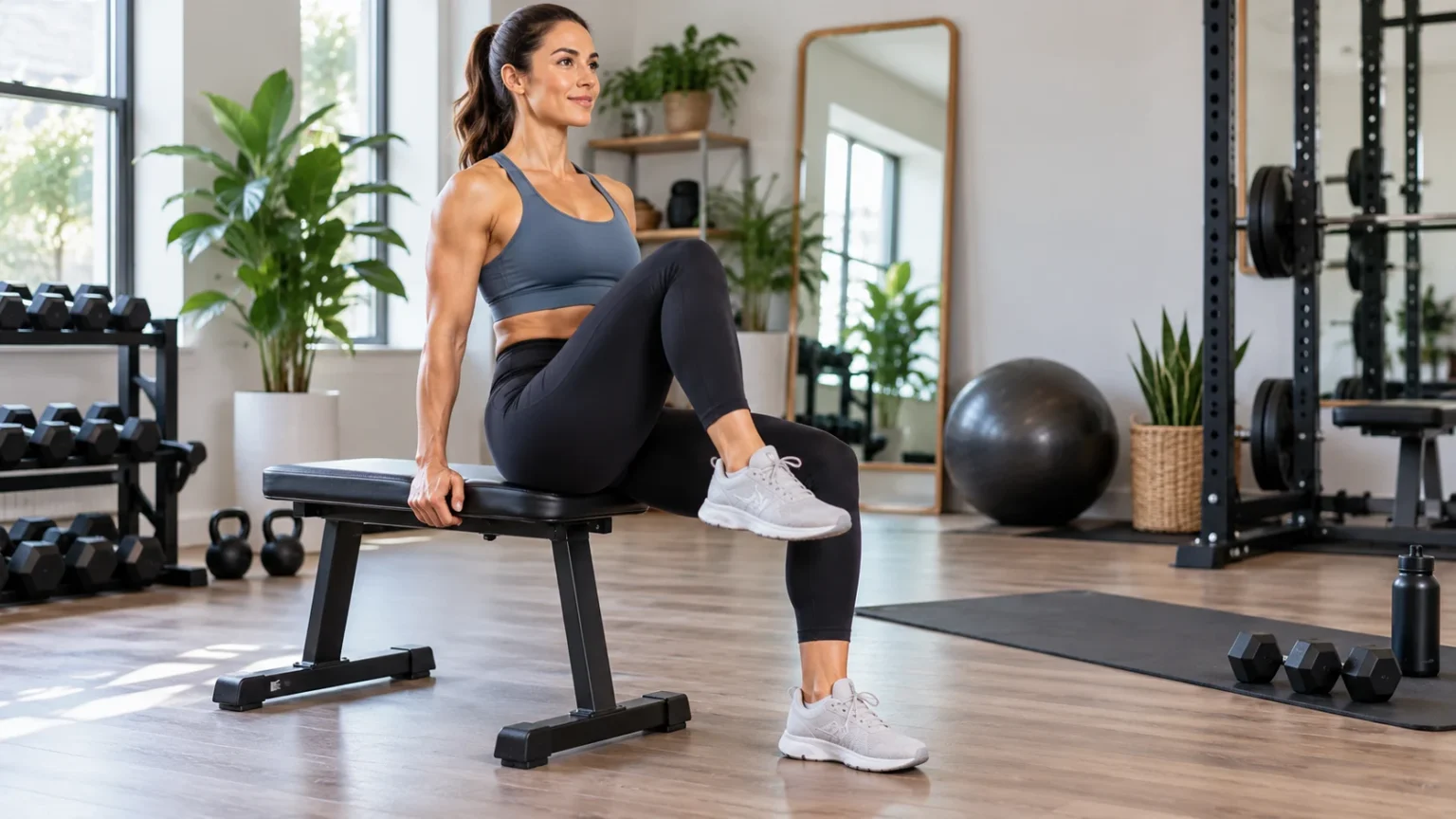

Unlike exercises that require standing or lying on the floor, seated knee lifts offer a supported position while encouraging controlled leg movement. They can be particularly useful for individuals who prefer low-impact exercise or want to improve coordination and hip mobility. However, the benefits depend on technique, exercise intensity, and individual physical abilities.
What Are Seated Knee Lifts?
Seated knee lifts are a chair-based exercise involving raising one knee toward the chest while maintaining a stable seated position. The movement primarily activates the hip flexor muscles, which help lift the thigh toward the torso. Depending on posture and exercise variation, the abdominal muscles also contribute to stabilizing the trunk during movement.
This exercise is sometimes called seated marching because it resembles walking movements performed while sitting. Instead of supporting your body weight through your legs, you remain seated while alternately lifting your knees. The movement is relatively simple, although maintaining controlled posture and avoiding excessive leaning are important for proper execution.
Seated knee lifts can be included in warm-ups, mobility routines, or general strengthening sessions. They are often suitable for people seeking manageable movement options without complicated equipment. However, the exercise may require modification for individuals with hip injuries, significant weakness, or medical conditions that affect comfortable movement.
How to Perform Seated Knee Lifts Correctly
Start by sitting upright on a sturdy chair with your feet resting comfortably on the floor. Position your knees approximately hip-width apart and keep your shoulders relaxed. Choose a chair that does not roll or shift during movement, allowing you to focus on lifting your knees without worrying about stability.
Slowly lift one knee toward your chest while keeping your back in a comfortable, upright position. Raise the leg only as high as you can without discomfort or excessive leaning. Lower your foot back to the floor with control, then repeat the movement using the opposite leg.
Maintain steady breathing throughout each repetition and avoid jerking your legs upward. Your abdominal muscles should help stabilize your torso, but you do not need to forcefully tighten your stomach. Focus on smooth movement and consistent posture rather than attempting to lift your knees as high or as quickly as possible.
What Muscles Do Seated Knee Lifts Work?
The hip flexors are the primary muscles responsible for lifting your knees during seated knee lifts. These include the iliopsoas and rectus femoris, which contribute to moving the thigh toward the torso. Strengthening these muscles can support everyday activities involving stepping, walking, and lifting the legs.
The abdominal muscles also participate by helping stabilize the trunk during movement. The rectus abdominis, obliques, and deeper core muscles contribute to maintaining posture, although their involvement depends on exercise technique. Seated knee lifts are therefore not exclusively abdominal exercises, despite sometimes being included in seated core workout routines.
Other muscles, including the quadriceps and smaller stabilizing muscles around the pelvis, may also assist during the movement. Their contribution varies depending on knee positioning, movement range, and individual coordination. For balanced lower-body conditioning, seated knee lifts should complement exercises targeting other major muscle groups rather than serving as the only strengthening activity.
1. Basic Seated Knee Lifts for Beginners
Basic seated knee lifts provide a straightforward introduction to chair-based exercise. This variation involves alternating your legs while maintaining contact with the chair and keeping your torso upright. It can help beginners become familiar with controlled hip movement before progressing to more challenging seated exercise variations.
Sit near the middle of a stable chair with both feet flat on the floor. Lift your right knee a comfortable distance, pause briefly, and gently return your foot to the starting position. Repeat the same movement with your left leg, keeping your shoulders relaxed and your breathing natural.
Begin with a manageable number of repetitions rather than trying to complete a demanding routine immediately. If lifting your leg feels difficult, use a smaller range of motion or hold the chair for additional support. As the movement becomes easier, you can gradually increase repetitions while maintaining comfortable technique.
2. Alternating Seated Knee Lifts for Coordination
Alternating seated knee lifts involve raising one knee at a time in a steady, marching-like pattern. This exercise can support coordination between the lower limbs while encouraging controlled hip movement. Because the body remains supported by the chair, it provides an accessible way to practice movements that resemble stepping.
Begin by sitting upright with your feet positioned comfortably beneath your knees. Lift your right foot slightly off the floor while bringing your knee upward, then lower it before lifting the left leg. Continue alternating sides at a comfortable pace without allowing your upper body to sway excessively.
Focus on creating a smooth rhythm rather than moving as quickly as possible. Some people find that following a slow count helps maintain coordination and steady breathing. If fatigue affects your posture, pause and rest before continuing, particularly when performing the exercise as part of a longer seated workout.
3. Seated Knee Lifts With a Brief Pause
Adding a short pause at the top of a seated knee lift can increase the challenge of controlling the movement. This variation encourages the hip flexors to maintain the raised-leg position momentarily while the torso remains stable. It can be useful for developing awareness of muscle engagement and improving movement precision.
Sit upright with both feet resting on the ground and your hands placed comfortably beside you. Slowly raise one knee, then hold the position briefly without leaning backward or lifting your hips from the chair. Lower your foot gently and repeat with the opposite leg.
Choose a pause that feels manageable and does not cause discomfort around the hip or lower back. Longer holds are not automatically more beneficial, especially when they encourage breath-holding or poor posture. Gradually improving control is a more practical goal than maintaining unnecessarily difficult positions during every repetition.
4. Seated Knee Lifts With Arm Movements
Combining seated knee lifts with gentle arm movements can create a more coordinated exercise involving the upper and lower body. Raising the opposite arm while lifting a knee resembles the natural movement pattern used during walking. This variation may also make a basic seated routine more engaging and mentally stimulating.
Sit comfortably with your feet on the floor and your arms relaxed at your sides. Lift your right knee while gently swinging your left arm forward, then return both to the starting position. Repeat with the opposite knee and arm, maintaining a smooth rhythm throughout the exercise.
Keep your arm movements controlled and avoid twisting or leaning excessively. Individuals with shoulder discomfort can reduce the range of arm movement or keep their hands resting on the chair. The purpose is to coordinate comfortable movements rather than turn the exercise into a fast or strenuous activity.
5. Seated Knee Lifts for Core Stability
Seated knee lifts can challenge core stability when performed with an upright torso and minimal upper-body movement. As one leg lifts, the abdominal and trunk muscles help maintain the body’s position. However, this exercise primarily trains hip flexion and should not be considered a complete abdominal strengthening program.
Sit on a stable chair with your spine comfortably upright and your shoulders positioned over your hips. Gently engage your trunk muscles while raising one knee without shifting your weight excessively. Lower the leg with control and alternate sides, paying attention to your posture throughout the movement.
Avoid aggressively pulling your stomach inward or holding your breath while lifting your knees. A comfortable level of abdominal engagement is sufficient for most beginner routines. For more comprehensive core training, seated knee lifts can be combined with other suitable exercises that develop trunk strength, balance, and coordination.
6. Seated Knee Lifts for Hip Mobility
Hip mobility refers to the ability of the hip joints to move comfortably through their available range of motion. Seated knee lifts encourage controlled hip flexion, making them useful for gentle movement practice. Regularly moving the hips may help reduce feelings of stiffness associated with prolonged sitting.
Begin by sitting upright and slowly lifting one knee within a comfortable range. Keep your pelvis relatively stable and avoid forcing the thigh toward your chest. Lower your leg gently before repeating on the opposite side, allowing each movement to remain smooth and controlled.
The appropriate range of motion varies depending on flexibility, joint structure, and medical history. People with hip arthritis, recent surgery, or persistent joint pain may need specific exercise modifications. If a movement produces sharp discomfort, stop and seek professional guidance rather than attempting to push through the restriction.
7. Benefits of Seated Knee Lifts for Everyday Movement
Seated knee lifts help activate muscles involved in raising the legs during routine activities. Hip flexor strength contributes to walking, stepping over obstacles, and moving the legs while changing positions. Practicing these movements in a supported seated position can help maintain familiarity with basic lower-body motion.
The exercise also encourages coordination between the hips, legs, and trunk. Alternating knee movements requires the body to control one leg while maintaining a relatively stable seated posture. This can complement other physical activities that support general mobility and functional independence.
Another benefit is convenience because seated knee lifts require minimal space and no specialized fitness equipment. They can be performed during a home exercise routine or as a short movement break from prolonged sitting. Although useful, they do not replace walking, resistance training, or other activities that provide broader physical benefits.
8. Are Seated Knee Lifts Good for Abdominal Muscles?
Seated knee lifts engage abdominal muscles primarily through their role in maintaining posture and controlling trunk movement. The exercise may produce greater abdominal involvement when the knees move toward the torso and the pelvis moves slightly. However, the hip flexors remain important contributors, particularly during basic alternating knee lifts.
Some seated fitness routines describe knee lifts as exercises for the lower abdominal region. Anatomically, the abdominal muscles work together rather than functioning as completely separate upper and lower sections. While certain movements may emphasize different muscle actions, seated knee lifts cannot selectively reduce fat from one area of the abdomen.
For individuals seeking stronger abdominal muscles, seated knee lifts may serve as an introductory movement within a larger routine. Additional exercises that safely challenge trunk stability and strength can provide more complete conditioning. Choosing movements based on comfort, functional goals, and physical ability is more useful than focusing on appearance-related outcomes.
9. Seated Knee Lifts for Older Adults
Seated knee lifts can be a practical exercise option for older adults who prefer supported movements. The chair reduces standing balance demands while allowing controlled hip and leg activity. This makes the exercise convenient for gentle fitness routines, although individual suitability depends on strength, mobility, and overall health.
A stable chair with a firm seat and supportive backrest can provide a comfortable starting position. Older adults may begin by lifting each foot only slightly from the floor while maintaining an upright posture. Holding the chair for support is appropriate when additional stability is needed during movement.
Seated knee lifts may contribute to general mobility and lower-body conditioning, but they should not replace appropriate standing and balance activities when those are safe. Individuals with significant weakness, frequent falls, or recent orthopedic procedures should seek individualized guidance. A physical therapist can recommend modifications that match specific movement abilities.
10. Seated Knee Lifts for Office Workers
People who spend long periods sitting may experience stiffness around the hips and lower back. Seated knee lifts provide a convenient way to introduce movement during extended desk work. Brief activity breaks can help interrupt prolonged sitting and encourage muscle activation without requiring a complete workout session.
Choose a stable chair and ensure that your feet have enough room to move freely. Lift one knee at a time while keeping your torso upright and avoiding contact with nearby furniture. Continue for a comfortable period before returning to your normal activities or incorporating another gentle movement.
Office-based movement routines are most helpful when combined with regular changes in position and suitable physical activity outside working hours. Standing, walking, and stretching may provide additional variety throughout the day. Seated knee lifts are a useful option, but remaining physically active involves more than performing occasional chair exercises.
11. Common Mistakes During Seated Knee Lifts
One common mistake is leaning excessively backward when raising the knees. This movement may reduce the intended challenge to the hip flexors and place unnecessary strain on the lower back. Keeping the torso comfortably upright encourages better control and makes it easier to maintain consistent movement between repetitions.
Another mistake involves lifting the knees too quickly or allowing the feet to drop heavily onto the floor. Fast, uncontrolled repetitions can interfere with coordination and create unnecessary impact. Using a smooth lifting and lowering motion helps maintain control while allowing the muscles to perform the intended movement.
Holding the breath, gripping the chair excessively, and forcing uncomfortable ranges of motion are additional habits worth avoiding. Exercise should challenge the muscles without creating sharp pain or significant joint discomfort. Slowing down, reducing the movement range, or taking a break can help restore proper technique when fatigue develops.
12. How Many Seated Knee Lifts Should You Do?
The appropriate number of seated knee lifts depends on fitness level, movement ability, and personal exercise goals. Beginners may start with approximately eight to ten controlled repetitions per leg if that amount feels comfortable. The purpose is to develop consistent movement rather than complete a demanding number of repetitions immediately.
As strength and coordination improve, some individuals may gradually increase repetitions or perform an additional set. Rest periods can be included whenever needed, especially during longer exercise sessions. The most useful progression is one that allows steady breathing, comfortable joint movement, and consistent posture throughout the routine.
There is no single repetition target suitable for everyone because physical abilities and medical needs vary. Individuals with recent injuries, significant pain, or mobility limitations may require a modified approach. Rather than forcing a specific number, focus on movement quality and adjust the exercise according to personal tolerance.
13. How Often Should You Practice Seated Knee Lifts?
Seated knee lifts can be practiced regularly as part of gentle mobility or general physical activity routines. The ideal frequency depends on whether the exercise is being used for light movement, coordination practice, or more challenging strengthening. Low-intensity movements may be appropriate more frequently than demanding resistance-based variations.
Beginners can introduce the exercise during short sessions and observe how their muscles and joints respond. If the movement remains comfortable, it may be included in regular activity breaks or planned exercise sessions. When adding resistance or increasing difficulty, allowing suitable recovery becomes more important.
Consistency matters more than performing the exercise excessively. A balanced routine should also include other activities that support cardiovascular health, lower-body strength, flexibility, and balance. Seated knee lifts work best as one component of an individualized fitness plan rather than the only exercise performed.
14. How to Make Seated Knee Lifts More Challenging
Once basic seated knee lifts become comfortable, small adjustments can increase the exercise challenge. Slowing the lowering phase, adding brief pauses, or practicing more controlled repetitions can place additional demands on the working muscles. These changes should be introduced gradually while maintaining a stable seated position.
Some individuals may progress to more advanced seated marching variations or appropriate resistance exercises under suitable guidance. However, adding resistance is not necessary for everyone, particularly when the main goal is gentle mobility. Exercise difficulty should match current strength and coordination rather than being increased simply to make the routine harder.
Advanced variations should never require excessive leaning, breath-holding, or painful hip movement. If balance or posture becomes difficult to maintain, return to a simpler version. Gradual progression helps develop confidence and allows muscles and joints to adapt without unnecessary stress.
15. Safety Tips and When to Avoid Seated Knee Lifts
Seated knee lifts are generally accessible, but they are not appropriate for every situation. Individuals recovering from hip surgery, experiencing severe joint pain, or managing certain spinal conditions may require exercise restrictions. Consulting a healthcare professional is advisable when medical conditions could affect movement safety.
Always use a stable chair positioned on a level surface and avoid wheeled furniture that can move unexpectedly. Wear comfortable clothing and ensure adequate space around the legs. If you experience dizziness, sharp pain, unusual weakness, or significant discomfort during the exercise, stop and assess the symptoms.
New or worsening hip pain, persistent numbness, or difficulty moving the leg should not be ignored. These symptoms may indicate an underlying problem requiring medical attention rather than additional exercise. Choosing appropriate movement intensity and respecting physical limitations can help make seated knee lifts a safer part of regular activity.
Conclusion
Seated knee lifts are simple chair-based exercises that activate the hip flexors, encourage controlled leg movement, and help maintain trunk stability. They can be included in beginner workouts, office movement breaks, and gentle fitness routines. Their convenience makes them accessible to many individuals who prefer exercising without specialized equipment.
Proper technique involves sitting upright, lifting each knee comfortably, and lowering the foot with control. Avoiding excessive leaning, sudden movements, and unnecessary strain helps improve exercise quality. Repetitions and frequency should reflect individual abilities, with gradual progression as strength and coordination improve.
Whether your goal is better hip mobility, general lower-body conditioning, or adding movement to a sedentary routine, seated knee lifts can provide a useful starting point. They work best alongside other suitable exercises that support overall physical function. With consistent practice and appropriate modifications, this simple movement can become part of a balanced activity routine.
Frequently Asked Questions (FAQs)
1. What are seated knee lifts good for?
Seated knee lifts help activate the hip flexors, support controlled leg movement, and encourage trunk stability. They are useful for gentle mobility exercises, beginner fitness routines, and short movement breaks during prolonged sitting.
2. Do seated knee lifts strengthen your core?
Seated knee lifts involve the abdominal muscles in stabilizing the torso, although the hip flexors perform much of the lifting. They can complement other exercises designed to improve overall core strength and control.
3. How many seated knee lifts should beginners do?
Beginners may start with approximately eight to ten controlled repetitions per leg, depending on comfort and ability. The number can be adjusted gradually while maintaining proper posture and avoiding painful movements.
4. Are seated knee lifts safe for older adults?
Seated knee lifts can be suitable for many older adults because they provide a supported exercise position. However, individuals with significant mobility limitations, recent surgery, or joint pain may require professional guidance.
5. Can seated knee lifts help improve hip mobility?
Yes, seated knee lifts encourage controlled hip flexion and may help maintain comfortable movement through the available joint range. They should be performed gently without forcing the knees upward or causing discomfort.


