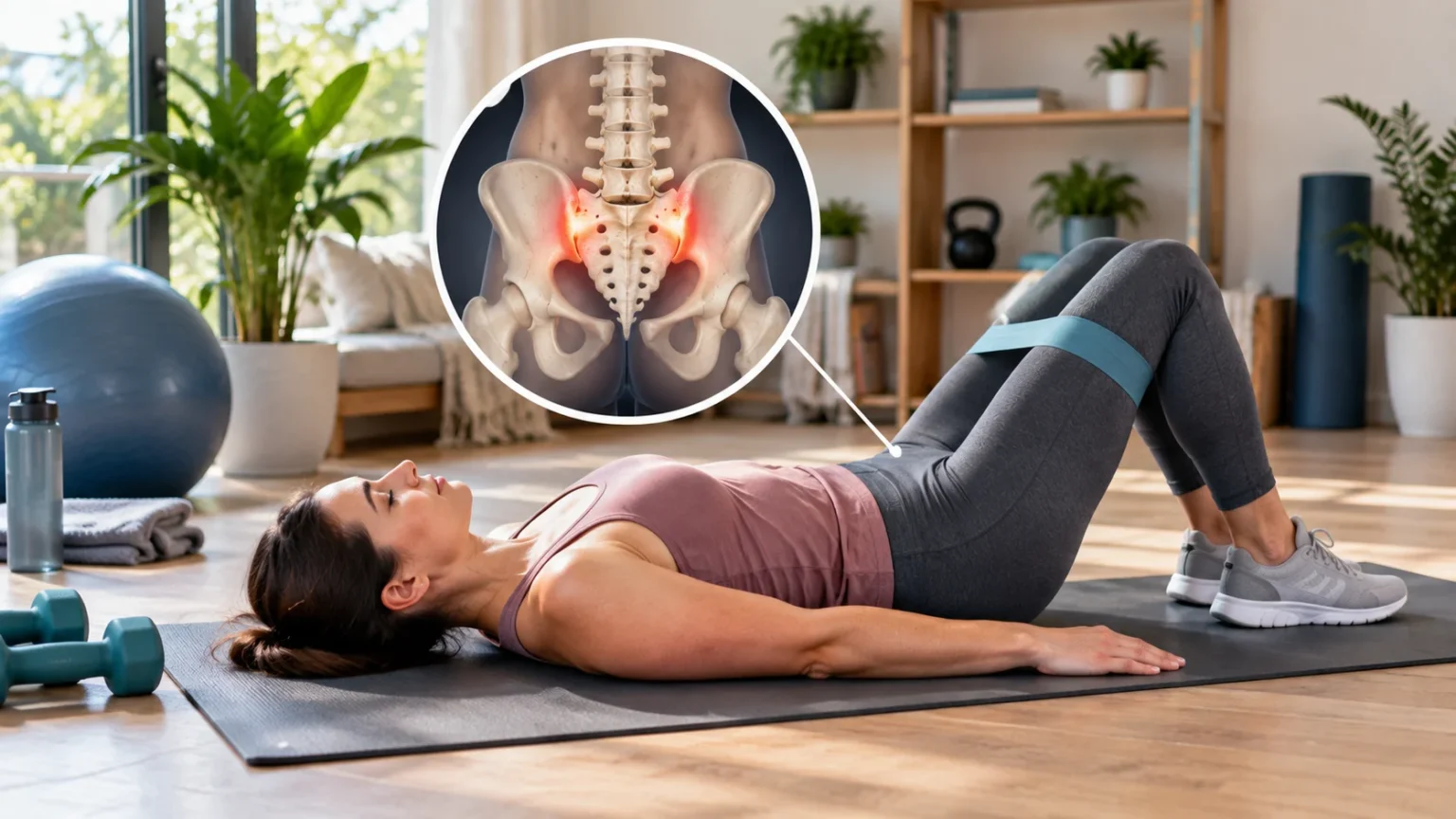

Sacroiliac joint discomfort can make walking, sitting, climbing stairs, exercising, and even rolling over in bed uncomfortable. The sacroiliac, or SI, joints sit where the pelvis connects to the lower spine, and irritation around this area may cause pain near the lower back, upper buttock, or one side of the pelvis. Gentle exercise can sometimes help by improving strength, mobility, and movement control.
The right SI joint exercises depend on what is contributing to your symptoms. Some people benefit from strengthening the glutes and core, while others need gentle mobility or changes in daily movement habits. Exercises should feel controlled rather than aggressive, and severe or persistent pain deserves professional assessment before you continue pushing through discomfort.
What Is the SI Joint?
The sacroiliac joints connect the sacrum at the base of the spine to the two sides of the pelvis. These joints move only a small amount, but they help transfer forces between the upper body and legs during walking, lifting, standing, and changing positions. Strong surrounding muscles help manage those forces efficiently.
SI joint pain is often felt near one side of the lower back or upper buttock. Some people notice discomfort around the back of the pelvis, hip, groin, or upper thigh. Because several lower-back and hip conditions can create similar symptoms, the location of pain alone cannot confirm that the SI joint is responsible.
Irritation may develop after a fall, repetitive loading, pregnancy-related changes, prolonged uneven postures, or changes in activity. However, symptoms sometimes appear without one obvious event. A healthcare professional or physical therapist can examine movement, strength, neurological signs, and nearby structures when the source of pain is unclear.
Benefits of SI Joint Exercises
Appropriate SI joint exercises can strengthen muscles that support the pelvis, hips, and lower spine. The glutes, abdominal muscles, and deep trunk muscles all contribute to controlling movement around the pelvic region. Improving their endurance may reduce unnecessary strain during everyday tasks such as walking, bending, lifting, and climbing stairs.
Exercise may also improve confidence in movement. People with recurring pain sometimes become stiff or guarded because they are afraid of triggering another flare. Gradual, comfortable movement can help restore normal activity while teaching the body to handle increasing loads without relying on excessive muscle tension or avoidance.
Mobility exercises can be helpful when stiffness around the hips contributes to altered movement. However, more flexibility is not automatically better for every person with SI joint pain. The best program usually balances mobility and stability instead of repeatedly stretching an already sensitive area as far as possible.
How to Prepare Before Doing SI Joint Exercises
Before exercising, notice your current pain level and what movements normally aggravate symptoms. Choose a comfortable surface and begin with gentle movements rather than immediately performing high-resistance exercises. If you recently injured the area or are experiencing severe pain, consider getting medical guidance before starting a new routine.
Warm up with a few minutes of easy walking or comfortable movement if tolerated. The goal is simply to get the hips and lower back moving naturally before strengthening exercises begin. Avoid forcing the pelvis through painful twisting motions or deep stretches just because they are commonly included in online SI joint routines.
Breathing matters during exercise as well. Try not to hold your breath or tighten every muscle around the abdomen and pelvis throughout each repetition. Smooth breathing can help you control movement more comfortably and reduce unnecessary bracing, particularly when pain has made you habitually tense.
Pelvic Tilts for Gentle Core Control
Pelvic tilts are a simple exercise that can help improve awareness and control around the lower back and pelvis. Lie on your back with your knees bent and feet resting comfortably on the floor. Keep your shoulders relaxed and allow your spine to begin in a comfortable neutral position.
Gently tighten the lower abdominal muscles and tilt the pelvis so the lower back moves slightly toward the floor. Hold briefly, then release back to the starting position without exaggerating the arch. The movement should remain small and smooth rather than turning into a strong abdominal crunch.
Start with several slow repetitions and focus on control rather than range. Stop if the exercise produces sharp pain or causes symptoms to spread into the leg. Pelvic tilts can be useful as an early-stage movement because they encourage gentle coordination without placing heavy resistance through the SI region.
Glute Bridges for Pelvic Stability
Glute bridges strengthen the buttock muscles and can help support the pelvis during walking and other daily activities. Lie on your back with knees bent and feet about hip-width apart. Keep your arms relaxed beside you and position the feet close enough that lifting the hips does not strain the lower back.
Gently tighten the glutes and lift the hips until your body forms a comfortable line from the shoulders toward the knees. Avoid pushing the hips excessively high or arching the lower back. Pause briefly at the top, then lower slowly while maintaining controlled movement from beginning to end.
Begin with a small number of repetitions and increase gradually as strength improves. If one side feels much more painful than the other, reduce the range rather than forcing symmetry. Bridges should primarily feel like work in the glutes and hips, not sharp pressure directly around the SI joint.
Clamshells for Hip Strength
Clamshells target muscles on the outside of the hip that help stabilize the pelvis. Lie on your side with hips and knees slightly bent and your feet together. Keep the pelvis stacked rather than rolling backward, and support your head so your neck remains comfortable throughout the exercise.
Keeping the feet together, slowly lift the top knee while the pelvis stays relatively still. You do not need to open the knee very far to activate the hip muscles effectively. Pause briefly, then lower it with control rather than allowing the leg to drop quickly.
Perform the movement on both sides unless your clinician has advised otherwise. If the exercise causes increasing buttock or pelvic pain, reduce the range or stop. Resistance bands can be added later, but good form without resistance should come first when symptoms are still sensitive.
Bird Dog for Core and Pelvic Control
The bird dog exercise challenges trunk stability while the arms and legs move. Begin on your hands and knees with your hands below the shoulders and knees below the hips. Keep the spine in a comfortable neutral position and gently engage the abdominal muscles without holding your breath.
Slowly extend one leg behind you while reaching the opposite arm forward if comfortable. Keep your hips level and avoid rotating the pelvis toward one side. Hold briefly, return to the starting position, and repeat with the opposite arm and leg using the same controlled technique.
If the full movement feels difficult, begin by moving only one arm or one leg at a time. Quality is more important than how high you lift your limbs. The exercise should build control around the trunk and pelvis without producing sharp pain, instability, or increasing symptoms afterward.
Knee-to-Chest Stretch for Gentle Mobility
A single knee-to-chest stretch can help some people reduce stiffness around the lower back and hip area. Lie on your back with both knees bent, then gently bring one knee toward the chest. Hold behind the thigh or around the shin without aggressively pulling the leg.
Keep the opposite leg in whatever position feels most comfortable. Some people prefer keeping it bent, while others gradually straighten it if that does not increase symptoms. Breathe normally and allow the stretch to remain mild rather than trying to create the strongest possible sensation.
Hold for a short period, release, and repeat on the other side. Stop if you experience sharp pelvic pain, numbness, tingling, or pain traveling farther down the leg. Not every SI joint problem responds well to stretching, so treat this as an optional mobility exercise rather than a required one.
Hip Flexor Stretch for Pelvic Position
Tightness around the front of the hip can influence how the pelvis moves during standing and walking. A gentle hip flexor stretch may help when prolonged sitting contributes to stiffness. Begin in a supported half-kneeling position, using a wall or stable chair if you need additional balance.
Keep your torso upright and gently shift your weight forward until you feel mild tension at the front of the hip on the kneeling side. Avoid arching the lower back or pushing the pelvis aggressively forward. A small movement is often enough to create an effective stretch.
Hold the position while breathing slowly, then change sides. The stretch should feel comfortable and should not reproduce sharp pain around the SI joint. If kneeling is uncomfortable, ask a physical therapist for an alternative standing version that better matches your mobility and symptom level.
Breathing and Pelvic Floor Relaxation
The pelvic floor, abdominal muscles, hips, and lower back work together during many everyday movements. Some people with persistent pelvic or SI-region discomfort develop a habit of clenching the abdomen, buttocks, or pelvic floor. Constant tension can make movement feel more restricted even when additional strengthening is not what the body needs.
Slow diaphragmatic breathing can help reduce unnecessary bracing. Let the lower ribs and abdomen expand naturally as you inhale, then exhale without forcefully tightening everything around the pelvis. If pelvic muscle tension is also a concern, these practical pelvic floor relaxation tips can provide additional guidance on breathing, relaxation, and gentle movement.
Relaxation does not mean the pelvis should become completely passive or unsupported. Healthy movement requires muscles to contract when needed and release when the effort is over. Learning both skills can be more useful than continuously tightening the core or pelvic floor in an attempt to keep the SI joint permanently “stable.”
Best Practices for SI Joint Exercise
Start with exercises that feel manageable and build slowly over time. Performing more repetitions is not automatically better, especially during a flare. A few controlled exercises completed consistently may be more useful than a long routine that leaves the pelvis significantly more painful afterward.
Pay attention to how you feel several hours after exercising as well as during the session. Mild muscle fatigue can be expected when strengthening, but a major increase in sharp pain or radiating symptoms suggests the routine may need modification. Reduce resistance, range, or total volume before assuming exercise itself is unsuitable.
Consistency matters more than intensity. Regular walking, strengthening, and mobility work can gradually improve tolerance when the exercises match the underlying problem. If symptoms repeatedly worsen despite careful technique, a physical therapist can evaluate your movement and build a more individualized program.
Exercises and Movements to Approach Carefully
Heavy lifting, deep twisting, and high-impact exercise may aggravate symptoms during an active SI joint flare. This does not mean these movements must always be avoided permanently. Instead, reduce or modify activities that clearly increase pain and reintroduce them gradually as strength, confidence, and tolerance improve.
Single-leg exercises can place greater demand on pelvic stability. Lunges, step-ups, and unilateral strength work may eventually be useful, but they can be too challenging early in recovery for some people. Begin with stable, controlled movements before progressing toward exercises that require more balance and force control.
Aggressive stretching should also be approached carefully. If the SI region already feels unstable or irritated, repeatedly forcing deep stretches may increase discomfort rather than relieve it. Exercises should be selected based on your symptoms and examination findings, not simply because a movement appears on a generic SI joint exercise list.
When to Stop Exercising and Seek Medical Advice
Stop exercising and seek medical advice if pain becomes severe, rapidly worsens, or follows significant trauma. You should also be assessed when symptoms prevent normal weight-bearing or when pain continues despite reasonable activity modification. Persistent nighttime pain or unexplained systemic symptoms deserve attention as well.
Urgent evaluation is important if lower-back or pelvic pain occurs with new bladder or bowel control problems, numbness around the groin, or rapidly increasing leg weakness. These symptoms can indicate serious nerve compression and should not be treated by continuing an exercise program at home.
Fever, unexplained weight loss, significant abdominal symptoms, or pain associated with serious illness also warrants professional assessment. Most SI-region pain is not caused by an emergency condition, but recognizing warning signs matters. When the diagnosis is uncertain, an examination can help distinguish SI joint irritation from spinal, hip, muscular, or neurological causes.
Conclusion
SI joint exercises can be useful when they focus on controlled strengthening, comfortable mobility, and better coordination around the pelvis. Pelvic tilts, bridges, clamshells, bird dogs, and selected stretches can help some people build strength and confidence. The right combination depends on your symptoms, activity level, and the actual source of pain.
Avoid treating every SI joint problem as something that simply needs more stretching or more core strength. Some people need stability, while others benefit from mobility, movement retraining, or reducing excessive muscle tension. Progress gradually and judge exercises by how your body responds during and after each session.
Persistent, worsening, or severe pain should be evaluated rather than repeatedly exercised through. A physical therapist or healthcare professional can determine whether symptoms are coming from the SI joint or another nearby structure. With appropriate guidance and consistent practice, many people can gradually improve movement tolerance and return to everyday activities more comfortably.
FAQs
What are the best exercises for SI joint pain?
Pelvic tilts, glute bridges, clamshells, bird dogs, and gentle hip mobility exercises may help some people. The best exercises depend on whether your symptoms involve weakness, stiffness, instability, or another underlying problem.
How often should I do SI joint exercises?
Many gentle exercises can be performed several times per week, depending on symptoms and intensity. Begin conservatively and allow recovery between strengthening sessions if the muscles feel significantly fatigued.
Can walking help SI joint pain?
Gentle walking can help maintain mobility and conditioning when it does not significantly worsen symptoms. Start with manageable distances and gradually increase your walking time as your comfort and endurance improve.
Should I stretch an irritated SI joint?
Gentle stretching may help when surrounding muscles are stiff, but aggressive stretching can aggravate some SI joint problems. Stop if a stretch causes sharp, radiating, or progressively increasing pain.
When should I see a doctor for SI joint pain?
Seek medical advice when pain is severe, persistent, worsening, or follows major trauma. Urgent assessment is needed for bladder or bowel changes, groin numbness, rapidly developing weakness, fever, or other serious symptoms.