
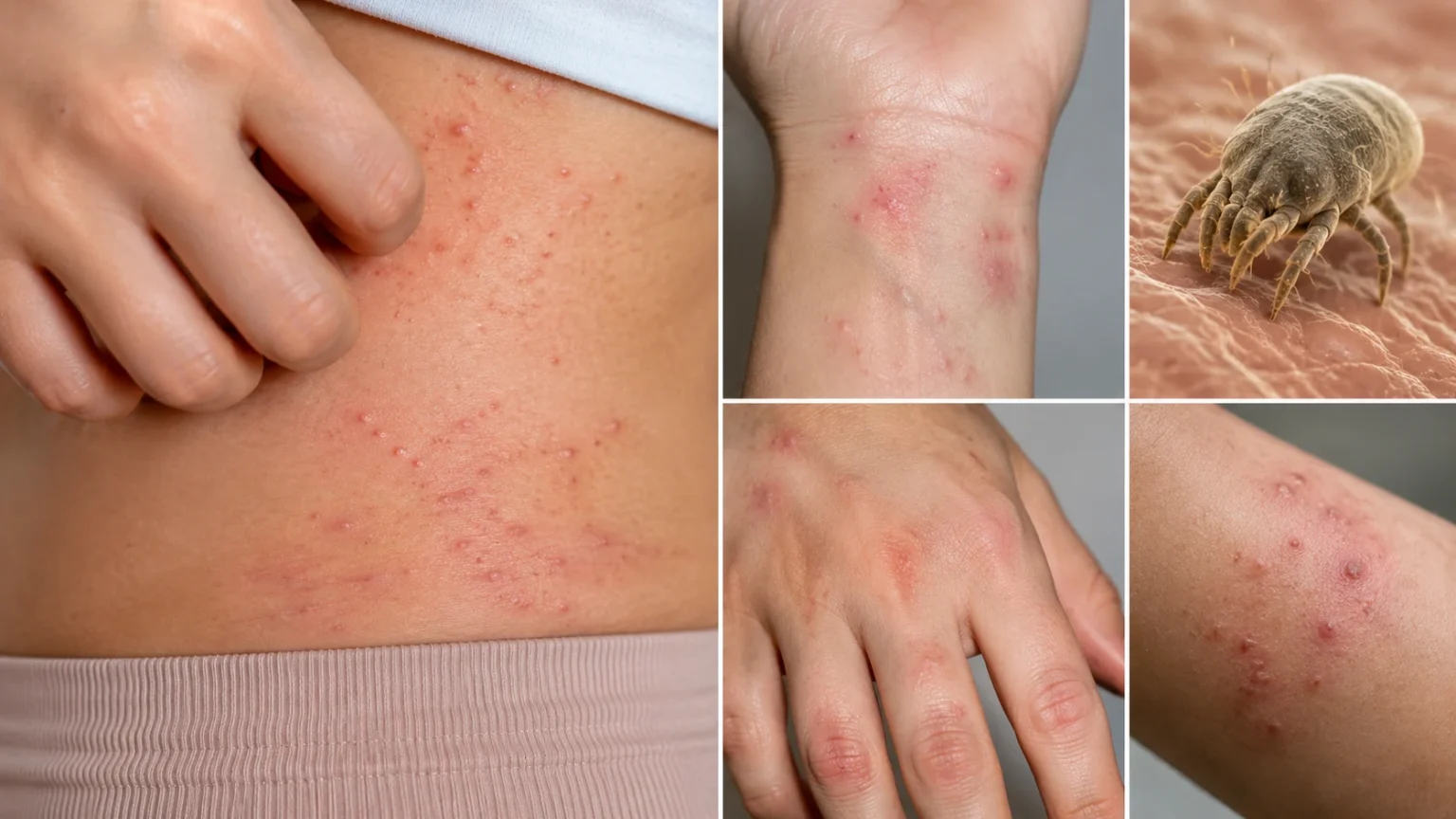

Scabies Pictures: Signs, Symptoms & What It Looks Like
Scabies is a contagious skin infestation caused by microscopic mites that burrow into the upper layer of the skin. Because the mites themselves are usually too small to see without magnification, most people recognize scabies by the rash, intense itching, tiny bumps, and thin burrow-like lines it can leave behind. Scabies pictures often show clusters of small red, pink, brown, or skin-colored bumps, but the appearance can vary considerably depending on skin tone, age, immune status, and how long the infestation has been present. The itching is typically worse at night and may become severe enough to interrupt sleep. Common locations include the wrists, finger webs, waist, armpits, buttocks, groin, and areas around the nipples.
Looking at pictures can help someone understand the general appearance of scabies, but photographs alone cannot confirm a diagnosis. Eczema, contact dermatitis, insect bites, folliculitis, heat rash, and several other skin conditions can resemble scabies closely. The pattern of itching, where the rash appears, whether household members are also itching, and whether visible burrows are present often provide more useful clues than color alone. Scabies usually requires treatment with prescription or professionally recommended medicine because ordinary moisturizers, antihistamines, and home remedies do not reliably eliminate the mites. Close contacts may also need treatment to prevent repeated spread. Understanding what scabies looks like and how it behaves can help you recognize when a persistent itchy rash deserves medical evaluation.
What Does Scabies Look Like?
Scabies commonly appears as a group of tiny raised bumps scattered across areas where the mites have burrowed or where the immune system is reacting to them. On lighter skin, the bumps may appear pink or red, while on darker skin they may look brown, purple, gray, or similar to the surrounding skin. The rash may resemble small pimples, insect bites, or irritated hair follicles rather than one continuous patch. Scratching can make the skin look more inflamed and can create scabs or small open sores. Because the reaction is partly caused by the body’s sensitivity to mites and their material, the rash can extend beyond the exact locations of individual burrows.
One of the more characteristic visual signs is a scabies burrow. A burrow may look like a very thin, slightly raised, curved, wavy, or irregular line on the skin. It can be grayish, whitish, brown, or skin-colored and may measure only a few millimeters to around a centimeter in length. Sometimes a tiny bump appears at one end of the line, representing the location where the mite is active. Burrows can be difficult to see because scratching, inflammation, or naturally textured skin may hide them. They are often easier to identify on the sides of the fingers, between the fingers, around the wrists, or along other thin-skinned areas.
Scabies pictures frequently show groups of bumps rather than evenly distributed redness. These clusters may occur around the finger webs, wrists, elbows, armpits, waistline, buttocks, thighs, nipples, or genital region. The back and head are less commonly affected in healthy adults, although patterns can differ in infants, elderly adults, or people with weakened immune systems. A person may have only a modest number of mites but still develop widespread itching because the immune response extends beyond the parasites themselves. This is why a dramatic-looking rash does not necessarily mean thousands of mites are present. The severity of visible inflammation and the number of mites are not always directly related.
Scratching can change the appearance significantly. Repeated rubbing may create linear scratch marks, crusts, bleeding spots, or thickened patches of skin. Bacteria can enter broken skin and cause secondary infection, making the rash look more swollen, warm, painful, or pus-filled than uncomplicated scabies. These secondary changes can make photographs harder to interpret because the original bumps or burrows become hidden underneath inflammation. People with long-standing itching may also develop darker or lighter marks after the active rash begins settling. These pigment changes can remain for some time after the mites have been successfully eliminated.
Scabies does not always look dramatic during the earliest stage. A person may initially notice only a few itchy bumps around the hands or waist before the rash becomes more noticeable. Someone who has never had scabies before can take several weeks to develop obvious symptoms after infestation because the immune system needs time to become sensitized. During that period, the person can still carry mites and potentially spread them to others. Once a person has had scabies previously, symptoms may appear much faster after another exposure. This delayed appearance is one reason identifying the likely source can sometimes be difficult.
Common Signs and Symptoms of Scabies
Severe itching is the symptom most strongly associated with scabies. The itching often becomes worse during the evening or at night, when warmth from bedding and reduced daytime distractions can make the sensation particularly noticeable. Some people describe the itch as relentless rather than mild, and scratching may repeatedly wake them from sleep. The itching results from an allergic or immune reaction to the mites, their eggs, and their waste rather than simply from the physical sensation of mites moving through the skin. This also explains why itching can continue for several weeks even after successful treatment. Persistent itching alone immediately after treatment does not always mean the medicine failed.
A scabies rash usually consists of small bumps that may be widely scattered or concentrated in characteristic areas. Some bumps can contain a tiny amount of fluid and resemble small blisters, while others appear more like firm papules or pimples. The skin between bumps may look relatively normal or mildly inflamed. In highly scratched areas, individual lesions can merge into rough patches that resemble eczema. People sometimes mistake the eruption for an allergic reaction because it can look widespread and intensely itchy. The location and nighttime itching pattern often provide important clues that distinguish scabies from a general allergy.
Burrows are particularly helpful when they can be identified, but not everyone notices them. These fine tracks develop as female mites move through the superficial skin layer and deposit eggs. Finger webs and wrist creases are common places to look because the skin is thin and the pattern may be easier to see. A magnifying glass and good lighting can sometimes help, but people should avoid aggressively scratching or scraping the skin in an attempt to find mites. Absence of an obvious burrow does not rule out scabies. Experienced clinicians may diagnose the condition from the overall pattern even when no burrow is visible to the naked eye.
Sleep disruption is an important symptom that can be overlooked when attention focuses only on the rash. Nighttime itching may lead to repeated waking, irritability, daytime fatigue, and difficulty concentrating. Children can become restless or unusually cranky because they cannot explain why they are uncomfortable. Adults may scratch unconsciously during sleep and wake with new sores or blood spots on bedding. Lack of sleep can make the infestation feel much more disruptive than the skin appearance alone suggests. Treating the underlying scabies is therefore important not only for infection control but also for restoring normal sleep and daily functioning.
Other members of the household developing itching is another strong clue. Scabies usually spreads through prolonged direct skin-to-skin contact, making families, couples, caregivers, and people sharing close living spaces particularly vulnerable. Symptoms may not appear at the same time because each person’s immune response develops differently. One family member can therefore begin itching weeks before another despite exposure occurring around the same period. If several close contacts suddenly develop intense nighttime itching, scabies becomes more likely. Treating only the person with the worst rash can allow the infestation to circulate back through the household.
Where Scabies Rash Usually Appears on the Body
The hands are among the most common locations for scabies. Tiny bumps or burrows can appear between the fingers, along the sides of the fingers, around the knuckles, and near the base of the fingers. The wrists are also frequently affected, particularly the creases on the inner surface. Because people use their hands constantly, scratching and washing can alter the appearance and make burrows difficult to see. Hand eczema can look similar, especially in people exposed to soaps or cleaning chemicals. However, intense nighttime itching and similar symptoms among close contacts make scabies more suspicious than ordinary dryness.
The waist and lower abdomen are other classic locations. Bumps may cluster near the beltline, around the navel, or underneath tight clothing where the skin remains warm and covered. People sometimes assume these areas are irritated by elastic waistbands, sweating, or laundry detergent. Scabies should become more strongly considered when the same person also has itchy bumps around the wrists, hands, armpits, or groin. The rash can extend toward the hips and upper thighs as well. Distribution often matters more than the exact appearance of any one bump.
The buttocks, groin, and genital area can also be involved. In adults, scabies may cause very itchy bumps or nodules in these regions, sometimes persisting longer than the rash elsewhere. These lesions can be mistaken for sexually transmitted infections, folliculitis, fungal rash, or shaving irritation. Although scabies can spread during sexual contact because of prolonged skin-to-skin contact, it is not limited to sexual transmission and can affect people of any age or relationship status. Embarrassment should not prevent someone from describing symptoms accurately to a healthcare professional. The location of the rash can provide valuable diagnostic information.
The armpits, elbows, chest, and areas around the nipples are also commonly affected. Small itchy bumps may appear in the folds of the armpits or along the inner elbows where skin remains warm. In some people, rash around the nipple area can be particularly noticeable and may become irritated from clothing. The upper back and face are less typical locations in healthy adults with ordinary scabies. If the face or scalp is heavily affected in an adult, a clinician may consider age, immune status, crusted scabies, or another diagnosis. The distribution of lesions is therefore not random and can provide important clues.
Infants and very young children can develop a different pattern. The scalp, face, neck, palms, and soles may be affected more frequently than they are in healthy adults. Babies may show irritability, poor sleep, feeding difficulties, or widespread rash rather than being able to communicate itching clearly. Older adults and people with neurological conditions can also develop unusual distributions. Because these groups may not describe symptoms reliably, caregivers need to pay attention to scratching, restlessness, or new crusted lesions. A child or medically vulnerable adult with suspected scabies should receive professional evaluation rather than relying only on comparison with internet photographs.
Scabies Pictures on Different Skin Tones
Scabies can be harder to recognize on darker skin when people expect every rash to appear bright red. In brown or black skin, inflamed bumps may appear dark brown, purple, gray, or only slightly different from the surrounding skin. The most noticeable feature may be texture rather than color. Raised bumps, scratching marks, crusting, and characteristic distribution can therefore be more useful than redness. Poor lighting and smartphone cameras can also make color differences difficult to appreciate. Examining the skin in bright natural or white light may make subtle changes easier to see.
Post-inflammatory hyperpigmentation is more noticeable in many people with darker skin tones. After scratching or inflammation begins settling, affected areas may leave dark marks that persist long after active scabies has been treated. These marks do not necessarily mean mites remain alive. Repeated scratching can deepen discoloration and prolong the time needed for the skin to regain its usual appearance. Some areas may also become temporarily lighter rather than darker. Pigment changes should therefore be interpreted alongside current itching, new lesions, and treatment history rather than being used alone to judge whether infestation persists.
On lighter skin, scabies lesions are often depicted as pink or red bumps with visible scratch marks. This representation dominates many educational photographs, which can create the misleading impression that scabies always has a bright inflammatory color. People with very fair skin may indeed show obvious redness around individual bumps or burrows, particularly after scratching. However, even in lighter skin, the rash can appear subtle and may look like ordinary dry patches or insect bites. Color alone remains an unreliable diagnostic feature. Distribution and symptoms provide a much stronger clinical pattern.
Burrows can also look different according to skin tone and lighting. A pale or silvery line may stand out clearly on some skin but blend almost completely into another complexion. On darker skin, a burrow may appear slightly darker, lighter, or simply raised without an obvious color change. Moisturizers and skin oils can also change how light reflects from the surface, making lines more or less visible. Medical professionals may use magnification or specialized examination methods when the diagnosis is uncertain. Patients should not assume that failing to see textbook-looking burrows means scabies is impossible.
Healthcare evaluation is especially useful when a rash looks different from widely circulated images. Dermatological conditions have historically been photographed more frequently on lighter skin, which can make self-comparison less accurate for people with deeper skin tones. A clinician can focus on lesion texture, location, history, household exposure, and itching pattern rather than relying mainly on color. This is important because delayed recognition can allow scabies to spread to more household members. The condition affects all skin tones, and the underlying infestation is the same even when the visible inflammation looks different.
Scabies vs Bed Bug Bites, Eczema and Other Rashes
Bed bug bites can resemble scabies because both conditions cause small itchy bumps and may affect multiple people living in the same home. Bed bug bites often appear on exposed areas such as the arms, legs, neck, or face and may occur in lines or clusters. Scabies more commonly affects covered areas and characteristic sites such as the finger webs, wrists, waist, groin, and armpits. Bed bugs live in the environment and bite temporarily, whereas scabies mites live and reproduce within the superficial layer of human skin. Finding burrows strongly favors scabies, but absence of burrows does not completely rule it out.
Eczema can also cause intense itching, dryness, rough patches, and scratch marks. Hand eczema in particular may affect the fingers and wrists, making it easy to confuse with scabies. Eczema often has a history of recurring dry or inflamed skin and may worsen after contact with soaps, detergents, allergens, or dry weather. Scabies tends to cause newer intense nighttime itching and can spread among close contacts. Steroid creams may temporarily reduce inflammation from scabies without eliminating the mites, which can sometimes make the diagnosis less obvious. Persistent symptoms despite ordinary eczema care should prompt reconsideration.
Contact dermatitis develops when the skin reacts to an irritating or allergenic substance. New cosmetics, detergents, jewelry, gloves, fragrances, cleaning products, or clothing materials can all trigger a rash. The eruption usually follows areas of direct exposure and may include redness, blisters, dryness, or burning in addition to itching. Scabies generally has a more characteristic body distribution and spreads through personal contact rather than exposure to a chemical. Contact dermatitis also does not cause mite burrows. A careful history of new products and close-contact symptoms can help distinguish the two.
Folliculitis produces small inflamed bumps centered around hair follicles and can sometimes contain visible pus. It commonly affects areas exposed to sweat, friction, shaving, or bacteria. Scabies bumps do not necessarily center on individual hairs and often occur in locations with relatively little hair, including finger webs and wrists. Folliculitis may feel tender or sore, while scabies typically produces severe itching. However, scratching scabies can cause secondary bacterial infection and create folliculitis-like lesions, making the two conditions overlap visually. Medical assessment can be helpful when pustules or painful areas develop.
Other conditions that can resemble scabies include flea bites, mosquito bites, heat rash, fungal infections, dermatitis herpetiformis, hives, and certain medication reactions. Because photographs capture only one moment, they cannot show whether itching becomes worse at night or whether new lesions are spreading through a household. These historical details often matter more than a visual match. People should be particularly cautious about self-treating repeatedly with multiple creams based only on internet images. A persistent widespread itchy rash deserves proper evaluation because different conditions require very different treatments.
What Crusted Scabies Looks Like
Crusted scabies is a severe form of infestation in which an extremely large number of mites can be present in the skin. Instead of mainly showing scattered bumps and burrows, the skin can develop thick crusts, scales, plaques, or wart-like areas. The hands, feet, elbows, knees, scalp, and other body surfaces may become covered with rough or flaky material. Crusts can be yellowish, gray, brown, or skin-colored depending on the person’s complexion and the stage of the condition. Because the appearance can resemble psoriasis, eczema, or another scaling disorder, diagnosis may be delayed if the possibility of scabies is not considered.
Interestingly, people with crusted scabies do not always experience the intense itching typical of ordinary scabies. Some may itch only mildly or hardly at all, particularly if they have reduced immune responses or neurological conditions. The lack of severe itching can make the condition seem less urgent despite the enormous number of mites present. This form is highly contagious because mites and eggs are abundant in shed scales and crusts. Brief contact or contaminated clothing, bedding, or furniture may carry more transmission risk than with ordinary scabies. Outbreaks in nursing homes or other care facilities can therefore become difficult to control.
Crusted scabies is more likely in people whose immune systems are significantly weakened, although it can occur in other circumstances as well. Older adults, people with certain neurological disorders, and individuals who cannot scratch effectively may also be at increased risk. Scratching ordinarily removes some mites mechanically, so inability to scratch may allow infestation to become much heavier. Medical conditions and medications that suppress immune function can further reduce the body’s ability to limit mite numbers. Anyone with widespread thick crusting and possible scabies exposure should receive prompt medical assessment.
Treatment of crusted scabies is more intensive than treatment for ordinary scabies. Multiple applications of topical medicine, oral medication, or a combination may be required according to medical guidance. Thick crusts can make it harder for topical medicine to reach the affected skin, so additional skin-softening treatment may sometimes be used. Close contacts need careful management because transmission risk is high. Environmental cleaning becomes more important as well because large quantities of mites may be shed into bedding, clothing, and surrounding materials. Attempting to treat severe crusted scabies with ordinary moisturizers or herbal products can allow the infestation to continue spreading.
Complications can become serious when damaged skin develops bacterial infection. Large areas of cracked or crusted skin create entry points for bacteria, potentially causing cellulitis or more widespread infection. Fever, increasing pain, warmth, swelling, pus, or rapidly worsening skin should receive urgent medical attention. Crusted scabies can also become a major public-health concern in institutions because one undiagnosed person may expose many caregivers and residents. Early recognition, isolation precautions when necessary, and coordinated treatment are therefore essential. This form should never be considered simply a more dramatic cosmetic version of ordinary scabies.
How Scabies Is Diagnosed
Diagnosis often begins with a detailed history rather than a laboratory test. A healthcare professional may ask when itching began, whether it becomes worse at night, which body areas are affected, and whether anyone else in the household has similar symptoms. Recent travel, shared sleeping arrangements, residential facilities, childcare settings, or prolonged skin-to-skin contact may also provide useful clues. The clinician then examines typical body sites for bumps and burrows. A classic distribution combined with severe nighttime itching can make scabies highly likely even before microscopic confirmation.
A dermatoscope, which magnifies and illuminates the skin, can help clinicians identify burrows or mites that are difficult to see with the naked eye. The end of a burrow may sometimes show a tiny dark triangular or dot-like structure corresponding to the mite. This technique can improve diagnostic confidence without requiring a large skin sample. However, visibility still depends on the location and whether scratching has damaged the burrow. A negative examination does not always exclude scabies because mite numbers can be low in ordinary infestation. Clinical judgment remains important.
Skin scraping is another possible diagnostic method. A clinician may gently scrape material from a suspected burrow or bump and examine it under a microscope for mites, eggs, or mite waste. Finding one of these structures confirms the diagnosis. However, failure to find a mite does not necessarily mean scabies is absent because the sample may have missed an active burrow. Several areas may need to be examined when suspicion remains high. The procedure is generally brief but should be performed by someone familiar with selecting appropriate lesions.
Adhesive tape or other sampling methods can occasionally be used depending on the clinical setting. In crusted scabies, diagnosis may be easier because so many mites are present in the thickened skin. Ordinary scabies can be more difficult because a person may have relatively few mites spread across a large body surface. This explains why household history and itching pattern remain so useful. A good diagnostic process combines visual examination, exposure history, symptom timing, and laboratory confirmation when available rather than depending on only one piece of evidence.
People should avoid trying to diagnose scabies by cutting or scraping their own skin deeply at home. The mites live only in the superficial layer, and aggressive scraping can cause bleeding, scarring, or bacterial infection without providing reliable information. Taking clear photographs of newly appearing lesions may be useful for a medical appointment, especially if the rash changes over time. Note which household members are itching and when symptoms began. These simple observations can help the clinician identify the pattern more accurately and decide whether treatment of close contacts is necessary.
How Scabies Is Treated and How Long the Rash Lasts
Scabies usually requires a medicine specifically capable of killing the mites, known as a scabicide. Depending on local medical guidance and the person’s age, health, pregnancy status, and severity, treatment may involve a topical cream or lotion, an oral medication, or both. Topical treatment generally needs to cover much more than the visibly affected spots because mites may exist in skin that does not yet show a rash. Applying medicine only to the itchiest bumps can allow untreated mites elsewhere to survive. Instructions should be followed carefully because the exact duration and body coverage depend on the medication used.
A second treatment is often needed after a specified interval because some medicines do not kill every egg during the first application. Newly hatched mites can therefore survive unless the treatment schedule is completed properly. Skipping the repeat dose is a common reason people believe scabies has returned. Another reason is failure to treat close contacts at the same time. A person can complete treatment correctly and then become reinfested by an untreated partner or household member. Coordinated treatment is therefore one of the most important steps in stopping the cycle.
Itching can persist after mites have been eliminated because the immune system continues reacting to material left in the skin. This post-scabies itch may last for several weeks and can make people think treatment failed immediately. The important question is whether new burrows or fresh bumps continue appearing after the expected recovery period. Existing lesions can remain itchy while gradually flattening and fading. A healthcare professional may recommend moisturizers, antihistamines, or anti-inflammatory creams to control residual symptoms. Repeating scabies medicine continuously without guidance can irritate the skin and make the situation harder to interpret.
Skin marks may last longer than itching. Scratched areas can remain darker, lighter, rough, or mildly inflamed for weeks or months, especially in people prone to post-inflammatory pigmentation. Nodular lesions in areas such as the groin or genital region may also persist after successful treatment. These changes do not automatically indicate active infestation. Gentle skincare and avoiding repeated scratching can help the skin recover. Persistent new lesions or worsening symptoms should still be reassessed because reinfestation, incorrect treatment, resistant mites, or another diagnosis may occasionally be responsible.
Treatment failure should be evaluated rather than managed by endlessly applying stronger household chemicals. Common explanations include incorrect application, washing the medicine off too early, failing to repeat treatment, untreated household members, or reinfestation from close contacts. Occasionally, the original condition was not scabies at all. A clinician can review exactly how the medication was used and determine whether another treatment is appropriate. Bleach, pesticides, kerosene, or harsh disinfectants should never be applied to the skin in an attempt to kill mites. These substances can cause chemical burns and do not replace safe medical treatment.
Preventing Scabies From Spreading at Home
Close contacts usually need attention because scabies can spread before itching begins. Household members, sexual partners, and others with prolonged direct skin contact may need treatment at the same time even when they have no symptoms yet. This prevents one asymptomatic person from reinfecting everyone else after treatment. The exact definition of a close contact depends on the living situation and clinical guidance. Casual brief contact usually carries less risk than prolonged skin-to-skin exposure. Families should follow one coordinated plan rather than treating individuals separately whenever symptoms appear.
Clothing, towels, and bedding used shortly before treatment should be cleaned appropriately. Hot washing and hot drying can kill mites and eggs in washable items. Articles that cannot be washed can usually be sealed away for several days because scabies mites do not survive indefinitely away from human skin. There is generally no need to throw away mattresses, sofas, clothing, or furniture after ordinary scabies. Excessive environmental destruction creates cost and stress without improving treatment. The focus should remain on treating people and cleaning recently used fabrics.
Vacuuming upholstered furniture or mattresses can be reasonable, particularly when someone has crusted scabies or has spent a great deal of time in one place. However, ordinary scabies spreads mainly through direct prolonged skin contact rather than through a home becoming permanently contaminated. Spraying insecticide throughout the house is generally unnecessary and can create respiratory or chemical hazards. The mite is adapted to living on human skin and survives poorly in the environment. Environmental cleaning should therefore be targeted rather than extreme.
Avoid sharing bedding, towels, clothing, or prolonged skin contact until treatment has reached the point considered noncontagious according to professional guidance. Children with scabies may need temporary exclusion from school or childcare depending on local rules, but they can usually return relatively soon after effective treatment. Adults working in healthcare or residential settings may have additional infection-control requirements. Good communication is important because hidden outbreaks can continue when people feel too embarrassed to report symptoms. Scabies is contagious, but it is treatable and does not reflect poor character or personal hygiene.
After treatment, continue watching for new symptoms among close contacts. Because the first infestation can take weeks to produce itching, someone exposed before treatment may begin scratching later even if they initially felt fine. If everyone was treated appropriately at the same time, this risk is reduced considerably. Repeated outbreaks in a household may require review of medication technique, contact tracing, or the possibility of exposure from another environment. Persistent scabies is frustrating, but systematic treatment and contact management are usually more successful than repeatedly changing home remedies.
Frequently Asked Questions About Scabies
What does scabies look like in pictures?
Scabies often appears as small itchy bumps, tiny blisters, scratch marks, and thin curved or wavy burrows. The rash may look red or pink on lighter skin and brown, purple, gray, or skin-colored on darker skin.
Where does scabies usually start?
Common early locations include the finger webs, wrists, waist, armpits, elbows, buttocks, groin, and areas around the nipples. Infants and some older or immunocompromised people may also develop lesions on the scalp, face, palms, or soles.
How can I tell scabies from ordinary insect bites?
Scabies typically causes intense itching that is worse at night and may produce visible burrows in characteristic body locations. Similar itching in household members or close contacts also makes scabies more likely than isolated mosquito or other insect bites.
Can scabies go away without treatment?
Scabies generally does not reliably disappear on its own because living mites continue reproducing in the skin. Effective scabicide treatment and management of close contacts are usually needed to eliminate the infestation and prevent reinfection.
How long does scabies itching last after treatment?
Itching can continue for several weeks after successful treatment because the immune system remains sensitive to material left behind by the mites. New burrows, fresh lesions, or worsening symptoms after the expected recovery period should be reassessed by a healthcare professional.