
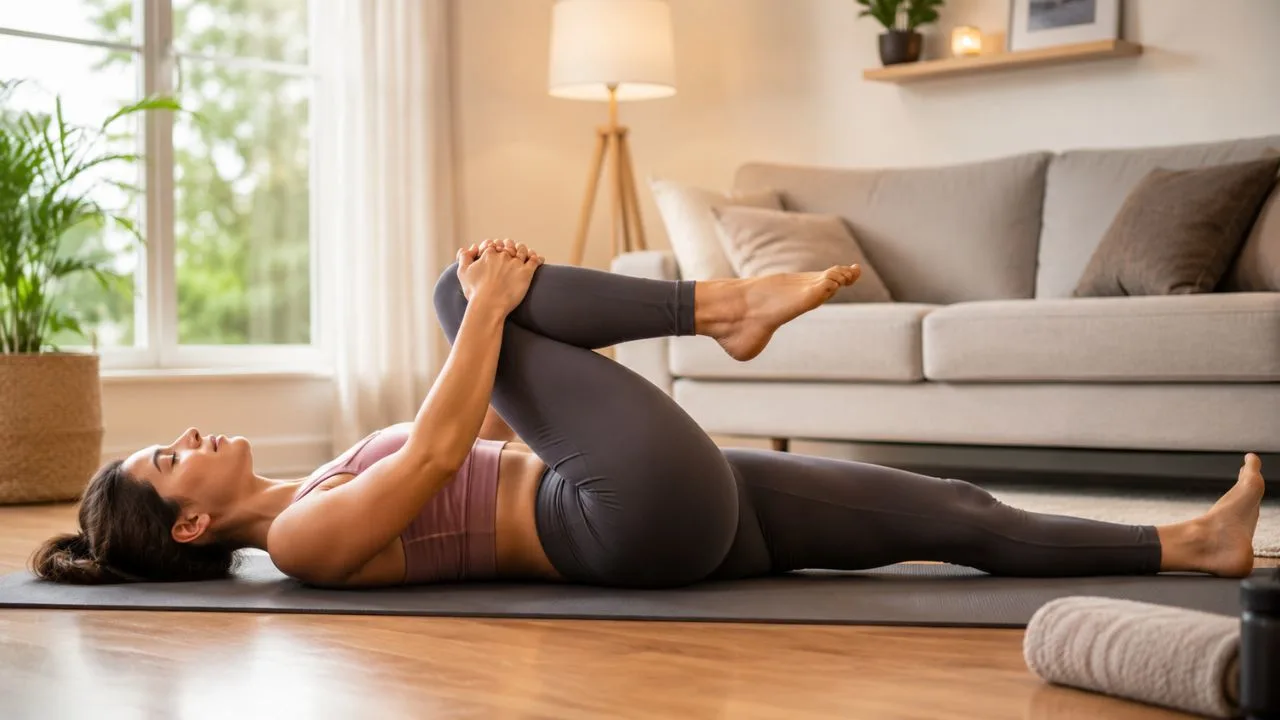

Lower-back stiffness can appear after prolonged sitting, an unfamiliar workout, repetitive lifting, travel or a sudden change in daily activity. Gentle movement may help the back feel less restricted, but the goal is not to force the spine into the deepest possible stretch. A useful lower-back stretching routine should feel controlled, comfortable and appropriate for your current symptoms.
Stretching is only one part of caring for the lumbar region. The muscles around the hips, buttocks, thighs, abdomen and spine all influence how the lower back moves and handles everyday loads. That is why a balanced mobility routine often includes hip and gluteal stretches alongside gentle spinal movements rather than focusing on one painful spot.
Most uncomplicated back pain improves with time, and current guidance generally encourages people to remain active and continue manageable daily activities. Long periods of bed rest can increase stiffness and reduce conditioning. Exercises should still be stopped when they clearly worsen pain, and persistent or severe symptoms should be evaluated by a qualified healthcare professional.
This guide explains how to stretch the lower back using pelvic tilts, knee-to-chest stretches, knee rolls, cat-cow movements, a bottom-to-heels stretch and a figure-four gluteal stretch. It is general educational information, not a diagnosis or individualized rehabilitation plan for an injury, surgical condition or neurological disorder.
Quick Answer: What Is the Best Way to Stretch the Lower Back?
Start with five to ten minutes of easy walking or another gentle activity so your muscles are not completely cold. Lie or kneel on a stable, comfortable surface, move slowly and breathe normally. A stretch should create mild tension or a comfortable sense of movement, not sharp, burning, electric or escalating pain.
Good beginner movements include pelvic tilts, single knee-to-chest stretches and slow knee rolls. These exercises move the lumbar spine through a comfortable range without requiring advanced flexibility. People who are comfortable kneeling can also try cat-cow and a bottom-to-heels stretch, sometimes called a child’s-pose variation.
Hold a static stretch for approximately 15 to 30 seconds when it feels comfortable, or use slow repetitions for mobility exercises such as pelvic tilts and knee rolls. Avoid bouncing, holding your breath or pulling the body into pain. General stretching guidance recommends gentle, controlled movement rather than using momentum to force additional range.
Try a small number of movements first and observe how your back responds over the next several hours. You do not need to perform every stretch in one session. A short routine completed consistently and without symptom aggravation is generally more useful than an intense routine that leaves the back feeling more painful or guarded.
Do Not Stretch Before Checking These Warning Signs
Seek urgent medical help for new loss of bladder or bowel control, difficulty starting urination, loss of sensation while urinating or numbness around the genitals, buttocks or inner thighs. These can be warning signs of cauda equina syndrome, a rare but serious condition involving compression of nerves that control pelvic and lower-limb functions.
Urgent assessment is also important when back pain is accompanied by significant or worsening leg weakness, difficulty walking, severe numbness or symptoms affecting both legs. Do not attempt to stretch through these problems in the hope of releasing a trapped nerve. Neurological changes require clinical evaluation rather than a general online mobility routine.
Contact a healthcare professional when the pain started after a serious fall, collision or other substantial injury. Medical advice is also appropriate when back pain occurs with fever, unexplained weight loss, a history of cancer, severe night pain or symptoms that are unusually intense and do not settle. These features can indicate causes that need investigation.
People who recently had spinal surgery, have a known fracture, severe osteoporosis, inflammatory disease, pregnancy-related complications or another diagnosed spinal condition should follow advice from their clinician or physical therapist. A movement that is reasonable for ordinary muscular stiffness may not be appropriate during recovery from surgery or for a condition requiring specific precautions.
How to Prepare for Lower-Back Stretches
Choose a firm but comfortable surface, such as an exercise mat or carpeted floor. A bed may be easier for someone who cannot safely get onto the floor, although a very soft mattress can make body positioning less stable. Keep a pillow nearby to support the head or knees when needed.
Warm up with a few minutes of relaxed walking, gentle marching or normal household movement. Stretching warm muscles is generally more comfortable than trying to lengthen completely cold tissues. The warm-up does not need to be demanding; its purpose is simply to increase movement and prepare the body.
Wear clothing that allows the hips and knees to move freely. Remove objects from your pockets, loosen a restrictive belt and make sure the area around you is clear. If kneeling is uncomfortable, place a folded towel beneath the knees or choose stretches performed while lying on your back.
Use a simple discomfort scale. Zero means no sensation, while ten represents unbearable pain. A gentle stretch may create mild tension, but it should remain well below your usual pain threshold and should not intensify with every repetition. Stop when a movement produces sharp pain, new tingling, numbness or pain spreading farther down the leg.
1. Pelvic Tilt for Gentle Lumbar Mobility
Lie on your back with your knees bent, feet flat and arms relaxed beside you. Allow the spine to rest in a comfortable neutral position rather than forcing it flat immediately. Keep your feet approximately hip-width apart and let the shoulders, neck and jaw remain relaxed.
Gently tighten the abdominal muscles and tilt the pelvis so the lower back moves slightly closer to the floor. The motion is small and controlled; you are not lifting the hips into a bridge. Hold for approximately three to five seconds while continuing to breathe, then release slowly.
Begin with five repetitions. As the movement becomes comfortable, gradually work toward eight to ten controlled repetitions. NHS lower-back exercise guidance commonly includes pelvic tilts as a gentle way to reduce stiffness and improve awareness of lumbar movement.
Avoid pushing forcefully through the feet or squeezing the abdomen so hard that you hold your breath. The purpose is to explore a comfortable range, not to press the spine aggressively into the floor. Reduce the movement or stop if it causes increasing pain in the back, hip or leg.
2. Single Knee-to-Chest Stretch
Lie on your back with both knees bent and both feet flat. Bring one knee toward your chest and place your hands behind the thigh or over the shin, depending on what feels comfortable. Keep the other foot on the floor at first to reduce the pull on the lower back.
Gently draw the raised knee closer until you feel a mild stretch through the buttock or lower back. Keep the back of the pelvis in contact with the floor and avoid lifting the head or shoulders. Hold for approximately 15 to 20 seconds while breathing normally.
Return the foot to the floor and repeat on the opposite side. Start with two repetitions per leg and increase gradually when the movement remains comfortable. AAOS and NHS exercise resources include knee-to-chest or knee-hug variations for lumbar and hip mobility.
Do not force the thigh tightly against your abdomen. People with painful hip or knee conditions may find the position uncomfortable and should use a smaller range or a towel behind the thigh. Stop if the stretch produces sharp groin pain, worsening leg symptoms or numbness.
3. Knee Rolls for Lower-Back Stiffness
Lie on your back with your knees bent, feet together or comfortably spaced and arms resting away from the body. Keep the shoulders relaxed against the surface. Tighten the abdomen only enough to guide the movement without creating unnecessary tension.
Slowly allow both knees to move a short distance to one side. Return them to the middle and move toward the other side. Begin with a small range and let the hips and lower back rotate together rather than trying to force the knees all the way to the floor.
Complete approximately five slow movements in each direction. NHS physiotherapy resources commonly recommend knee rolls to maintain motion and reduce lower-back stiffness. Some programs suggest holding a comfortable end position briefly, while others use continuous, controlled repetitions.
Keep both shoulders as relaxed as possible, but do not treat shoulder contact as a strict test that encourages you to push farther. The exercise should feel smooth rather than twisted or strained. Reduce the range if one direction feels significantly more sensitive than the other.
4. Cat-Cow Stretch
Begin on your hands and knees with the hands beneath the shoulders and knees beneath the hips. Keep the elbows soft instead of locked. Look toward the floor so the neck stays in line with the rest of the spine.
Breathe out as you gently round the middle and lower back, allowing the head to follow naturally. Breathe in as you slowly return through neutral and let the abdomen move slightly downward. The movement should travel through the spine rather than coming only from the neck.
Perform five to eight relaxed repetitions. Pause briefly in whichever position feels comfortable, but do not force a dramatic arch or rounded shape. NHS rehabilitation resources include cow-cat movements among exercises used to restore comfortable mobility in mechanical lower-back pain.
Place extra padding under the knees if needed. Skip this exercise when bearing weight through the wrists or knees is painful, or perform a seated pelvic movement instead. Stop when either direction increases radiating leg pain, tingling or weakness.
5. Bottom-to-Heels Stretch
Start on your hands and knees with your back in a comfortable neutral position. Slowly move your hips backward toward your heels while allowing your arms to remain extended in front. Let your head lower naturally without pressing it toward the floor.
Move only as far as your knees, hips and lower back comfortably allow. You do not need to sit fully on the heels. Hold the position for approximately 15 to 30 seconds while breathing into the sides and back of the rib cage, then return slowly.
Repeat two or three times. This movement, often called a bottom-to-heels stretch or child’s-pose variation, is included in NHS lower-back exercise guidance. It can create a gentle sense of length through the back, shoulders and hips.
Widening the knees slightly may create more space for the abdomen, but the position should remain stable. Avoid the movement when deep knee bending is painful or when a clinician has advised against loaded spinal flexion. Use a smaller range rather than forcing the hips backward.
6. Figure-Four Gluteal Stretch
Lie on your back with both knees bent. Place one ankle across the opposite thigh, just above the knee, creating a figure-four shape. Keep the foot gently flexed and make sure the crossed ankle rests on the thigh rather than directly on the kneecap.
Stay in this position when you already feel a comfortable stretch through the outer hip or buttock. For a stronger stretch, hold behind the supporting thigh and gently bring it toward your chest. Keep the pelvis and lower back resting against the floor.
Hold for approximately 15 to 20 seconds, release gradually and change sides. AAOS describes a similar diagonal hip stretch for the buttock and hip region. Improving comfortable hip mobility may reduce the need to force movement entirely through the lumbar spine.
Do not press aggressively on the crossed knee. Use a smaller range when the hip feels pinched or the knee feels strained. A person with a recent hip replacement or specific hip precautions should not perform this position unless it has been approved by their healthcare team.
7. Seated Hamstring Stretch
Sit near the front of a stable chair with one leg extended and the heel resting on the floor. Keep the other foot planted for balance. Lengthen the spine and place your hands on the supporting thigh rather than pulling on the extended leg.
Lean forward from the hips while keeping the back comfortably straight. Stop when you feel a gentle stretch along the back of the thigh. You do not need to reach the toes, and rounding the back deeply does not make the hamstring stretch more effective.
Hold for approximately 20 to 30 seconds, then return upright and change legs. Mayo Clinic’s workplace stretching guidance uses a similar seated position and emphasizes hinging at the hip, keeping the back straight, breathing freely and avoiding bouncing.
Do not lock the extended knee or pull the toes forcefully toward you. If the movement creates tingling, burning or pain below the knee, ease out of the position. Those sensations may reflect nerve sensitivity rather than an ordinary muscular stretch.
A Simple Five-Minute Lower-Back Stretching Routine
Begin with one minute of easy walking or gentle marching. Then complete five pelvic tilts and five knee rolls in each direction. Move slowly enough to notice whether the back feels easier, unchanged or more sensitive with each repetition.
Next, perform a single knee-to-chest stretch on each side for 15 to 20 seconds. Follow it with a figure-four gluteal stretch on each side. Keep the first session conservative, particularly when the back has been stiff or inactive for several days.
Finish with either cat-cow or the bottom-to-heels stretch, depending on which feels more comfortable. People who spend long periods sitting may add the seated hamstring stretch. The complete routine should feel calm and manageable rather than like a flexibility test.
Try the routine once daily at first. It can be performed more frequently when the movements consistently feel helpful and do not cause delayed symptom aggravation. NHS physiotherapy guidance commonly recommends gentle exercises little and often, while gradually returning to normal activity according to tolerance.
How Often Should You Stretch Your Lower Back?
For general flexibility, many people can stretch major muscle groups two or three days per week. A person using gentle movements for temporary stiffness may prefer short sessions more often. The correct frequency depends on symptoms, activity level and whether the routine feels better during and after completion.
Mobility exercises such as pelvic tilts and knee rolls are usually performed as slow repetitions. Static stretches such as knee-to-chest or the figure-four position may be held for 15 to 30 seconds. There is no need to chase a longer hold when the position begins to feel painful or causes guarding.
Consistency matters more than performing dozens of repetitions. Start with one set and increase only when the body responds well. Muscle soreness, fatigue or greater stiffness the following day may indicate that the routine was too intense, too long or performed through an unsuitable range.
Consider keeping a simple record of which movements help. Note pain or stiffness before the routine, immediately afterward and later in the day. This makes it easier to identify a useful pattern and gives a physical therapist clearer information when professional guidance becomes necessary.
Should You Stretch During a Lower-Back Pain Flare-Up?
Gentle movement can be reasonable during a mild, uncomplicated flare-up when no warning signs are present. Current guidance encourages staying active and continuing normal activities as much as possible rather than remaining in bed for prolonged periods. Activity should be paced according to comfort.
A flare-up is not the time to test maximum flexibility. Use smaller ranges, fewer repetitions and slower movement than usual. Choose positions that feel safe and stop an exercise when it clearly increases pain rather than assuming discomfort must be overcome.
Some movements may feel relieving while others feel irritating. A person who dislikes bending forward may tolerate a supported standing position or gentle walking better than a deep child’s pose. Individual responses differ, which is one reason guidelines recommend tailoring exercise to a person’s needs, preferences and abilities.
Contact a clinician when the pain is severe, keeps worsening or does not begin improving with sensible self-care. Medical assessment is also appropriate when pain repeatedly returns, limits sleep or work, travels below the knee, or is accompanied by numbness or weakness.
Can You Stretch the Lower Back With Sciatica?
Sciatica commonly describes pain, tingling or numbness that travels from the lower back or buttock into a leg. A stretch that feels comfortable for muscular stiffness may irritate a sensitive nerve. For that reason, people with radiating symptoms should be particularly cautious about deep hamstring stretches and forceful spinal positions.
Use movements that keep symptoms stable or make them feel more central rather than sending them farther down the leg. Stop when pain spreads into the calf or foot, numbness increases or the leg feels weaker. Do not repeatedly reproduce nerve symptoms to make the area more flexible.
Continuing manageable activity is generally encouraged for low-back pain with or without sciatica, but the type of exercise should reflect individual needs and capabilities. A physiotherapist can assess which movements are helpful and whether mobility, strengthening, nerve-related exercise or another approach is more appropriate.
Seek urgent assessment when sciatica occurs with bladder or bowel changes, saddle numbness, rapidly worsening weakness or symptoms affecting both legs. These are not ordinary flexibility problems and should not be managed by experimenting with additional stretches.
Stretching Alone May Not Be Enough
Stretching can improve comfort and movement, but lower-back health also depends on strength, endurance, daily activity and load management. The muscles of the abdomen, hips, buttocks and spine help support movement during lifting, walking, bending and prolonged positions.
Strength exercises may include bridges, supported squats, bird-dog variations and other movements selected for the individual. Core training does not require holding the abdomen rigid throughout the day. It involves developing controlled strength around the trunk and pelvis while breathing and moving normally.
Walking is a simple way to restore general movement without turning every session into a formal workout. Swimming, yoga and Pilates may also help some people, provided that the movements are suitable and symptoms are monitored. NHS guidance lists these activities among options that may ease back pain.
For recurring pain, a physical therapist can combine mobility work with progressive strengthening, pacing and advice about daily tasks. Passive stretching may provide temporary relief, but a broader program is often needed when weakness, deconditioning, work demands or movement confidence contribute to the problem.
Common Lower-Back Stretching Mistakes
The first mistake is stretching into pain. A deeper position is not automatically more effective, and pain is not proof that a tight muscle is being released. General stretching recommendations advise backing away from pain and using a controlled range that creates mild tension instead.
The second mistake is bouncing. Repeatedly using momentum at the end of a stretch can irritate muscles and make the movement harder to control. Move into the position slowly, hold or repeat it calmly and return to the starting position without sudden pulling.
The third mistake is holding the breath. Breath-holding may create unnecessary tension through the abdomen, shoulders and jaw. Continue breathing normally, particularly during knee-to-chest, figure-four and bottom-to-heels stretches. Make the position easier when you cannot breathe comfortably.
The final mistake is treating every back problem as muscular tightness. Pain can involve joints, nerves, discs, bones or conditions outside the spine. Stretching should not delay medical care when symptoms are severe, neurological, trauma-related or accompanied by systemic warning signs.
When Should You See a Doctor or Physical Therapist?
Arrange a routine appointment when lower-back pain remains troublesome despite several days of sensible activity and gentle self-care. Assessment is also useful when pain repeatedly returns, limits normal work, disturbs sleep or prevents you from gradually resuming your usual activities.
A physical therapist can examine movement, strength, neurological symptoms and the demands of your work or sport. The resulting program may include stretching, strengthening, aerobic activity, education and a graded return to normal tasks. Exercise selection should reflect the person’s preferences and capabilities.
Seek earlier medical advice when pain travels below the knee, numbness or weakness is developing, or symptoms started after an injury. Back pain accompanied by fever, unexplained weight loss, a history of cancer or severe night pain also deserves professional assessment.
Use emergency services for new bladder or bowel dysfunction, saddle numbness, major walking difficulty or rapidly progressing weakness. Do not drive yourself when your local emergency guidance advises against it. These symptoms need urgent investigation, even when the back pain itself does not feel extreme.
Final Verdict: How Should You Stretch Your Lower Back?
The safest approach is to begin with gentle movements rather than deep stretches. Warm up briefly, use a stable surface and start with pelvic tilts, knee rolls or a single knee-to-chest stretch. Add kneeling and hip stretches only when the initial exercises remain comfortable.
Move slowly, breathe normally and avoid bouncing. A useful stretch should create mild tension or easier movement, not sharp pain, worsening leg symptoms or numbness. Reduce the range whenever the body begins to tense or resist the position.
Combine stretching with ordinary movement, walking and appropriate strengthening. Avoid long periods of bed rest, but pace your return to demanding activity. A short routine that supports daily movement is more valuable than forcing flexibility once or twice and then stopping.
Most importantly, recognize when stretching is not the correct response. Severe trauma, progressive weakness, bladder or bowel changes, saddle numbness, fever or other warning signs require medical assessment. Safe self-care begins with distinguishing ordinary stiffness from symptoms that need professional attention.
Frequently Asked Questions
What is the best stretch for a tight lower back?
Pelvic tilts, single knee-to-chest stretches and gentle knee rolls are suitable starting options for many people with uncomplicated stiffness. The best movement is one that feels comfortable and does not worsen symptoms.
How long should I hold a lower-back stretch?
Hold a comfortable static stretch for approximately 15 to 30 seconds while breathing normally. Stop sooner when it becomes painful, causes tingling or sends symptoms farther down a leg.
Is it good to stretch the lower back every day?
A short daily routine may be reasonable when it consistently feels comfortable. Begin conservatively and reduce the frequency or intensity when the back feels more painful or stiff afterward.
Should I stretch my lower back if it hurts?
Gentle movement may help mild, uncomplicated back pain, but do not stretch through sharp or worsening pain. Seek advice when symptoms are severe, persistent, injury-related or associated with numbness or weakness.
Can lower-back stretching help sciatica?
Some gentle movements may feel helpful, but deep stretching can aggravate a sensitive nerve. Stop when symptoms spread down the leg and seek urgent care for bladder changes, saddle numbness or progressive weakness.