
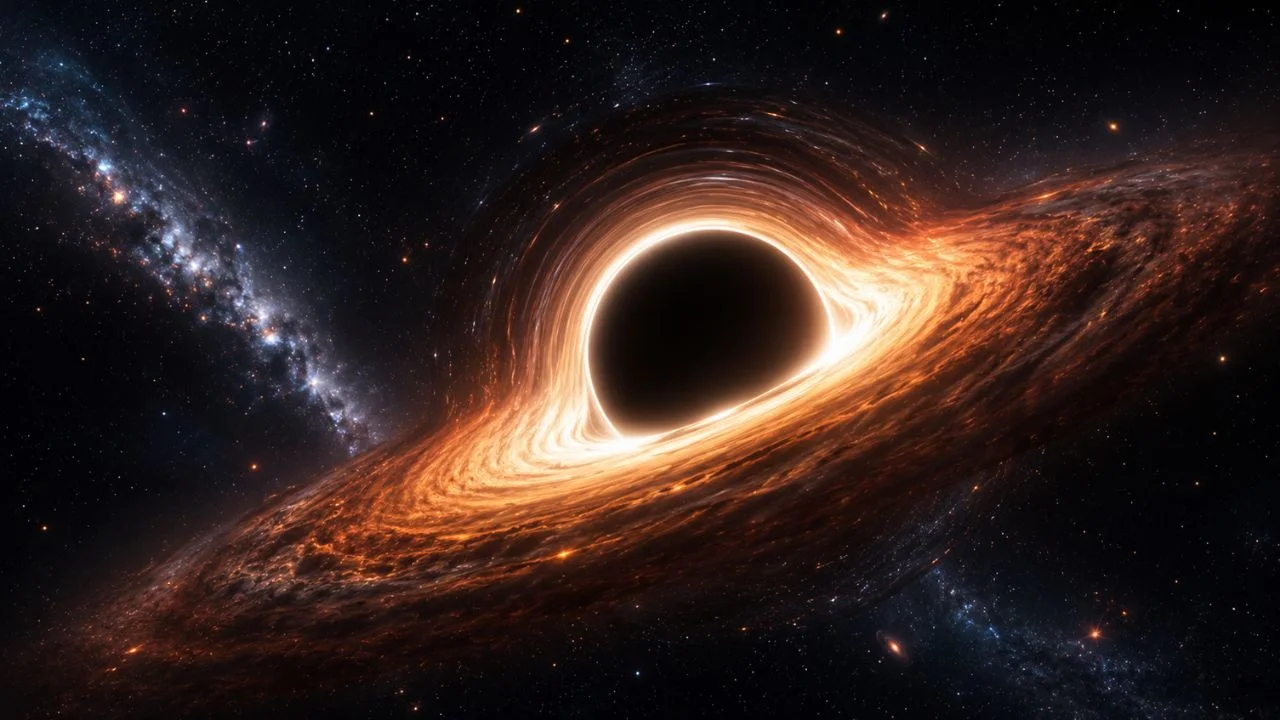

A black hole is an object in space with gravity so strong that nothing crossing a certain boundary can return. Not even light can escape, which is why the object appears black. A black hole is not an empty opening or tunnel in space. It is a huge amount of matter packed into an extremely small region.
Black holes affect nearby stars, gas, dust, and even the path of light. Some pull material into bright, hot disks that can be seen across enormous distances. Others remain quiet and almost invisible when no matter surrounds them. Scientists find black holes by studying their effects on nearby objects and the signals produced when black holes collide.
Most known black holes form when very massive stars reach the end of their lives and collapse. Much larger black holes, called supermassive black holes, exist near the centers of most large galaxies. The Milky Way has one called Sagittarius A*. Scientists are still studying exactly how the earliest supermassive black holes became so large.
This guide explains what a black hole is, how it forms, how its gravity works, and what happens near its event horizon. It also covers black hole types, accretion disks, time effects, collisions, and Hawking radiation. The explanations use simple words, but some questions remain unanswered because black holes push physics to its limits.
Quick Answer: What Is a Black Hole?
A black hole is a very dense concentration of matter surrounded by a boundary called the event horizon. Once matter or light crosses this boundary, it cannot escape and send information back to the outside universe. The event horizon is not a solid surface. It is the point where every possible path forward leads deeper into the black hole.
The gravity of a black hole is strong because a great deal of mass is packed into a small space. Gravity becomes stronger as an object moves closer to that concentrated mass. Far from the black hole, its gravity acts like the gravity of any other object with the same mass. A black hole does not pull everything across the universe toward it.
Black holes can grow by pulling in nearby matter and by merging with other black holes. Gas and dust may orbit outside the event horizon in a hot structure called an accretion disk. Friction and motion heat the disk until it produces visible light, ultraviolet radiation, and X-rays. The glowing disk is often easier to detect than the black hole itself.
Scientists do not yet have a complete description of what happens at the center. General relativity predicts a region called a singularity, where density and the bending of spacetime become extreme. However, this prediction may show that current theories are incomplete. A theory combining gravity with quantum physics may be needed to explain the center properly.
How Does a Black Hole Form?
Many stellar-mass black holes begin as massive stars. A star remains stable for much of its life because energy from nuclear reactions pushes outward while gravity pulls inward. When the star runs out of usable fuel, the outward support weakens. Gravity can then cause the star’s core to collapse.
Some massive stars explode as supernovae during this process. The outer layers are thrown into space, while the central core becomes a compact object. Depending on the core’s mass and other conditions, it may become a neutron star or collapse further into a black hole. Not every star becomes a black hole.
Our Sun is not massive enough to form a black hole. In several billion years, it is expected to become a red giant and later leave behind a white dwarf. A black hole normally requires a much more massive stellar core. Therefore, the Sun will not suddenly collapse and turn into a black hole.
Supermassive black holes may form through more complicated paths. Smaller black holes can grow by feeding and merging, while dense gas clouds may sometimes collapse more directly. The earliest supermassive black holes appeared surprisingly early in cosmic history, so astronomers are still testing different formation ideas.
What Is the Event Horizon?
The event horizon is the boundary around a black hole beyond which escape becomes impossible. It is sometimes called the point of no return. Once an object crosses it, no signal from that object can reach a distant observer. The event horizon is the feature that makes a black hole truly black.
It is important to understand that the event horizon is not made from solid material. A falling astronaut would not crash into a wall at this boundary. For a sufficiently large black hole, the astronaut might cross it without noticing an immediate local change. The inability to return becomes clear because every future path points inward.
The size of the event horizon depends mainly on the mass and rotation of the black hole. A more massive black hole generally has a larger event horizon. For a non-rotating black hole, the event horizon’s size is related to its Schwarzschild radius. The mathematics changes when the black hole spins.
From far away, an object falling toward the event horizon appears to slow down and become dimmer. Its light becomes increasingly stretched and redshifted. The falling object experiences time normally from its own point of view and crosses the horizon after a limited time. These two descriptions differ because gravity changes how time and light are observed.
What Is Inside a Black Hole?
According to general relativity, matter that crosses the event horizon continues inward toward the central region. In a simple non-rotating model, the matter eventually reaches a singularity. This is described as a place where density and spacetime curvature become mathematically infinite. NASA describes the singularity and event horizon as the two main parts in the simplest black hole picture.
However, scientists should not treat the predicted singularity as a fully understood physical object. Infinite values often suggest that a theory is being used beyond the conditions it can explain. General relativity describes gravity and large objects extremely well, but it does not include a complete quantum description. Quantum physics becomes important in tiny, highly energetic regions.
Rotating black holes may have a more complex internal structure than non-rotating ones. Most real black holes probably spin because the stars and matter that formed them had angular momentum. Mathematical models predict additional boundaries and unusual effects inside rotating black holes. Whether these ideal models perfectly describe nature remains uncertain.
No information from inside the event horizon can be sent directly to Earth. This creates a major challenge for testing ideas about black hole interiors. Scientists instead study the region just outside the horizon, black hole collisions, and theoretical predictions. The true nature of the deepest interior remains one of physics’ biggest mysteries.
How Strong Is a Black Hole’s Gravity?
A black hole’s gravity is not magical or unlimited. If the Sun were somehow replaced by a black hole with exactly the same mass, Earth would continue orbiting at roughly the same distance. The solar system would become dark and cold, but the planets would not immediately be sucked in. Gravity far away depends mainly on mass and distance.
The difference becomes extreme when an object moves close to the black hole. Because the mass is concentrated inside a small region, an object can approach much closer than it could approach the center of a normal star. At short distances, gravity and the bending of spacetime become very strong. Light paths can curve dramatically around the black hole.
The strength of gravity also changes across an extended object. The side closer to the black hole feels a stronger pull than the side farther away. This difference is called a tidal force. Near some black holes, tidal forces can stretch an object into a long, thin shape.
A supermassive black hole can have weaker tidal differences at its event horizon than a smaller stellar-mass black hole. This happens because the event horizon of a supermassive black hole is much larger. An astronaut could cross the horizon of a very large black hole before being torn apart. The final outcome would still be unavoidable.
What Is Spaghettification?
Spaghettification is the stretching and squeezing of an object falling toward a black hole. The part of the object nearest the black hole experiences stronger gravity than the part farther away. This difference pulls the object lengthwise. At the same time, it can be squeezed from the sides.
The name sounds humorous, but the process would be destructive. A star moving too close to a black hole can be pulled apart by tidal forces. Its gas may spread into long streams and later form part of an accretion disk. Astronomers call this type of event a tidal disruption event.
Near a stellar-mass black hole, strong tidal forces may tear an object apart before it crosses the event horizon. Near a supermassive black hole, the event horizon can be so large that tidal forces at the boundary are less extreme. An object may cross first and experience fatal stretching farther inside.
Spaghettification does not mean every object near a black hole is instantly destroyed. Stars can orbit black holes safely when they remain far enough away. Gas can also orbit for long periods before losing energy and moving inward. Distance, speed, mass, and the black hole’s spin all affect what happens.
What Is an Accretion Disk?
An accretion disk is a rotating disk of gas, dust, and broken material around a compact object such as a black hole. Matter does not usually fall straight inward because it carries sideways motion. Instead, it orbits and spreads into a flattened disk. Collisions and magnetic effects gradually remove orbital energy and allow matter to move closer.
The material in the inner disk travels at enormous speeds and becomes extremely hot. It can produce visible light, ultraviolet radiation, and powerful X-rays. For many black holes, this hot disk is the main source of detectable light. The black hole itself remains dark because light cannot escape from inside the horizon.
An accretion disk does not form around every black hole. A black hole travelling through a nearly empty region may have little matter to consume. Without a disk or nearby star, it may be almost impossible to see directly. Astronomers then need to detect its gravitational effects or other indirect signals.
Material can remain in the disk without immediately crossing the event horizon. Some of it may be heated, thrown outward, or directed into jets before falling in. The exact behavior depends on magnetic fields, disk temperature, black hole spin, and the amount of incoming matter. Accretion is a complicated and active process.
Why Do Some Black Holes Produce Jets?
Some feeding black holes are linked with narrow jets of particles moving outward at speeds close to the speed of light. These jets can extend far beyond the host galaxy. They are among the most powerful structures in the universe. However, the particles do not come from inside the event horizon.
Jets are thought to form in the area outside the black hole, involving the accretion disk, strong magnetic fields, and possibly the black hole’s rotation. Magnetic fields can guide and accelerate charged particles away from the disk. Energy connected with the spinning black hole may also help power the jets.
This does not break the rule that nothing can escape once it crosses the event horizon. The material in a jet is redirected before crossing that boundary. NASA notes that jets originate around the accretion disk rather than escaping from inside the black hole.
Jets can produce radio waves, visible light, X-rays, and gamma rays. When one points toward Earth, the source may appear extremely bright and variable. Astronomers use these signals to study black holes that are otherwise too distant or too small to image directly.
What Types of Black Holes Exist?
Astronomers commonly group black holes into stellar-mass, intermediate-mass, and supermassive categories. These groups are based on mass, although the exact boundaries are approximate. Scientists also study the possible existence of primordial black holes.
Stellar-mass black holes generally form through the collapse of massive stars. They may contain several to tens of times the Sun’s mass, although mergers can produce heavier examples. Many are found in binary systems where they orbit normal stars. Others are detected through gravitational waves when two black holes merge.
Intermediate-mass black holes fill the gap between stellar and supermassive black holes. They may contain hundreds or thousands of solar masses. Astronomers have found several strong candidates, but this group is harder to study. Black hole mergers may help build objects in this mass range.
Supermassive black holes contain millions or billions of times the Sun’s mass and usually sit near galactic centers. A possible fourth category, primordial black holes, may have formed from dense regions in the early universe. Primordial black holes remain theoretical because none has been conclusively confirmed.
How Large Can a Black Hole Be?
The physical size of a black hole usually refers to the diameter of its event horizon. A stellar-mass black hole may have an event horizon only tens or hundreds of kilometers wide. This means several Suns’ worth of mass can be contained inside an area smaller than a country. The exact size depends on mass and spin.
Supermassive black holes are far wider. Sagittarius A*, the black hole at the center of the Milky Way, contains about four million solar masses. Its event horizon is much larger than that of a stellar black hole. Yet it is still tiny compared with the galaxy surrounding it.
The black hole in galaxy M87 contains about 6.5 billion times the Sun’s mass. The Event Horizon Telescope produced the first image of its shadow in 2019. The bright ring in that image comes from hot material and strongly bent light around the black hole, not from the event horizon shining.
Some known black holes contain tens of billions of solar masses. Scientists do not know whether nature has a strict maximum size. Growth becomes difficult when radiation and energetic activity push surrounding matter away. Mergers with galaxies and other black holes can still increase their mass over long periods.
How Do Scientists Detect Black Holes?
Because isolated black holes emit no ordinary light, astronomers often study nearby objects. A visible star may orbit an unseen massive companion. By measuring the star’s speed and orbit, scientists can estimate the hidden object’s mass. If the mass is too large for a neutron star and no light comes from it, a black hole becomes a strong explanation.
Scientists also detect radiation from accretion disks. Gas falling toward a black hole can become hot enough to produce X-rays. Space telescopes such as Chandra, XMM-Newton, and others study these energetic emissions. Changes in brightness can reveal how matter behaves close to the event horizon.
The Event Horizon Telescope links radio observatories across Earth to act like one planet-sized telescope. It has imaged the shadows of the black holes in M87 and at the center of the Milky Way. These images test predictions about light bending near an event horizon. They do not show the hidden interior.
Gravitational-wave observatories detect ripples in spacetime caused by black hole mergers. LIGO’s first direct detection came from two stellar-mass black holes that merged about 1.3 billion light-years away. The measured signal closely matched predictions from general relativity.
What Happens When Two Black Holes Collide?
Two black holes may orbit one another in a binary system. As they move, they release energy through gravitational waves. This energy loss causes their orbit to shrink. The black holes move faster and closer until they finally merge.
The final moments produce an extremely powerful burst of gravitational waves. These waves travel outward through space at the speed of light. LIGO, Virgo, and KAGRA can detect the tiny changes in distance they cause when passing through Earth. The signals allow scientists to estimate the masses and spins of the original black holes.
The merged object is usually a larger spinning black hole. Its final mass is slightly lower than the combined mass of the original pair. The missing mass has been converted into gravitational-wave energy. After the merger, the new black hole settles through a stage called ringdown.
Black hole collisions help scientists study gravity under extreme conditions. They also reveal black holes that may produce little or no light. Large catalogs of gravitational-wave events are helping researchers investigate black hole populations and cosmic expansion.
Does Time Stop Near a Black Hole?
Time does not stop for a person falling toward a black hole. That person’s watch continues ticking normally from their own point of view. However, an observer far away sees the falling person’s clock appear to slow as the person approaches the event horizon. This difference is caused by gravitational time dilation.
Light sent by the falling person becomes increasingly redshifted and faint. Each signal takes longer to reach the distant observer. Eventually, the person seems to fade from view near the horizon. The observer does not receive a clear image of the person crossing it.
From the falling person’s viewpoint, crossing the event horizon can happen within a limited amount of personal time. They would not see the entire future of the outside universe instantly. The exact experience would depend on the black hole’s size, rotation, and the person’s path.
These different viewpoints do not contradict each other. Relativity allows observers in different gravitational conditions to measure time differently. The event horizon is not simply a place where all clocks physically freeze. It is a boundary that changes which events and signals can remain connected.
Can a Black Hole Swallow an Entire Galaxy?
A supermassive black hole can strongly affect the central region of its galaxy, but it does not normally swallow the entire galaxy. Stars orbit the galactic center because of the combined gravity of stars, gas, dark matter, and the central black hole. Most stars remain far from the event horizon.
The Milky Way’s central black hole contains millions of solar masses, while the galaxy contains far more total mass. The black hole therefore does not control every star by itself. Our solar system is around 26,000 light-years from the galactic center and is not in danger of falling into Sagittarius A*.
A black hole can consume stars or gas that move too close. It may also influence star formation by heating or removing gas through radiation and jets. These effects can shape the development of the galaxy. They are not the same as the black hole directly eating every object.
Galaxies can collide and merge, causing their central black holes to move closer together. The black holes may eventually form a binary and merge. The rest of the galaxy can survive this process, although its stars and gas may be rearranged by the larger galactic merger.
Could Earth Fall Into a Black Hole?
There is no known black hole close enough to threaten Earth. Stellar-mass black holes are separated from us by enormous distances. They do not wander through space sucking in everything around them. An object must pass very close to be captured.
Earth safely orbits the Sun because of its distance and sideways motion. The same orbital rules apply around a black hole. A planet could orbit a black hole if it remained at a safe distance. The environment might be dangerous for other reasons, especially if the black hole were actively feeding.
If a small black hole somehow passed near the solar system, its gravity could disturb planetary orbits. However, such an event is not expected. The idea belongs more to science fiction than to a realistic current danger. Astronomers continue to monitor nearby stars and compact objects.
Particle accelerators also cannot create a dangerous black hole that consumes Earth. Cosmic rays strike Earth with energies equal to or greater than those produced in human accelerators. The planet has survived these natural collisions for billions of years. There is no evidence that normal accelerator research creates a black hole threat.
Do Black Holes Live Forever?
Classical general relativity suggests that an isolated black hole could remain for an extremely long time. However, quantum theory predicts that black holes can slowly release energy through Hawking radiation. As they lose energy, they also lose mass. In principle, they can eventually evaporate.
Hawking radiation is expected to be incredibly weak for ordinary astrophysical black holes. Larger black holes are colder and evaporate more slowly than smaller ones. A black hole with the Sun’s mass would require about 10^64 years to evaporate, far longer than the universe’s current age.
Most present-day black holes gain more energy from surrounding radiation and matter than they lose through Hawking radiation. Their evaporation is therefore not noticeable. Only in the distant future, after the universe becomes much colder, might evaporation become the main change affecting them.
Hawking radiation has not been directly observed from an astrophysical black hole. It comes from combining quantum ideas with curved spacetime. A complete theory of quantum gravity might change some details. Still, Hawking’s prediction plays a central role in modern discussions about black holes and information.
What Is the Black Hole Information Problem?
Quantum physics says that information about a physical system should not be permanently destroyed. However, general relativity suggests that information falling through an event horizon cannot return. If a black hole later evaporates completely, it becomes unclear what happens to the information about everything that entered it.
This conflict is called the black hole information problem. It is not mainly about everyday messages, books, or computer files. In physics, information describes the complete quantum state of matter. The question is whether that state can be reconstructed in principle.
Scientists have proposed several possible answers. Information might be stored in some way at the event horizon, carried out through Hawking radiation, or connected with a deeper structure of spacetime. Some ideas suggest that the inside and outside descriptions are linked more closely than they appear.
There is no universally accepted final solution. The problem connects gravity, quantum mechanics, thermodynamics, and the nature of spacetime. Solving it may help scientists build a theory of quantum gravity. Black holes are therefore important not only as objects in space, but also as tests of fundamental physics.
Common Myths About Black Holes
One myth is that black holes behave like giant vacuum cleaners. They do not automatically pull in everything nearby. Objects can orbit them just as planets orbit stars. Capture occurs when an object comes too close or loses enough orbital energy.
Another myth is that black holes are empty holes leading somewhere else. A black hole is a concentration of mass and energy with an event horizon. Wormholes are separate theoretical ideas and have not been observed. There is no evidence that real black holes provide safe passages to another universe.
A third myth is that the glowing ring in a black hole image is the black hole itself. The dark center is the shadow created by light capture and bending. The bright material lies outside the horizon. The Event Horizon Telescope observes radio waves from this surrounding region.
A final myth is that scientists know exactly what happens at the center. Current theories predict a singularity, but they do not give a complete physical explanation. The interior remains hidden behind the event horizon. Any confident claim about what definitely happens at the deepest center goes beyond confirmed evidence.
Why Are Black Holes Important to Science?
Black holes allow scientists to test gravity in conditions that cannot be recreated on Earth. Their enormous gravity bends light, changes time measurements, and produces powerful gravitational waves. Observations can be compared with Einstein’s general theory of relativity. So far, many results closely match its predictions.
They also help explain how galaxies grow and change. Supermassive black holes can release huge amounts of energy while feeding. Their radiation and jets may heat or remove gas that would otherwise form stars. This creates a close connection between the development of black holes and their host galaxies.
Black holes provide natural laboratories for studying hot plasma, magnetic fields, particle acceleration, and high-energy radiation. Accretion disks can reach temperatures and speeds that are impossible to reproduce fully in ordinary laboratories. Space observatories study these extreme environments through several types of light.
Most importantly, black holes expose the limits of present theories. General relativity and quantum mechanics both work extremely well, but they do not fit together completely inside a black hole. Understanding these objects may lead to a deeper theory of matter, gravity, space, and time.
Final Thoughts
A black hole is a highly concentrated object surrounded by an event horizon from which nothing can escape. It usually forms when a massive stellar core collapses, although supermassive and possible primordial black holes may have different origins. Its gravity behaves normally from far away but becomes extreme close to the horizon.
The black hole itself is dark, yet its surroundings can be among the brightest places in the universe. Gas in an accretion disk heats up and produces powerful radiation. Magnetic fields may also create enormous jets outside the horizon. These visible effects allow scientists to study otherwise hidden objects.
Astronomers detect black holes through stellar orbits, X-rays, radio images, gravitational lensing, and gravitational waves. The first black hole shadow image and the first gravitational-wave detections opened new ways to study them. Each method reveals a different part of how black holes behave.
Many basic questions remain open, especially about singularities, quantum gravity, and information. Black holes are therefore both real astronomical objects and major scientific puzzles. They show how much we have learned about the universe while reminding us that some of nature’s deepest rules are still unknown.
Frequently Asked Questions
What is a black hole?
A black hole is an extremely dense object whose gravity prevents anything inside its event horizon from escaping.
Can light escape from a black hole?
No. Once light crosses the event horizon, it cannot return to the outside universe.
How are black holes formed?
Many form when the cores of massive stars collapse after running out of fuel.
Is a black hole an actual hole?
No. It is a dense concentration of matter and energy, not an empty opening in space.
What is an event horizon?
It is the boundary around a black hole beyond which escape is impossible.
What happens if someone falls into a black hole?
Tidal forces would eventually stretch and destroy the person, and they could not return after crossing the event horizon.
Do black holes suck in everything?
No. Objects can safely orbit a black hole when they remain far enough away.
Can we see a black hole?
We cannot see the black hole directly, but we can detect its shadow and effects on nearby matter and light.
Is there a black hole in the Milky Way?
Yes. Sagittarius A*, a supermassive black hole, lies at the center of our galaxy.
Can black holes disappear?
Quantum theory predicts that they can slowly evaporate through Hawking radiation over extremely long periods.