
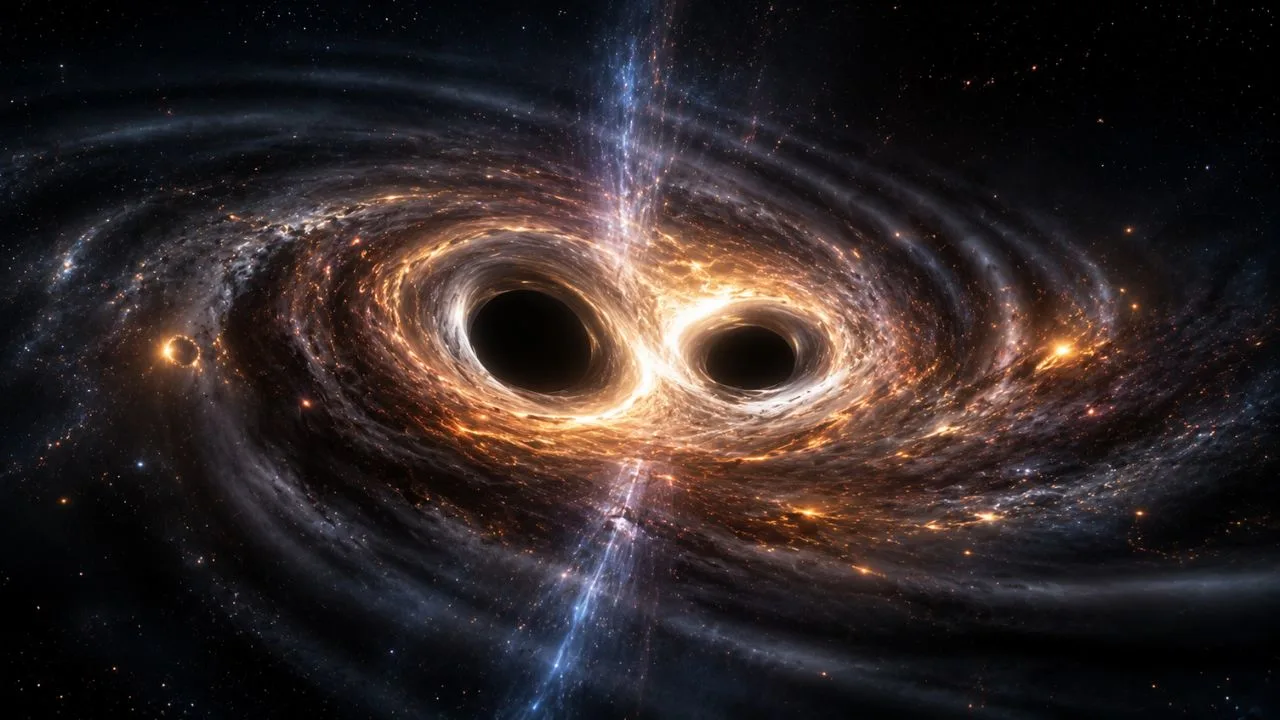

What Happens When Two Black Holes Collide?
When two black holes come close enough, their gravity can lock them into an orbit around each other. They may circle for millions or billions of years before finally colliding. As their orbit becomes smaller, they move faster and release energy through gravitational waves. The final collision forms one larger black hole.
A black hole merger is not like two solid objects crashing together. Black holes do not have hard surfaces that break or explode on contact. Instead, their event horizons join while the surrounding structure of space and time changes rapidly. Much of the collision’s energy travels outward as gravitational waves.
These waves are tiny stretches and squeezes in spacetime. They spread across the universe at the speed of light and can pass through planets, stars, and people. By the time they reach Earth, their effect is extremely small. Sensitive instruments such as LIGO, Virgo, and KAGRA can still detect some of them.
Black hole collisions allow scientists to study gravity in its most extreme known form. They reveal hidden black holes, test Einstein’s theory of general relativity, and show how larger black holes can form. Modern observatories have now detected hundreds of gravitational-wave signals from merging compact objects.
Quick Answer: What Happens During a Black Hole Collision?
Two black holes usually begin by orbiting one another as a binary system. Their moving masses create gravitational waves that carry energy away from the orbit. As the system loses energy, the distance between the black holes slowly decreases. This process causes them to spiral closer together.
The black holes move increasingly faster during the final part of the spiral. Their gravitational-wave signal becomes stronger and rises in frequency. Scientists call this rising pattern a chirp because the signal can be turned into a short sound that increases in pitch. The final moments may happen in less than a second for stellar-mass black holes.
Their event horizons then join and form one distorted black hole. The newly formed object is larger than either original black hole but initially has an uneven shape. It quickly releases more gravitational waves as it becomes stable. This final settling stage is known as the ringdown.
The final black hole normally spins because the original black holes carried both spin and orbital motion. Its mass is slightly less than the combined masses of the two original objects. The missing mass is not destroyed. It has been converted into energy and carried away mainly by gravitational waves.
How Do Two Black Holes Find Each Other?
Some binary black holes may begin as two massive stars born in the same star system. The stars orbit one another, use their nuclear fuel, and eventually collapse. If the system remains together after both stars die, it may contain two black holes. Their orbit can then slowly shrink through gravitational-wave emission.
Other black hole pairs may form in crowded star clusters. Black holes moving through these dense environments can pass close to one another and become gravitationally connected. Later interactions with nearby stars or black holes can make their orbit smaller. Some pairs may eventually merge inside the cluster.
Supermassive black hole pairs usually form after two galaxies collide. Most large galaxies contain a massive black hole near the center. When the galaxies merge, their central black holes move through the combined galaxy and gradually approach one another. They may eventually form a close binary system.
Scientists are still studying how quickly supermassive black hole pairs reach the final collision stage. Stars, gas, and other black holes can remove energy from their orbit. Once the pair becomes close enough, gravitational waves begin to control the process. The black holes then spiral inward toward a merger.
The First Stage: A Slow Cosmic Dance
At first, two black holes can orbit each other from a great distance. Their orbital period may be long, and the gravitational waves they produce may be weak. The system can remain in this stage for millions or billions of years. Most of the merger’s lifetime may pass during this slow approach.
The orbit may not begin as a perfect circle. Interactions with stars, gas, or other objects can produce a stretched orbit. Over time, gravitational-wave emission often makes the orbit more circular. The exact path depends on how the binary formed and what exists around it.
Each orbit sends ripples through spacetime. These waves carry energy and angular momentum away from the binary. Since the system loses orbital energy, the black holes can no longer remain at the same distance. They gradually move inward and complete each orbit more quickly.
The change may be extremely slow at first, but it does not continue at a steady rate. Gravitational-wave emission becomes much stronger as the black holes move closer and faster. This creates a runaway process. A system that spent billions of years approaching can complete its final stage very quickly.
The Second Stage: The Inspiral
The inspiral is the period when the black holes move steadily closer while orbiting one another. As their separation decreases, their speed rises. The gravitational waves become stronger and more frequent. Earth-based observatories can detect the later part of this stage for suitable stellar-mass systems.
A gravitational-wave signal carries information about the black holes. Scientists can study the signal’s changing frequency and strength to estimate their masses, spins, distance, and orbital direction. A heavier system creates a different signal from a lighter one. Spinning black holes can also change the shape of the waveform.
During the inspiral, the black holes may complete many orbits in a short time. Their speed can become a large fraction of the speed of light. Spacetime around them becomes strongly curved and highly dynamic. Simple versions of Newton’s gravity are no longer enough to describe the system accurately.
Scientists use Einstein’s general relativity and powerful computer simulations to predict the signal. These models are compared with real detector data. The first directly observed black hole merger closely matched the predicted inspiral, merger, and ringdown waveform.
The Third Stage: The Final Merger
The merger begins when the two event horizons become so close that they join. At this point, it no longer makes sense to describe the system as two separate black holes. A single shared horizon forms around both objects. This combined horizon is initially stretched and distorted.
A black hole collision does not produce a normal impact surface. There is no solid crust, fireball, or breaking material at the event horizon. Instead, the geometry of spacetime changes rapidly. The two strongly curved regions become one larger region from which light cannot escape.
NASA visualizations show the joined horizon briefly taking an uneven or peanut-like form. Within about one rotation, it becomes a single black hole. The strongest gravitational-wave burst appears around this final merger.
The merger releases an enormous amount of energy in a very short time. For a brief moment, gravitational-wave power can exceed the combined light output of all visible stars. Most black hole mergers still remain dark to ordinary telescopes because the energy leaves mainly as gravitational waves rather than visible light.
The Fourth Stage: Ringdown
Immediately after the merger, the new black hole is not perfectly settled. Its event horizon is distorted by the violent collision. The black hole then vibrates while releasing the remaining unevenness as gravitational waves. This stage is known as the ringdown.
The process is often compared with a bell ringing after it is struck. A bell produces tones connected to its size, shape, and material. In a similar way, a new black hole produces gravitational-wave patterns connected to its mass and spin. Scientists call these patterns quasinormal modes.
The ringdown signal becomes weaker as the black hole settles. After a short period, the object reaches a stable spinning state described by general relativity. For an isolated black hole, its main measurable properties are then its mass and spin. Any electric charge is expected to be very small in most astrophysical cases.
Studying ringdown signals helps scientists test whether the final object behaves like a black hole predicted by Einstein’s theory. Finding several ringdown modes would allow more detailed tests. A major difference between prediction and observation could point toward new physics or an incomplete understanding of gravity.
What Are Gravitational Waves?
Gravitational waves are moving distortions in spacetime. They are created when massive objects accelerate in an uneven way. A perfectly round object spinning alone may not produce a strong changing wave, but two black holes orbiting each other create a powerful and changing gravitational field.
The waves travel outward at the speed of light. As one passes, it slightly stretches space in one direction and squeezes it in another. It does not push objects through space like wind. Instead, it changes the measured distance between objects for a very short time.
The effect reaching Earth is extremely small. LIGO uses long laser interferometers to compare the lengths of two arms placed at right angles. A passing gravitational wave changes those lengths by less than the width of a proton. Careful isolation and data analysis are required to find the signal.
Einstein predicted gravitational waves in 1916 as a result of general relativity. Their first direct detection was announced in 2016 from a signal recorded on September 14, 2015. The event also became the first direct observation of two black holes merging.
How Much Energy Is Released?
The total mass of the final black hole is usually less than the combined mass of the original pair. The difference has been converted into energy, mainly through gravitational waves. Einstein’s relationship between mass and energy explains how a small amount of mass can produce a huge release of energy.
In the first detected merger, the original black holes were estimated to contain about 36 and 29 times the Sun’s mass. The final black hole contained about 62 solar masses. Roughly three Suns’ worth of mass was converted into gravitational-wave energy.
That energy was released mostly during the final fraction of a second. It travelled outward in every direction as expanding ripples in spacetime. The waves became weaker as they spread across the universe. By the time they reached Earth, they changed detector lengths by only a tiny amount.
The event was powerful without creating a destructive blast near Earth. Its source was about 1.3 billion light-years away, so the waves had spread over an enormous area. Gravitational waves also interact very weakly with matter. They passed through Earth without causing noticeable harm.
What Does the New Black Hole Look Like?
The final black hole is larger than either original black hole. Its event horizon covers a greater area, and its gravity reflects its increased mass. However, it is not as massive as the simple total of the two starting objects because some energy escaped during the merger.
The new black hole will normally rotate. Its spin comes from the original black holes’ own rotation and their motion around each other. If their spins point in different directions, the final motion can be complex. Scientists use the gravitational-wave signal to estimate the final spin.
The event horizon becomes smooth after ringdown. According to general relativity, an isolated stable black hole is described mainly by its mass and spin. The complicated details of the two original black holes do not remain visible as bumps or separate parts on the final horizon.
The final object may continue interacting with nearby stars, gas, and other black holes. In a crowded environment, it could later become part of another binary and merge again. Repeated mergers are one possible way of building black holes with hundreds, thousands, or millions of solar masses.
Can the Final Black Hole Be Kicked Away?
Gravitational waves are not always emitted equally in every direction. Differences in the black holes’ masses, spins, and orbital positions can make the outgoing wave pattern uneven. This uneven energy release gives the final black hole a push in the opposite direction. The effect is called a gravitational recoil or kick.
Some kicks may be relatively small, while others can reach thousands of kilometers per second in extreme simulations. A strong kick could move a black hole away from its original position. It might even remove the black hole from a small galaxy or star cluster.
The kick does not come from an ordinary explosion. It follows the same basic idea as recoil when momentum leaves a system in an uneven direction. The gravitational waves carry momentum, so the remaining black hole must move in response. The exact speed depends strongly on spin direction and mass difference.
Astronomers search for displaced or unusually moving black holes that might show evidence of recoil. Such observations are difficult because galactic centers can contain complicated gas and stellar motion. Confirming black hole kicks would help explain how mergers affect galaxies and black hole populations.
Do Black Hole Collisions Produce Light?
A merger between two isolated black holes is expected to produce almost no light. Black holes have no glowing surfaces, and empty space provides no material to heat. The main observable signal is therefore gravitational radiation. This is why gravitational-wave detectors opened a new way to study them.
A merger may produce light when gas or other matter surrounds the system. The moving black holes can disturb and heat this material. After the merger, the final black hole may also move through the gas and create a bright reaction. Possible signals could appear as visible light, X-rays, radio waves, or gamma rays.
In 2020, scientists reported a possible light flare linked with a black hole merger. The idea was that the collision happened inside the gas disk surrounding a much larger black hole. The final black hole may have been kicked through the disk, heating the gas. The connection was interesting but not treated as certain proof.
Supermassive black hole mergers inside gas-rich galaxies may have a better chance of producing electromagnetic signals. Simulations predict that disturbed gas could create radiation along with gravitational waves. Detecting both signals from one event would give scientists much more information.
Can Two Supermassive Black Holes Collide?
Yes, two supermassive black holes can eventually merge after their host galaxies combine. Each galaxy may bring a black hole containing millions or billions of solar masses. The black holes first move through the larger merged galaxy before forming a close pair near its center.
Their approach can take hundreds of millions of years. Nearby stars and gas interact gravitationally with the pair and remove orbital energy. Once they become sufficiently close, gravitational-wave emission begins driving them together. Their final merger forms an even larger supermassive black hole.
Supermassive black hole mergers produce waves with much lower frequencies than stellar-mass mergers. Ground-based instruments such as LIGO are not designed for those signals. The planned Laser Interferometer Space Antenna, or LISA, will use spacecraft separated by millions of kilometers to detect lower-frequency gravitational waves.
The James Webb Space Telescope has identified distant systems containing growing black holes that may be moving toward mergers. Studying these early pairs may help explain how giant black holes appeared so soon after the Big Bang. Future gravitational-wave observatories could directly observe their final collisions.
How Did Scientists First Detect a Black Hole Merger?
On September 14, 2015, the two LIGO detectors in the United States recorded a short gravitational-wave signal. The signal lasted only a fraction of a second in the detectors’ most sensitive frequency range. Its rising pattern closely matched the predicted collision of two black holes.
The event was named GW150914. Scientists estimated that the two original black holes had masses of about 36 and 29 Suns. They formed a final black hole of about 62 solar masses. The remaining mass was released as gravitational-wave energy.
The signal arrived at the two LIGO sites several milliseconds apart. This timing difference was consistent with a gravitational wave crossing Earth at the speed of light. Teams performed months of checks before announcing the discovery on February 11, 2016.
The event confirmed two major ideas at once. It provided the first direct detection of gravitational waves and the first direct observation of a binary black hole merger. It also showed that pairs of heavy stellar-mass black holes exist in nature.
How Do LIGO, Virgo, and KAGRA Detect Collisions?
LIGO operates two large detectors in the United States. Virgo is located in Italy, and KAGRA operates underground in Japan. Each instrument uses laser light travelling through long arms. Mirrors reflect the lasers back toward a central measuring system.
When no gravitational wave is present, the light paths are arranged to produce a stable pattern. A passing wave changes the lengths of the arms by slightly different amounts. This changes how the returning laser beams combine. The detector records the resulting signal.
One detector alone cannot locate a source precisely. When several observatories detect the same event, arrival-time differences help identify the direction. A wider global detector network also improves confidence that the signal did not come from local noise or equipment problems.
The observatories compare the measured signal with predicted waveforms for different masses, spins, and orbits. Computer analysis finds the models that best match the data. From this process, scientists estimate what collided and how far away the event occurred.
What Have Recent Gravitational-Wave Catalogs Found?
Black hole mergers are no longer rare scientific detections. LIGO, Virgo, and KAGRA have observed large numbers of candidate signals during several observing runs. Most confirmed gravitational-wave events have involved two black holes, although neutron-star mergers and mixed systems have also been found.
The GWTC-4.0 catalog, released in 2026, more than doubled the previous number of known signals by adding events from part of the fourth observing run. A later catalog update reported 161 additional significant compact-binary signals and brought the total number of detections to 390.
These catalogs contain mergers with different masses and spins. Some black holes are heavier than scientists once expected from ordinary stellar collapse. Such objects may have formed through earlier mergers. This possibility supports the idea of hierarchical growth, where one merger product later merges again.
Large catalogs allow scientists to study black holes as a population rather than as isolated events. They can investigate how often mergers occur, how black holes form, and whether their properties change across cosmic history. Unusual signals may also reveal new formation paths or weaknesses in current models.
Can We Hear a Black Hole Collision?
Space is mostly empty, so a black hole collision does not create normal sound waves that travel to Earth through air. Human ears cannot directly hear gravitational waves. However, scientists can convert a detected gravitational-wave pattern into an audio signal.
The frequency of some stellar-mass merger signals falls within or near the human hearing range. When detector data is played through speakers, the rising inspiral and final merger can sound like a short chirp. This sound represents the measured spacetime wave, not noise recorded by a microphone.
Heavier black hole systems usually create lower-frequency signals. Their collision may sound shorter or deeper after conversion. Lighter systems can remain in a detector’s frequency range for longer and produce a rising signal with more cycles.
Turning data into sound helps people notice changes in frequency and timing. Scientists still perform the actual analysis using mathematical data rather than relying on human hearing. The audio version is mainly an accessible way to experience the event’s waveform.
Would a Nearby Black Hole Merger Harm Earth?
Known black hole mergers are extremely far away. The gravitational waves reaching Earth are so weak that highly sensitive instruments are required to detect them. They pass through the planet without causing harmful stretching, earthquakes, or changes to human bodies.
A collision would need to happen impossibly close to produce a strong gravitational effect on Earth. There is no known binary black hole system near the solar system that presents such a threat. Black holes are not moving toward Earth in pairs that are expected to collide nearby.
If a merger occurred in a gas-rich environment, it might produce strong radiation. However, distance would again be the main safety factor. The observed events lie millions or billions of light-years away. Their light or radiation becomes much weaker as it spreads through space.
The detections are scientifically valuable precisely because gravitational waves can travel across huge distances with little disturbance. They carry information from regions that may be hidden from ordinary telescopes. Their arrival at Earth is a measurement opportunity, not a disaster warning.
Do the Black Holes Touch Before Merging?
The word “touch” normally describes solid surfaces making contact. Black holes do not have solid surfaces, so they do not touch in the ordinary sense. Their event horizons are boundaries in spacetime rather than material shells. The merger occurs when the separate horizons form one connected horizon.
Before that moment, the black holes remain distinct objects with separate event horizons. They orbit so quickly and closely that the spacetime around them becomes strongly distorted. Computer simulations are needed to describe this final stage accurately.
After the horizons join, an outside observer can no longer identify two separate escape boundaries. A single distorted horizon surrounds the merged region. It then settles into the smooth horizon of the final black hole.
Matter outside the black holes may collide, heat up, and produce light if gas is present. That surrounding matter can behave more like material in an ordinary collision. The black holes themselves merge through changing spacetime geometry rather than through surface contact.
Do Black Holes Destroy Each Other?
The black holes do not destroy one another and disappear. They combine into a new black hole with greater mass and a larger event horizon. The final object keeps most of the original system’s total mass and angular momentum. Some of both are carried away by gravitational waves.
Information about the original masses and spins influences the waveform. Scientists can use the signal to reconstruct major properties of the system. After the final black hole settles, its outside gravitational field becomes much simpler.
The original black holes stop existing as separate objects. There is no line or internal wall that permanently divides them. From the outside, only the final black hole remains. Its event horizon does not contain two visible black holes floating inside it.
Whether deeper quantum information is truly lost is a separate unsolved question. The black hole information problem asks how quantum information behaves when matter enters a black hole and the black hole later evaporates. It does not change the observed fact that the two horizons form one.
Why Black Hole Mergers Matter to Science
Black hole mergers test general relativity where gravity is extremely strong and rapidly changing. Scientists compare every stage of the detected signal with Einstein’s predictions. So far, major observations have remained consistent with general relativity. Greater sensitivity allows increasingly strict tests.
The signals reveal black holes that may be completely dark to ordinary telescopes. Before gravitational-wave astronomy, scientists mainly found black holes by observing nearby stars or glowing gas. A quiet pair in empty space could remain hidden. Its merger can now be detected through spacetime waves.
Mergers also help explain how black holes grow. Repeated collisions may produce intermediate-mass black holes and help build some supermassive black holes. The masses and spins found in catalogs provide clues about whether binaries formed from paired stars, dense clusters, or earlier mergers.
Finally, black hole collisions connect astronomy with fundamental physics. They provide information about gravity, spacetime, stellar evolution, galaxies, and the early universe. Each new signal is both a distant cosmic event and a controlled test of physical laws that cannot be recreated on Earth.
Final Thoughts
When two black holes collide, they first orbit and spiral inward while releasing gravitational waves. Their motion becomes faster until their event horizons join. The result is one larger, spinning black hole. A short ringdown signal follows as the final object settles.
The collision converts part of the system’s mass into gravitational-wave energy. These ripples spread across the universe at the speed of light. Although their source is extremely powerful, the waves reaching Earth are incredibly weak. Instruments such as LIGO, Virgo, and KAGRA measure their tiny effect.
Most isolated black hole mergers produce no ordinary light. Events surrounded by gas may create a flare that telescopes can observe. Finding both light and gravitational waves from the same merger would allow scientists to study the event through several types of information.
Black hole mergers have changed astronomy by making the invisible universe measurable. They reveal hidden objects, test Einstein’s theory, and show how black holes grow. As detectors improve, scientists expect to find more unusual collisions and learn more about gravity’s most extreme environments.
Frequently Asked Questions
What happens when two black holes collide?
They merge into one larger spinning black hole and release energy as gravitational waves.
Do black holes explode when they collide?
No. Their event horizons combine, and most released energy travels away as gravitational waves.
How long does a black hole merger take?
The slow approach can last billions of years, but the final merger may happen in less than a second.
What are gravitational waves?
They are ripples in spacetime produced by accelerating massive objects such as orbiting black holes.
Does the final black hole equal both original masses?
It is slightly less massive because part of the original mass becomes gravitational-wave energy.
Can a black hole collision produce light?
Usually not, but surrounding gas may heat up and create a visible or high-energy flare.
Can we hear two black holes collide?
Not directly, but scientists can convert gravitational-wave data into a short chirping sound.
Are black hole mergers dangerous to Earth?
No known merger is close enough to threaten Earth, and detected waves are extremely weak.
How are black hole mergers detected?
Laser observatories such as LIGO, Virgo, and KAGRA measure tiny changes caused by gravitational waves.
What happens after the merger?
The new black hole rings down, becomes stable, and may later consume matter or merge again.