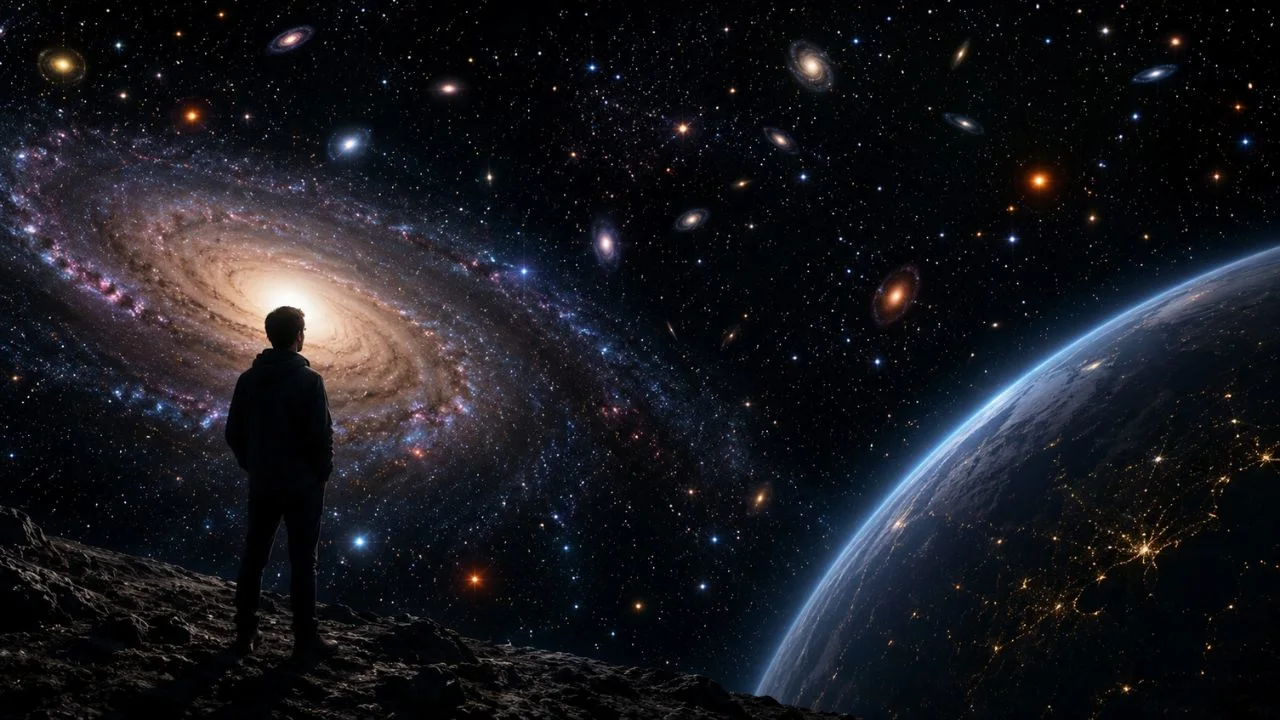

The universe is everything that exists, including space, time, matter, energy, galaxies, stars, planets, and the empty-looking regions between them. It is so large that ordinary units such as miles and kilometers become difficult to use. Astronomers instead measure cosmic distances in light-years. One light-year is the distance light travels in one year.
Scientists estimate that the universe is about 13.8 billion years old. However, the part we can observe is much wider than 13.8 billion light-years. The observable universe is estimated to be about 92 billion light-years across. This surprising difference exists because space expanded while ancient light was travelling toward us.
The observable universe is only the region whose light has had enough time to reach us. The complete universe may extend far beyond that visible region. It may be much larger than we can measure, or it may even be infinite. Scientists currently have no reliable measurement for the total size of the entire universe.
The universe is also still expanding. Galaxies that are not held together by gravity are becoming more widely separated as space stretches. Even more surprisingly, this expansion is speeding up rather than slowing down. Scientists use the name dark energy for the unknown cause of this accelerated expansion.
Quick Answer: How Big Is the Universe?
The observable universe is approximately 92 billion light-years across. This means the farthest regions we can observe today are roughly 46 billion light-years away in every direction. Earth is not located at a special physical center. Any observer elsewhere would also appear to sit at the center of their own observable region.
The complete universe is almost certainly larger than the observable universe. Light from regions beyond our cosmic horizon has not had enough time to reach Earth. Some distant regions may also be moving away so quickly because of expanding space that their present-day light will never reach us. We cannot observe what lies beyond this limit.
Scientists do not currently know whether the whole universe has a limited size. It could be finite but enormously larger than the visible region. It could also continue forever without an outer edge. Modern observations can study the shape and behavior of visible space, but they cannot directly reveal the full size of an unobservable universe.
The simple answer is therefore divided into two parts. The observable universe is about 92 billion light-years wide, but the size of the entire universe remains unknown. It may be many times larger than what we see. It may even have no final boundary at all.
What Is the Observable Universe?
The observable universe is the part of space that we can study from Earth. We observe distant objects because light, radio waves, and other forms of radiation travel from those objects to our telescopes. Because these signals move at a limited speed, they require time to cross enormous distances. Looking farther into space also means looking further into the past.
When astronomers observe the Moon, they see it as it appeared slightly more than one second earlier. Sunlight takes about eight minutes to reach Earth. Light from a galaxy one million light-years away began its journey one million years ago. Images from distant space are therefore records of earlier cosmic history.
There is a limit to how far back telescopes can see using ordinary light. The oldest directly observable light is called the cosmic microwave background. It was released when the universe became transparent about 380,000 years after the Big Bang. Before that period, the universe was too hot and dense for light to move freely.
The observable universe contains at least 100 billion galaxies, according to NASA’s broad estimate. Each galaxy may contain millions or billions of stars, along with planets, gas, dust, black holes, and other objects. However, everything we can observe may represent only a small part of the complete cosmos.
Why Is the Universe Wider Than 13.8 Billion Light-Years?
It may seem reasonable to think that a 13.8-billion-year-old universe should have a radius of only 13.8 billion light-years. This idea would work if light moved through space that remained completely unchanged. However, space itself has expanded throughout the time that ancient light has been travelling toward us.
Imagine dots drawn on the surface of a balloon. As the balloon expands, the distance between every pair of dots becomes greater. The dots do not need to move across the rubber for their separation to increase. In a similar way, galaxies can become farther apart because the space between them stretches.
Light from a very distant galaxy may have travelled for more than 13 billion years before reaching Earth. During that journey, the space between Earth and the galaxy continued to expand. The galaxy that released the light is therefore much farther away today than it was when the light began travelling.
When astronomers include the history of cosmic expansion in their calculations, they estimate that the observable universe has a radius of about 46 billion light-years. Doubling that radius gives a width of roughly 92 billion light-years. This is why the observable universe is much wider than its age multiplied by the present speed of light.
Does the Universe Have an Edge?
The observable universe has a viewing limit, often called a cosmic horizon. This horizon is not a physical wall or border in space. It simply marks the greatest distance from which signals have been able to reach us. There may be more galaxies and space beyond it, but we cannot see them.
A person standing near the edge of Earth’s visible horizon does not reach the edge of the planet. They simply have a different horizon around their own position. The observable universe works in a similar way. An observer in a distant galaxy would see a different cosmic region centered around that galaxy.
If the complete universe is infinite, it has no physical edge and no final point where space ends. If it is finite, it still may not have an edge. Earth’s surface is finite but has no boundary where the surface suddenly stops. Some models suggest that three-dimensional space could have a more complex version of this type of shape.
Scientists study patterns in the cosmic microwave background to learn about the shape of space. Current evidence suggests that the observable universe is very close to geometrically flat on large scales. However, flatness does not prove that the universe is infinite. A finite universe could be so large that its curvature is too small for us to measure easily.
Is the Universe Still Growing?
Yes, the universe is still expanding. Astronomers have known since the late 1920s that distant galaxies generally move away from us. Galaxies that are farther away usually appear to separate faster. This observation shows that the scale of the universe changes over time.
The universe is not expanding outward into an empty area surrounding it. Instead, the distances within space are increasing. There is no confirmed outside room into which the universe grows. Asking what the universe expands into may therefore be similar to asking what lies north of the North Pole.
Cosmic expansion mainly affects the enormous distances between groups of galaxies. It does not make every object grow larger. People, planets, stars, solar systems, and individual galaxies are held together by forces that overcome expansion at those scales. The effect becomes important across vast regions of intergalactic space.
Observations show that the universe expanded more slowly in the distant past than it does today. The expansion began speeding up several billion years ago. Scientists call this accelerated expansion one of the most important discoveries in modern cosmology.
What Does It Mean When Space Expands?
When scientists say that the universe expands, they mean that the distance between widely separated locations increases over time. Galaxies are not simply flying away from one explosion point through fixed space. Space itself changes its scale. This difference is important for understanding modern cosmology.
The balloon example can make expansion easier to picture, although it is not perfect. Place several dots on an uninflated balloon and then blow it up. Every dot becomes farther from the others. No single dot on the balloon’s surface must be treated as the center of the expansion.
The real universe has three spatial dimensions rather than the two-dimensional surface of a balloon. It also does not need an outside space or a central point. From almost any galaxy, distant galaxies would appear to be moving away. This happens because space expands throughout the universe.
Expansion also stretches light as it travels. The wavelengths become longer and move toward the red part of the spectrum, a process called cosmological redshift. Astronomers measure this stretching to study distance and expansion. Light from extremely distant galaxies can be shifted from visible wavelengths into infrared light.
How Do Scientists Know the Universe Is Expanding?
Astronomers study the light from galaxies and separate it into a spectrum. Chemical elements create recognizable patterns within that light. In distant galaxies, these patterns are shifted toward longer, redder wavelengths. This redshift shows that the space between the galaxy and Earth has expanded while the light travelled.
Scientists also measure the distance to galaxies using objects with known properties. Cepheid variable stars and certain exploding stars help form a system called the cosmic distance ladder. By comparing distance with redshift, astronomers can estimate how quickly the universe is expanding.
The cosmic microwave background provides another major source of evidence. This ancient radiation contains small temperature differences that reveal information about the early universe. ESA’s Planck mission mapped this radiation in great detail and helped scientists estimate the universe’s age, composition, shape, and expansion history.
Different measurement methods currently produce slightly different values for the expansion rate. This disagreement is often called the Hubble tension. It may result from measurement problems, or it may point toward missing physics in our current model. Scientists continue to compare Hubble, Webb, Planck, and other observations.
What Is Dark Energy?
Dark energy is the name given to whatever is causing cosmic expansion to speed up. Scientists do not yet know exactly what it is. The term describes an observed effect rather than a fully understood substance. It remains one of the largest unanswered questions in physics and astronomy.
For much of cosmic history, gravity slowed the expansion because matter attracts other matter. Several billion years ago, the expansion began accelerating. NASA explains that this faster phase started roughly nine billion years after the universe began. Dark energy is the leading explanation for this change.
Current models suggest that dark energy makes up roughly 68 percent of the universe. Dark matter accounts for about 27 percent, while ordinary matter makes up less than 5 percent. Ordinary matter includes every star, planet, person, gas cloud, and visible object.
Scientists are still testing whether dark energy remains constant or changes over time. Future observatories, including NASA’s Roman Space Telescope, are designed to study cosmic expansion across different periods. New evidence could confirm current ideas or reveal that our understanding of gravity and the universe needs to change.
Is the Universe Expanding Faster Than Light?
Some distant galaxies are separating from us at an effective rate greater than the speed of light. This does not mean that those galaxies are breaking the normal rule that objects cannot travel through space faster than light. Instead, the space between us and those galaxies is expanding.
The speed limit described by Einstein applies to objects moving locally through space. Cosmic expansion works differently because it changes the scale of space itself. Over a great enough distance, the total growth of all the space between two locations can exceed the distance light travels during the same time.
This means there are regions from which light sent today may never reach Earth. The space between those regions and us may expand too quickly for the light to make progress. Such regions can exist even though their ancient light is still arriving now from a time when they were closer.
We should therefore separate motion through space from the expansion of space. A spacecraft cannot pass a nearby beam of light by travelling faster than it. However, two extremely distant galaxies can become separated at a rate above light speed because a huge amount of expanding space lies between them.
Did the Big Bang Happen at One Point?
The Big Bang was not a normal explosion that occurred at one location inside existing empty space. It describes the early state in which the universe was extremely hot, dense, and rapidly expanding. Space, matter, energy, and time evolved from that early condition.
Every region of the observable universe was once much closer together. This means the Big Bang did not happen at one visible point that we could travel toward. It happened everywhere in the sense that all present locations were part of the early hot universe.
The balloon example again offers a limited picture. As a balloon expands, every point on its surface moves away from other points. A creature living only on that surface would not find a central location of expansion within the surface. The center of the physical balloon is not part of that two-dimensional world.
Similarly, astronomers do not observe a direction toward the place where the Big Bang happened. Distant galaxies appear in every direction, and the cosmic microwave background surrounds us across the sky. The evidence supports a universe that expanded throughout space rather than from one point within space.
Where Is the Center of the Universe?
There is no known center of the universe in the ordinary sense. The expansion does not appear to begin from one galaxy, star, or location. On the largest scales, every observer sees distant galaxies generally moving away. This is what we expect when space expands everywhere.
Earth appears to sit in the center of the observable universe because we observe the cosmos from Earth. The visible horizon extends around our location in every direction. An observer in another galaxy would appear to be at the center of a different observable universe.
This can feel similar to looking across the ocean from a ship. The visible horizon forms a circle around the ship, but the ship is not the center of the ocean or Earth. Its position only determines which part of the larger surface it can see.
The same reasoning means that Earth has no special central position. Our observable universe is centered on us only because our measurements begin here. The complete universe may not have a central point at all. Current cosmological models do not require one.
How Can We See 13.5 Billion Years Into the Past?
Light has a fixed speed, so looking at distant objects means seeing old light. When a telescope detects light that travelled for 13.5 billion years, it shows an object as it appeared 13.5 billion years ago. The object may look very different today, or it may no longer exist.
The James Webb Space Telescope observes infrared light, which is especially useful for studying the early universe. Cosmic expansion stretches ancient visible and ultraviolet light into infrared wavelengths. Webb can detect this stretched light from galaxies that formed only a few hundred million years after the Big Bang.
In 2026, ESA reported observations of a galaxy whose light had travelled for about 13.5 billion years. That galaxy was seen as it existed roughly 280 million years after the Big Bang. Its present-day distance is much greater than 13.5 billion light-years because space expanded during the light’s journey.
Telescopes are therefore sometimes described as time machines. They do not take us physically into the past. Instead, they collect light that began travelling long ago. The farther an object is, the earlier the stage of cosmic history shown in its image.
Will the Universe Expand Forever?
The future depends mainly on the nature of dark energy and the total contents of the universe. If dark energy continues behaving in the way described by the standard cosmological model, expansion will continue and accelerate. Distant galaxy groups will eventually move beyond our observable reach.
Over extremely long periods, stars will use their fuel and new star formation will become less common. Galaxies outside our gravitationally bound local region may disappear from view as their light becomes increasingly redshifted. The universe would become colder, darker, and more widely spread out.
This possible future is often called heat death or the Big Freeze. It does not mean everything suddenly freezes at one moment. Instead, usable energy gradually becomes harder to obtain as matter and radiation spread out. The process would take an almost unimaginable amount of time.
Other endings have been proposed, including a Big Rip or a future collapse. However, these possibilities depend on dark energy behaving differently from the simplest current model. Scientists cannot confidently predict the final future until they understand dark energy more completely. Future observations may change the answer.
Could the Universe Be Infinite?
Yes, the complete universe could be infinite. An infinite universe would continue without a physical boundary, no matter how far someone travelled. However, infinity cannot be confirmed simply by looking farther because observations always cover a limited region. We can only measure the part connected to us by light.
A universe can appear flat and still be either infinite or extremely large but finite. Imagine standing on a tiny section of Earth that looks completely flat. The planet’s curvature becomes visible only across much larger distances. Cosmic curvature may also be too small to detect within the observable universe.
If the universe is infinite today, it may also have been infinite during the early universe. Expansion would not mean that it grew from a small object into an infinite one. Instead, distances between locations throughout an already infinite space would have increased.
NASA states that science currently has no reliable estimate for the total size of the entire universe. We know the approximate size of the observable region, but not what exists beyond it. The honest answer is that infinity remains possible, but unproven.
What Is the Universe Made Of?
Ordinary matter forms stars, planets, people, gas, dust, and everything visible around us. Yet it represents less than 5 percent of the universe in the standard model. This means almost everything we directly experience is only a small part of the total cosmic contents.
Dark matter is estimated to form about 27 percent of the universe. It does not produce or reflect ordinary light, but its gravity affects galaxies and galaxy clusters. Scientists infer its presence by observing how visible matter moves and how gravity bends light.
Dark energy is thought to make up roughly 68 percent. It is linked to the accelerating expansion of the universe, but its basic nature remains unknown. Dark matter and dark energy share the word “dark,” yet they describe different mysteries. Dark matter attracts through gravity, while dark energy appears connected with cosmic acceleration.
These percentages come from combining several types of evidence, including the cosmic microwave background, galaxy patterns, supernovae, and gravitational effects. They are part of the best current model rather than a final explanation. New measurements may improve or change our understanding.
Common Misunderstandings About the Expanding Universe
One misunderstanding is that every object expands with the universe. Galaxies, stars, planets, buildings, and human bodies do not grow because of cosmic expansion. Local forces hold these systems together. Expansion becomes important mainly across the enormous spaces between distant galaxy groups.
Another misunderstanding is that the universe expands into an empty area. The standard model does not require an outside space. The universe includes space itself, and expansion means that its internal scale changes. There may be no meaningful external direction into which it grows.
People also sometimes believe the observable universe is the complete universe. It is only the region visible from our location. There may be a huge amount of space beyond our horizon. We cannot currently determine whether that hidden region is limited or infinite.
Finally, the Big Bang should not be pictured as matter exploding from one point into darkness. It was an early period of expansion throughout the universe. Every present region traces back toward that hotter and denser state. There is no known location in the sky that marks the center of the Big Bang.
Why Studying the Universe Matters
Studying the universe helps scientists understand the origin of matter, stars, galaxies, planets, and the conditions that eventually allowed life to exist. Questions about cosmic size and expansion are connected to the most basic laws of physics. They test our understanding of gravity, energy, space, and time.
Cosmology also reveals how much remains unknown. Ordinary matter makes up only a small percentage of the universe. Dark matter and dark energy dominate current models, yet neither has been directly explained. This shows that modern science still faces deep unanswered questions.
Research into the universe can also lead to useful technology. Space telescopes require advanced detectors, computing, communication, materials, and image-processing methods. Knowledge developed for astronomy can later influence medicine, navigation, cameras, software, and other fields.
Most importantly, astronomy changes our view of our place in nature. Earth is one planet around one star in one galaxy within a vast observable universe. This does not make human life unimportant. It shows how unusual and valuable our ability to observe, question, and understand the cosmos is.
Final Thoughts
The observable universe is about 92 billion light-years across, even though the universe is only about 13.8 billion years old. This is possible because space expanded while light travelled toward us. The objects that released the oldest light are now much farther away than the original light-travel distance.
The complete universe is larger than the part we can observe, but its actual size remains unknown. It may be finite and extremely large, or it may be infinite. The cosmic horizon is not a wall at the end of space. It is simply the limit of what signals have reached us.
The universe is still expanding, and that expansion is currently accelerating. Dark energy is the name scientists use for the unexplained cause of this acceleration. Understanding dark energy is necessary before we can confidently describe the universe’s distant future.
New telescopes and surveys will continue to measure ancient galaxies, cosmic structure, and expansion. They may solve current mysteries or uncover new ones. For now, the clearest answer is both impressive and incomplete: the visible universe is enormous, the full universe may be far larger, and space is still growing.
Frequently Asked Questions
How big is the observable universe?
The observable universe is estimated to be about 92 billion light-years across.
How old is the universe?
The universe is approximately 13.8 billion years old.
Is the universe still expanding?
Yes. Space is expanding, and observations show that the expansion is accelerating.
Why is the universe wider than its age?
Space expanded while ancient light travelled, making the light’s source much farther away today.
Does the universe have an edge?
The observable universe has a viewing limit, but no physical edge of the complete universe has been found.
Is Earth at the center of the universe?
No. Earth only appears central because our observable region is measured from our location.
What is outside the universe?
Science does not know whether an “outside” exists. The universe includes space itself.
Is the universe infinite?
It may be infinite, but current observations cannot prove whether the complete universe is finite or infinite.
What is making the universe expand faster?
Scientists call the unknown cause dark energy, but its true nature remains unexplained.
Will the universe keep expanding forever?
It may continue expanding forever under the leading model, but the answer depends on how dark energy behaves.