
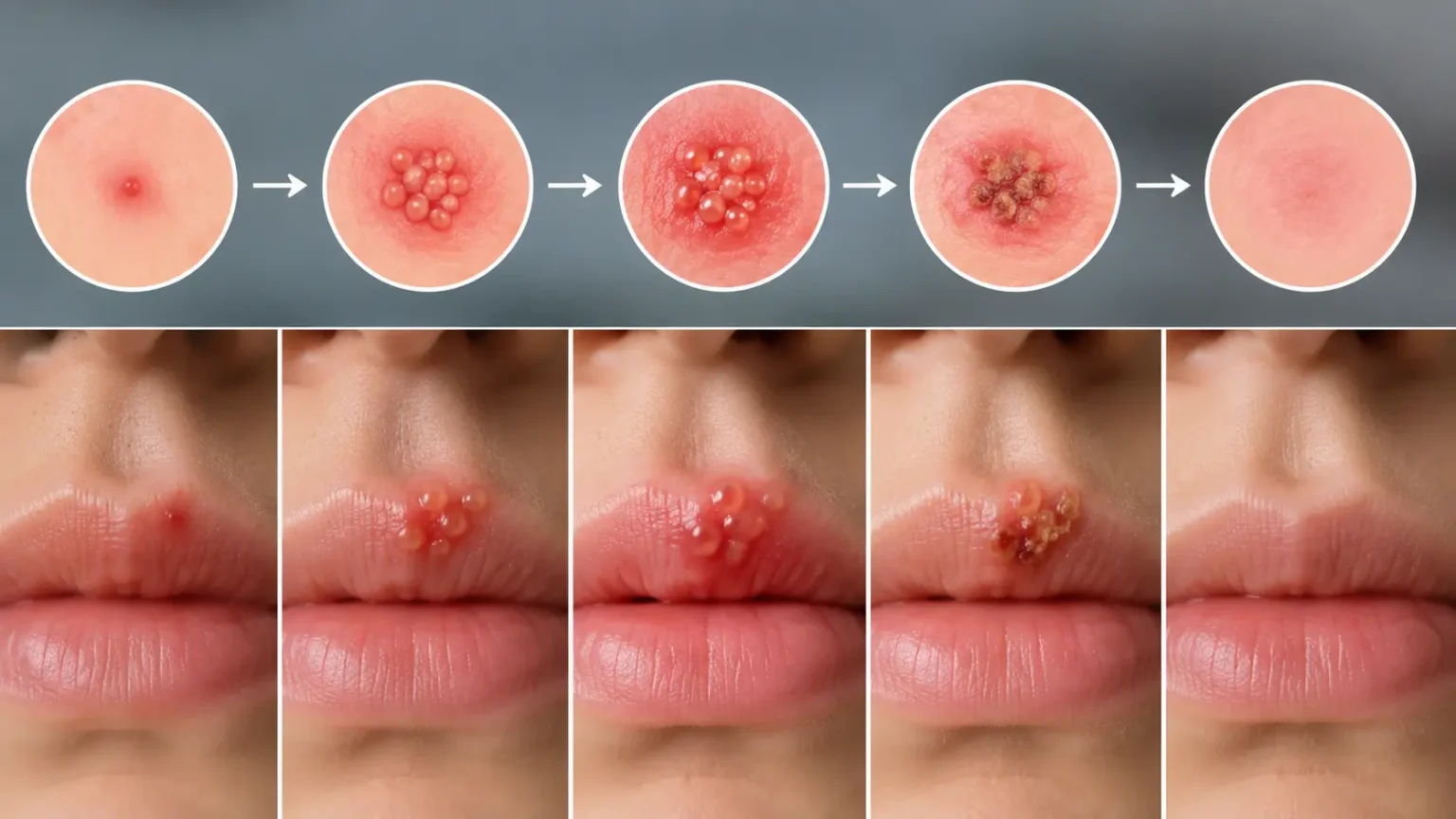

Herpes Photos in Different Stages: What to Know
Searching for herpes photos in different stages is common when someone notices an unfamiliar bump, blister, sore, or irritated area around the mouth or genitals. Images can provide general context, but they cannot reliably diagnose herpes because herpes simplex virus infections can look different from person to person. Some people develop recognizable clusters of blisters, while others experience very mild symptoms or no visible sores at all.
Genital and oral herpes are caused by the herpes simplex virus, usually HSV-1 or HSV-2. HSV-1 commonly causes oral herpes but can also cause genital infections, while HSV-2 primarily causes genital herpes. Both viruses remain in the body after infection and can reactivate, which means symptoms may return after the first outbreak.
When visible symptoms occur, herpes sores may progress from subtle redness, tingling, or small bumps to fluid-filled blisters, open ulcers, crusting, and eventually healed skin. However, not every outbreak follows an identical sequence. Lesions can be so mild that they are mistaken for pimples, ingrown hairs, irritation, or other common skin conditions.
This guide explains what herpes looks like at different stages, how first and recurrent outbreaks can differ, which conditions may resemble herpes, and why testing is more dependable than comparing your skin with photographs online. It also covers healing, transmission, treatment, and warning signs that should prompt medical evaluation.
What Does Herpes Look Like?
Herpes can appear as one or more small bumps, fluid-filled blisters, or shallow open sores. Genital herpes lesions may occur around the external genital area, buttocks, thighs, anus, or nearby skin, while oral herpes commonly develops on or around the lips and mouth. The appearance depends partly on where the infection occurs and how strong the outbreak is.
A classic outbreak often involves multiple small blisters grouped relatively close together. These may contain clear or slightly cloudy fluid before breaking open. Once the blister surface opens, the underlying area can look raw, red, or ulcerated and may feel painful or sensitive. The lesions eventually dry, crust, or gradually close as the skin heals.
Herpes does not always produce this textbook appearance. Some people notice only a tiny crack in the skin, localized redness, itching, tenderness, or one small bump. Others have symptoms so mild that they never realize they have an outbreak. This variation is one reason medical organizations caution against diagnosing genital herpes solely by appearance.
Skin tone can also affect how inflammation appears. Redness may look pink or bright red on lighter skin while appearing darker, purplish, brown, or less visually obvious on deeper skin tones. Photographs found online often fail to represent this diversity, making image comparison particularly unreliable for people whose skin does not resemble the example shown.
Herpes Stage 1: Tingling, Itching or Early Warning Signs
Some herpes outbreaks begin with a prodrome, meaning symptoms develop before obvious sores become visible. A person may notice tingling, itching, burning, tenderness, sensitivity, or discomfort in the area where an outbreak is about to appear. These sensations can occur around the mouth or genital area depending on the location of the infection.
The skin may initially look completely normal despite these sensations. In other cases, mild redness or localized swelling develops before any obvious blister appears. This early stage can be difficult to photograph because the visible changes may be extremely subtle or absent altogether.
People who have experienced previous outbreaks sometimes become familiar with their personal warning signs. They may recognize a characteristic tingling sensation or localized discomfort before lesions develop. Recognizing these patterns can be useful because antiviral treatment is often most effective when started early in an outbreak according to the treatment plan provided by a healthcare professional.
A tingling or itchy sensation alone does not prove herpes. Allergic reactions, friction, shaving irritation, eczema, fungal infections, nerve irritation, and other conditions can produce similar sensations. The complete pattern—including recurrence, location, lesion appearance, exposure history, and testing—is more informative than one isolated symptom.
Herpes Stage 2: Small Bumps and Blisters
As an outbreak progresses, small raised bumps or fluid-filled blisters may become visible. Herpes lesions can occur individually, but they are often described as multiple small blisters occurring close together. The surrounding skin may look irritated or swollen, and the area can become increasingly tender.
The blisters are often small enough that someone may initially mistake them for pimples, razor bumps, or irritation. Genital skin naturally contains follicles, glands, folds, and variations in texture, which can make self-assessment even more difficult. CDC guidance specifically notes that mild genital herpes symptoms may be confused with pimples or ingrown hairs.
Blisters can also appear around the lips with oral herpes, often called cold sores or fever blisters. These lesions are usually fluid-filled and may occur together in a small patch. They can break open and later form a crust as healing progresses.
The blister stage can be particularly relevant for testing. When visible genital lesions are present, clinicians can take a swab from a fresh blister or sore and perform a virologic test. Testing from lesions works best before they are heavily crusted or well into the healing process.
Herpes Stage 3: Blisters Break and Become Open Sores
Herpes blisters can eventually rupture and leave shallow open sores or ulcers. At this stage, the lesions may appear moist, red, raw, or irritated. The affected area can become more uncomfortable because the protective surface of the skin has been disrupted.
Genital sores may sting particularly when urine comes into contact with irritated skin. Friction from clothing or movement may also increase discomfort. The amount of pain differs considerably between people, however, and not every herpes lesion produces severe symptoms.
An ulcerated lesion is not unique to herpes. Syphilis, trauma, other infections, inflammatory skin disorders, and several additional conditions can cause genital ulcers. CDC guidance specifically emphasizes that genital, anal, or perianal ulcers can have multiple causes and sometimes more than one infection may be present simultaneously.
Because an open lesion provides a useful opportunity for laboratory testing, seeking care while sores are still fresh can improve diagnostic accuracy. A clinician may collect material directly from the lesion for HSV testing rather than relying solely on visual inspection.
Herpes Stage 4: Drying and Crusting
As healing begins, herpes sores may start drying out. On some areas of the body, particularly the lips, a visible crust or scab can form over the lesion. Genital lesions do not always develop an obvious thick scab because the surrounding skin and moisture levels differ from facial skin.
A healing sore generally becomes less wet and irritated over time. Pain and sensitivity may gradually decline, and the surface begins closing as new skin forms underneath. This process is part of the body’s natural response to the outbreak rather than evidence that the virus itself has left the body.
Visible improvement does not mean the herpes simplex virus has been eliminated. HSV remains in nerve cells after infection and can become active again later. This ability to remain latent explains why some people experience recurrent cold sores or genital outbreaks after months or years without symptoms.
Picking at crusts or healing lesions can irritate the skin and potentially delay healing. Keeping the area reasonably clean, avoiding unnecessary friction, and following any treatment instructions provided by a healthcare professional are generally more useful than repeatedly examining or manipulating the sore.
Herpes Stage 5: Healing Skin
The final visible phase of an uncomplicated outbreak involves the sores closing and the skin returning toward its usual appearance. Redness or discoloration may remain temporarily even after the surface has healed. In many cases, uncomplicated herpes lesions heal without permanent scarring.
The total healing time varies. Genital herpes sores may take a week or longer to heal, and a first outbreak can last longer than later recurrences. Oral cold sores commonly resolve over roughly one to several weeks, depending on the individual and severity.
A first outbreak can sometimes involve several waves of lesions rather than one neat group of sores progressing simultaneously. One blister may already be healing while another appears nearby, making photographs of “stage one,” “stage two,” and “stage three” less orderly than many online diagrams suggest.
Once the visible skin has healed, recurrence remains possible because herpes is a lifelong viral infection. Some people experience regular outbreaks, others have occasional recurrences, and many have very few recognizable symptoms.
What Does a First Herpes Outbreak Look Like?
A first herpes outbreak may be more noticeable than later recurrences, although this is not true for everyone. It can involve multiple blisters or ulcers appearing around the affected area, accompanied by pain, itching, burning, or tenderness. New lesions may continue developing over several days.
Some people also develop symptoms affecting the whole body during an initial outbreak. Fever, body aches, headache, fatigue, or swollen lymph nodes can occur, particularly with a symptomatic first episode. CDC guidance notes that flu-like symptoms can accompany the first genital herpes outbreak.
Genital symptoms may also include painful urination when urine passes over external sores. Depending on where lesions appear, sitting, walking, or wearing tight clothing can become uncomfortable. The severity ranges widely, however, and some newly infected individuals experience such mild symptoms that they do not recognize an outbreak.
The absence of a dramatic first outbreak does not rule out herpes. Many infected people have no noticeable symptoms or symptoms that are mistaken for common skin problems. Someone may therefore discover HSV only much later or may never know exactly when they acquired the infection.
What Do Recurrent Herpes Outbreaks Look Like?
Recurrent outbreaks are often shorter and less severe than a symptomatic first episode. Someone may notice a familiar tingling sensation followed by a smaller cluster of lesions in approximately the same general region. The number of sores may also be lower than during an initial outbreak.
Recurrences happen because HSV remains dormant in nerve tissue and can later reactivate. Certain people notice outbreaks during periods of illness, stress, hormonal change, sleep disruption, or other physical strain, although triggers vary and an obvious trigger is not always identifiable.
HSV-2 genital infections tend to recur more frequently than genital infections caused by HSV-1. The type of virus therefore influences the expected pattern of recurrence and shedding. This distinction can sometimes be useful when discussing prognosis after laboratory confirmation.
Not every new genital bump in someone with known herpes represents another outbreak. Folliculitis, ingrown hairs, irritation, cysts, and other common problems can still occur. Learning your typical outbreak pattern may help, but unusual or persistent lesions should still be evaluated when there is uncertainty.
Oral Herpes Photos: What Cold Sores Usually Look Like
Oral herpes commonly causes cold sores around the lips or mouth and is most often associated with HSV-1. A typical outbreak may begin with tingling or burning before small fluid-filled blisters become visible. These blisters can cluster together and eventually rupture.
After the blisters break, a crust or scab can develop. The lesion may change from moist and blistered to dry and crusted before gradually disappearing. Temporary discoloration can remain while the skin completes the healing process.
Cold sores frequently occur near the border of the lips, although oral herpes can affect nearby facial or oral tissues. Because acne, angular cheilitis, irritation, canker sores, and other conditions can also occur around the mouth, location and appearance should be considered together rather than assuming every lip lesion is herpes.
HSV-1 can also cause genital herpes through oral-genital contact. This means describing HSV-1 purely as “oral herpes” and HSV-2 purely as “genital herpes” is an oversimplification. Either type can affect the genital area, although their transmission patterns and recurrence tendencies differ.
Genital Herpes Photos: What Symptoms May Look Like
Genital herpes can appear as small bumps, blisters, open sores, or healing lesions around the genital or anal region. Lesions may occur on external genital skin and can also affect nearby areas such as the buttocks or thighs.
The appearance can vary depending on anatomy. On areas with drier skin, lesions may crust more obviously, whereas sores involving moist mucosal tissue may appear as shallow raw areas without developing a prominent scab. This variation can make image comparisons particularly misleading.
In some cases, the infection causes tiny cracks, redness, or subtle irritation rather than obvious clusters of blisters. These mild presentations may resemble shaving irritation, friction, yeast-related inflammation, or ingrown hairs. Many people with genital herpes therefore do not recognize that their symptoms could be HSV.
Clinical diagnosis based on appearance alone can also be difficult for professionals. CDC treatment guidance recommends confirming suspected genital herpes with lesion-based virologic testing when lesions are available. That is a much safer approach than making a diagnosis from photographs.
What Does Herpes Look Like on a Penis?
Herpes lesions on penile skin may begin as small irritated bumps or fluid-filled blisters. They may occur on the shaft, glans, foreskin, or surrounding genital region. Multiple lesions can develop close together, although a person may sometimes notice only one or two subtle areas.
Once the blisters open, they can become shallow ulcers that appear red or raw. These areas may sting or become uncomfortable with friction. As healing progresses, they usually become less inflamed and gradually close.
The appearance can overlap with folliculitis, friction injuries, contact dermatitis, pearly penile papules, molluscum contagiosum, syphilis, and other conditions. Some of these require entirely different treatment, making photographs inadequate for confirming the cause.
A new genital ulcer or blister should be professionally assessed when possible, particularly if there has been recent sexual exposure. Swabbing a fresh lesion can provide substantially more useful information than trying to decide whether it resembles a photograph found through an image search.
What Does Herpes Look Like on the Vulva?
Herpes affecting the vulva may produce small blisters, bumps, shallow sores, redness, or localized swelling. Lesions can occur on the labia, surrounding skin, or other external genital tissues. Their appearance may be especially subtle when sores occur within folds of skin.
After blisters rupture, affected areas may look raw rather than forming a dramatic external scab. Moisture and friction can influence how genital lesions appear during healing, which is one reason herpes photographs from other body locations may not be useful comparisons.
Some symptoms can resemble yeast infections, shaving irritation, folliculitis, dermatitis, or small skin tears. Burning during urination may occur if urine contacts external ulcers, but urinary discomfort can also have other causes such as urinary tract infections.
Anyone who develops painful genital sores, unexplained blisters, or recurring lesions should consider medical evaluation. Testing becomes particularly useful while fresh lesions are still present because swabs can directly test material from the affected area.
Herpes vs Pimples: How Can You Tell?
Pimples usually develop when pores or hair follicles become blocked or inflamed. They may have a central whitehead, contain thicker material, or occur directly around a hair follicle. Shaving, sweating, friction, and tight clothing can contribute to folliculitis and ingrown hairs around the genital region.
Herpes lesions more commonly begin as delicate fluid-filled blisters or superficial sores rather than a deep acne-like bump. Several lesions may occur close together, and the area may be preceded by tingling, burning, or unusual sensitivity. However, mild herpes can genuinely resemble an ordinary pimple.
Pain also does not provide a perfect answer. Herpes sores can be painful, but some outbreaks cause only mild discomfort. Pimples and ingrown hairs can likewise become painful when inflamed. Trying to diagnose the cause simply by pressing, squeezing, or repeatedly inspecting a bump can further irritate the area.
Avoid deliberately popping an unexplained genital lesion to see what comes out. If herpes is possible, a clinician can inspect the area and collect a diagnostic swab if appropriate. Laboratory testing provides much stronger evidence than differences in appearance alone.
Herpes vs Ingrown Hair
An ingrown hair occurs when a growing hair curves back into the skin or becomes trapped under the surface. It commonly appears after shaving, waxing, or other hair removal and may develop as an isolated red bump around a visible hair follicle.
Herpes does not originate from the hair follicle. Instead, it can produce superficial blisters or ulcers involving nearby skin. Multiple lesions and a pattern of burning, tingling, or recurrence can make herpes more suspicious, but these features are not reliable enough for self-diagnosis.
An ingrown hair may occasionally show a trapped hair beneath the skin or develop a small amount of pus. Herpes blisters generally contain thinner fluid before becoming ulcers. Even so, CDC information specifically notes that genital herpes is frequently mistaken for ingrown hairs.
If an unexplained bump repeatedly appears in the same genital region or becomes blistered or ulcerated, seeking testing is more useful than repeatedly treating it as an ingrown hair. Avoid squeezing genital lesions because doing so can cause additional irritation or introduce bacterial infection.
Herpes vs Syphilis
Herpes and syphilis can both cause genital sores, but their typical appearances differ. Herpes commonly produces painful clusters of blisters or ulcers, whereas the initial sore associated with syphilis is classically firm, round, and painless.
These are general tendencies rather than diagnostic rules. Herpes can occasionally cause mild or minimally painful lesions, and syphilis does not always look exactly like textbook photographs. More than one sexually transmitted infection can also be present at the same time.
Syphilis is particularly important not to miss because its initial sore can disappear without treatment even though the infection remains in the body. The disappearance of a genital ulcer therefore does not prove that the underlying cause has resolved.
Testing is the only reliable way to distinguish many cases. Someone with a new genital ulcer, particularly after possible sexual exposure, may need evaluation for both herpes and syphilis rather than assuming one diagnosis from photographs.
Herpes vs Mpox
Mpox can also cause lesions that sometimes resemble blisters or pimples, including around the genitals or anus. CDC guidance describes mpox lesions as potentially painful or itchy and notes that they progress through several stages before scabbing and healing.
The overall pattern can differ from herpes, and accompanying symptoms, exposure history, lesion characteristics, and distribution all help guide diagnosis. However, relying on a side-by-side photo comparison is risky because individual presentations vary.
Some mpox cases involve lesions in several body areas, while others may initially involve genital or perianal skin. Herpes tends to recur because HSV remains latent in nerve cells, whereas mpox represents a different viral infection with a different natural history.
Anyone concerned about mpox because of symptoms and a relevant exposure should seek medical evaluation and testing. This is particularly important when the diagnosis could affect isolation, treatment decisions, or notification of close contacts.
Herpes vs Shingles
Shingles and herpes simplex both belong to the broader herpesvirus family, but they are caused by different viruses. Shingles results from reactivation of the varicella-zoster virus, the same virus responsible for chickenpox. HSV-1 and HSV-2 cause oral and genital herpes.
Shingles typically creates a painful blistering rash concentrated on one side of the body, often following a stripe-like distribution associated with a nerve pathway. Pain, tingling, itching, or numbness may appear before the rash becomes obvious.
Herpes simplex outbreaks usually occur around the mouth or genital area, although HSV can affect other locations. Because both conditions can involve grouped blisters, photographs without information about location and symptom pattern may create confusion.
The treatments and potential complications differ, making correct diagnosis important. Shingles involving the eye or face can require particularly prompt medical attention, while genital herpes requires its own testing, counseling, and management approach.
Can Herpes Be Present Without Visible Sores?
Yes. A large number of people with herpes have no obvious symptoms, or their symptoms are so mild that they are not recognized as herpes. This is especially important because the absence of visible lesions does not necessarily mean the virus is absent.
HSV can sometimes be released from infected skin even when no outbreak is visible, a process commonly called asymptomatic viral shedding. This helps explain why herpes can be transmitted by someone who does not currently have recognizable sores.
Because of this, checking a partner’s skin before sexual activity cannot completely determine whether transmission is possible. Avoiding sexual contact during visible outbreaks helps reduce risk, but it does not eliminate the possibility of transmission at other times.
Barrier methods and, for people with diagnosed genital herpes, suppressive antiviral treatment can form part of a risk-reduction strategy. Specific recommendations depend on HSV type, outbreak history, partners, pregnancy considerations, and individual circumstances.
How Long Does a Herpes Outbreak Last?
The length of an outbreak varies according to whether it is the first recognized episode or a recurrence, the location of infection, immune response, and whether antiviral treatment is used. A first symptomatic genital outbreak can persist longer and produce more symptoms than later episodes.
CDC information notes that genital herpes sores may take a week or more to heal. Some sexual-health services report that a first episode can continue for considerably longer while successive lesions develop and heal.
Recurrent outbreaks are often shorter because the immune system has already encountered the virus. Someone may experience only a small number of lesions that resolve relatively quickly. Individual experiences still differ considerably, so one person’s timeline should not be treated as a rule for everyone.
A lesion that persists unusually long, becomes increasingly painful, develops pus, produces spreading redness, or repeatedly fails to heal should be assessed. Not every chronic genital or oral sore is herpes, and persistent lesions can have other causes requiring different treatment.
Does Herpes Always Form a Scab?
No. Whether a visible herpes scab develops depends partly on the location of the outbreak. Cold sores on the relatively dry skin around the lips commonly develop a noticeable crust after the blisters break.
Genital sores may heal less dramatically, particularly on moist mucosal tissue. Instead of producing a thick crust, the ulcer may gradually become shallower, less red, and less painful until the surface closes.
This means a lesion does not have to produce a textbook-looking scab to be herpes. Conversely, the presence of a scab does not prove herpes because acne, cuts, bacterial infections, and many other skin problems can crust while healing.
Monitoring the full progression can provide useful context, but testing remains more reliable than deciding whether the lesion followed a particular visual sequence. Fresh blisters or ulcers generally provide the best opportunity for lesion-based HSV testing.
Does Herpes Leave Scars?
Typical herpes lesions usually heal without permanent scarring when they resolve normally. Temporary redness, darkening, or other color changes can remain after the surface has closed, particularly when the skin has been significantly inflamed.
Scarring becomes more possible if lesions are repeatedly scratched, picked, squeezed, or complicated by secondary infection. Skin responses also vary between individuals, and some people are naturally more prone to post-inflammatory pigmentation or scarring.
A mark remaining after a suspected outbreak does not confirm that the original lesion was herpes. Numerous common skin conditions can leave temporary discoloration during healing.
If a sore repeatedly breaks down, produces a persistent scar-like change, or fails to heal, it is worth having the area examined. Chronic ulcers should not automatically be attributed to herpes without appropriate assessment.
How Is Herpes Diagnosed?
When someone has fresh genital blisters or sores, one of the most useful diagnostic approaches is taking a sample directly from the lesion. CDC guidance recommends confirming suspected genital herpes with type-specific virologic testing using a nucleic acid amplification test or culture when lesions are present.
Timing matters because lesion tests generally perform best when the blister or ulcer is relatively fresh. Once the area has crusted extensively or is already healing, the opportunity to detect the virus may decrease.
Blood tests can sometimes identify antibodies to HSV, but they answer different questions and need appropriate interpretation. They cannot necessarily tell exactly where the infection is located or when someone acquired it, which can create confusion if testing is performed without a clear clinical reason.
A healthcare professional can decide which test makes sense based on symptoms, lesion status, sexual history, previous results, and individual circumstances. This is much more reliable than asking whether a picture “looks exactly like herpes.”
Why Herpes Photos Cannot Confirm a Diagnosis
Online photographs usually show clear or medically selected examples. Real-life herpes is often much more subtle. Someone may have only one tiny lesion, mild redness, a crack in the skin, or no visible symptoms at all.
Photographs also flatten important diagnostic information. They cannot show whether an area is painful, how quickly it appeared, whether tingling came first, whether the lesions recur, or what potential exposures occurred. Lighting, camera quality, magnification, and skin tone can also dramatically alter appearance.
Several unrelated conditions can visually resemble herpes, including folliculitis, ingrown hairs, syphilis, contact dermatitis, yeast-related inflammation, friction injuries, and mpox. Treating one of these conditions based on a photo comparison can lead to unnecessary worry or inappropriate treatment.
Images are therefore most useful for general education rather than diagnosis. If a suspicious lesion is currently present, getting it assessed while it is fresh can provide much more definitive information and may allow a clinician to perform a direct swab.
Herpes Treatment and Healing
There is currently no treatment that removes herpes simplex virus completely from the body, but antiviral medications can help manage symptoms and outbreaks. Treatment options may include medicines such as acyclovir, valacyclovir, or famciclovir depending on the person’s circumstances and clinician’s recommendation.
Antiviral treatment can be used episodically around outbreaks or, for some people, taken regularly as suppressive therapy. The appropriate strategy depends on factors such as outbreak frequency, symptom severity, transmission concerns, HSV type, pregnancy status, and personal preference.
Starting treatment early can be helpful, particularly when someone recognizes warning symptoms or develops new lesions. Valacyclovir, for example, can reduce discomfort and help sores heal faster, although it does not eliminate HSV from the body.
People should avoid relying on harsh household remedies, strong essential oils, bleach, alcohol, or other irritating substances on genital or oral sores. These products do not cure herpes and can damage already sensitive skin, potentially making pain and healing worse.
How to Reduce Herpes Transmission
Herpes primarily spreads through direct contact with infected skin or mucosal surfaces. HSV-1 is commonly transmitted through oral contact, while HSV-2 is mainly transmitted sexually, although HSV-1 can also cause genital herpes.
Transmission risk is higher when active blisters or ulcers are present. Avoiding oral, vaginal, or anal sexual contact involving the affected area during an outbreak is an important risk-reduction step. Symptoms such as tingling that typically precede an outbreak may also signal a period when additional caution is appropriate.
Condoms and other barriers can reduce exposure but may not cover every area where HSV can be present. Transmission can therefore still occur despite barrier use, although consistent safer-sex practices can reduce overall risk.
For people with diagnosed genital herpes, discussing suppressive antiviral therapy and partner risk with a healthcare professional may be useful. Honest communication allows partners to make informed decisions without treating HSV as a moral judgment or source of shame.
When Should You See a Doctor for Possible Herpes?
Consider seeking medical care when you develop new genital blisters, unexplained ulcers, recurring painful sores, or symptoms following a possible sexual exposure. Evaluation is particularly useful while lesions are still fresh because direct testing can then be performed more effectively.
Prompt assessment is also appropriate when pain is severe, urination becomes very difficult, symptoms are extensive, sores are not healing, or there are signs of another infection. People whose immune systems are weakened may also need earlier medical attention.
Pregnancy deserves special consideration because genital herpes can have implications for delivery and newborn health. Anyone who is pregnant and develops a suspected first genital herpes outbreak should contact their maternity or healthcare team rather than relying on photographs for diagnosis.
Eye symptoms also require prompt evaluation because herpes viruses can affect the eye. Eye pain, light sensitivity, significant redness, or vision changes should not be treated as an ordinary skin outbreak without professional assessment.
Living With Herpes After a Diagnosis
A herpes diagnosis can initially bring anxiety, embarrassment, frustration, or worry about future relationships. These reactions are understandable, but HSV is extremely common worldwide and does not define someone’s health, relationships, or personal worth. WHO describes herpes simplex infection as widespread globally.
Learning your individual pattern can make the condition easier to manage. Some people identify early symptoms and respond quickly with prescribed medication, while others eventually experience very infrequent outbreaks. Recurrence patterns vary substantially.
Communication with partners can also become easier with accurate information. Herpes can be transmitted without visible lesions, but risk can be reduced through avoiding contact during outbreaks, considering barriers, and discussing antiviral treatment where appropriate.
Medical management focuses on reducing symptoms, shortening outbreaks, and limiting transmission rather than eliminating the virus. With appropriate information and care, most people with HSV continue ordinary relationships, sexual lives, work, exercise, and everyday activities.
Common Myths About Herpes Appearance
One myth is that herpes always looks like a large cluster of obvious blisters. In reality, many infections cause no recognized symptoms, and mild outbreaks may look like pimples, ingrown hairs, or minor irritation.
Another misconception is that painless lesions cannot be herpes. Although herpes is commonly associated with pain, symptoms vary considerably. Likewise, a painful genital bump does not automatically indicate herpes because numerous inflammatory and infectious conditions can hurt.
People sometimes believe that a sore disappearing proves there was no STI. Both herpes lesions and syphilis sores can heal even though the underlying infection remains present. Healing appearance alone therefore cannot determine the cause.
Finally, photographs cannot reveal whether someone acquired HSV recently. Because people can have unrecognized infections for long periods, the first noticed outbreak does not necessarily identify when transmission occurred or from whom.
Final Thoughts on Herpes Photos in Different Stages
Herpes photos in different stages can help illustrate the general progression from early irritation or tingling to small blisters, open sores, drying, and eventual healing. However, real outbreaks are highly variable and may never follow a perfectly recognizable sequence.
HSV can produce obvious clusters of painful lesions, one subtle bump, small skin cracks, or no noticeable symptoms at all. Both HSV-1 and HSV-2 can cause genital herpes, while HSV-1 is also a major cause of oral cold sores.
The biggest limitation of comparing photographs is that several other conditions can look similar. Pimples, ingrown hairs, syphilis, irritation, and other infections may all create confusing genital or oral lesions. Even clinicians may require laboratory confirmation when genital herpes is suspected.
If you currently have a fresh blister or ulcer and are concerned about herpes, getting tested while the lesion is present is generally more useful than continuing to compare images online. Accurate diagnosis can provide clarity, guide treatment, and help you make informed decisions about sexual health.
Frequently Asked Questions About Herpes Stages
What Does Herpes Look Like at the Beginning?
Early herpes may cause tingling, itching, burning, redness, or tiny raised bumps before obvious blisters develop. Some people have such mild symptoms that the beginning of an outbreak is difficult to recognize.
What Does Herpes Look Like When It Is Healing?
Healing herpes sores generally become less moist and irritated before closing. Some lesions form a crust or scab, particularly around the mouth, while genital lesions may simply become shallower and gradually disappear.
Can Herpes Look Like a Pimple or Ingrown Hair?
Yes. Mild genital herpes can be mistaken for pimples, folliculitis, or ingrown hairs. Because appearance alone is unreliable, a fresh suspicious lesion is best assessed and tested by a healthcare professional.
How Long Do Herpes Blisters Take to Heal?
Healing time varies, but sores may take a week or longer to resolve, and an initial outbreak can last longer than recurrent episodes. Antiviral treatment may help shorten symptoms when appropriately prescribed.
Can You Have Herpes Without Any Visible Blisters?
Yes. Many people with HSV have no obvious symptoms or experience symptoms too mild to recognize. The virus can also sometimes be transmitted when no visible sores are present.