
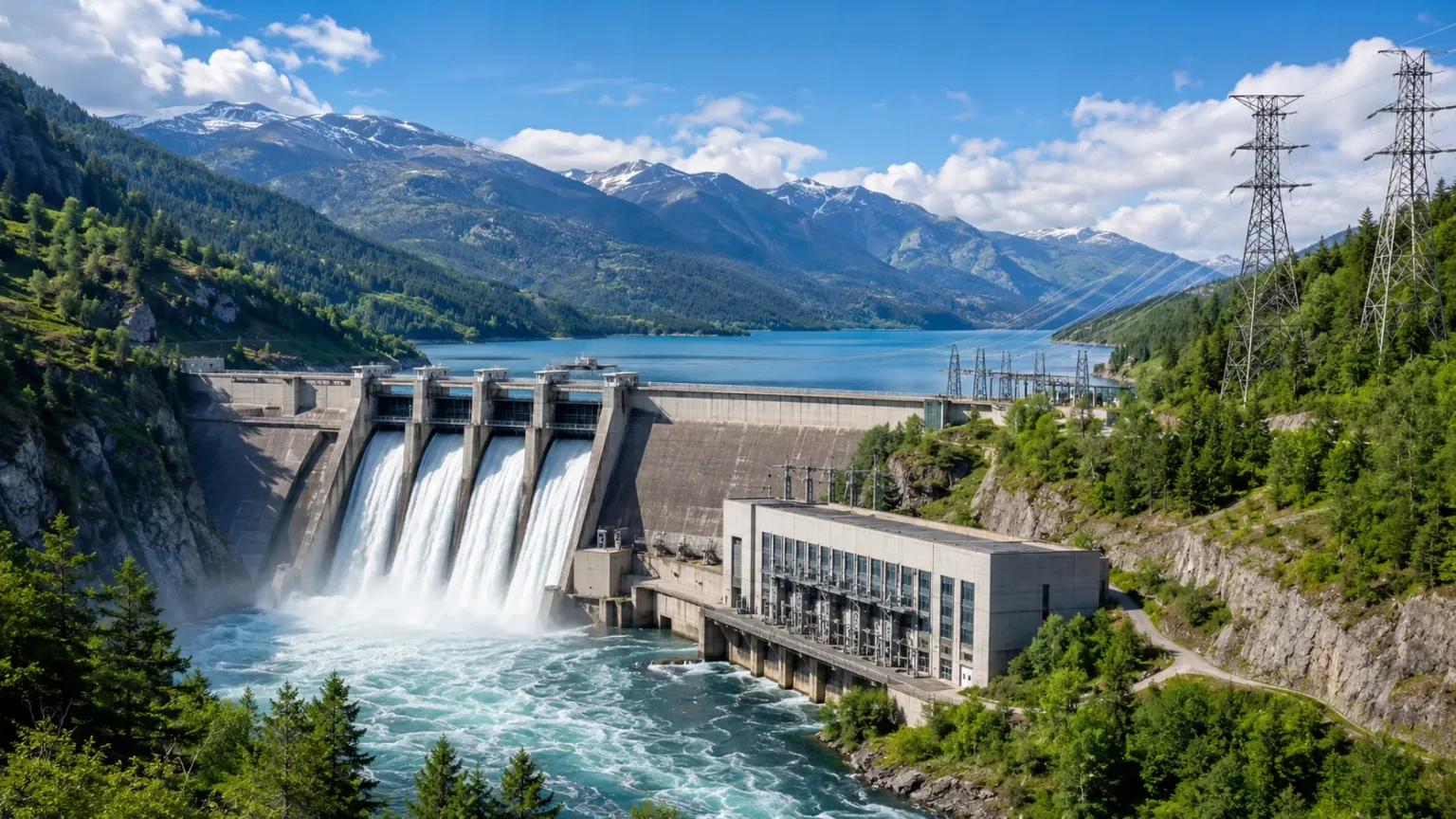

How Does Hydroelectric Power Work?
Hydroelectric power generates electricity by using the energy of moving or falling water. Water flows through a turbine, causing its blades to rotate, and that spinning motion drives a generator that produces electrical energy. It is one of the oldest and most widely used forms of renewable electricity generation in the world.
The basic idea sounds simple, but modern hydroelectric power plants rely on carefully engineered dams, reservoirs, intake systems, turbines, generators, transformers, and transmission lines. Each component helps control the movement of water and convert its energy efficiently into electricity that can be delivered to homes, businesses, and industries.
Hydropower is especially valuable because some facilities can adjust their electricity output quickly. Unlike solar or wind power, which depend directly on weather conditions at a particular moment, reservoir-based hydroelectric plants can release stored water when electricity demand rises and reduce generation when demand falls.
However, hydroelectric power is not environmentally impact-free. Large dams can change river ecosystems, affect fish migration, alter sediment flow, and sometimes displace communities. Understanding how hydropower works therefore requires looking at both its advantages and its environmental and social trade-offs.
What Is Hydroelectric Power?
Hydroelectric power, often called hydropower, is electricity generated from the movement of water. It usually relies on flowing rivers, falling water, reservoirs, or other systems where gravity can move water through turbines.
The energy in moving water is known as kinetic energy, while water stored at a higher elevation contains gravitational potential energy. Hydroelectric plants convert these forms of energy into mechanical rotation and then into electrical energy.
Some hydroelectric systems use large dams that create reservoirs, while others operate with little or no water storage. The exact design depends on geography, river flow, electricity needs, environmental conditions, and available infrastructure.
Hydropower is considered renewable because the water cycle continuously replenishes rivers and reservoirs through evaporation, rainfall, and snowmelt. However, electricity generation can still vary significantly during droughts or unusually dry seasons.
Where Does Hydropower Energy Come From?
The Sun is indirectly responsible for most hydroelectric power. Solar energy causes water to evaporate from oceans, lakes, rivers, and soil, sending water vapor into the atmosphere.
That water later falls as rain or snow and may collect at higher elevations. Gravity then pulls it downhill through streams, rivers, and watersheds, creating moving water that can be used to generate electricity.
When water is stored behind a dam, its elevation gives it potential energy. The greater the height difference between the reservoir and the turbine, the more energy may be available as the water moves downward.
This combination of the water cycle and gravity makes hydropower renewable. The same water can move through the environment repeatedly, although local water availability can change because of weather, climate, and seasonal conditions.
How Does a Hydroelectric Dam Generate Electricity?
A hydroelectric dam creates a barrier across a river and stores water in a reservoir. The water behind the dam is held at a higher elevation than the river below, giving it significant gravitational potential energy.
When electricity is needed, controlled gates allow water to enter an intake and flow through a large pipe known as a penstock. Gravity accelerates the water as it moves toward the turbine.
The fast-moving water strikes or flows through the turbine blades, causing the turbine shaft to rotate. This spinning shaft is connected to an electrical generator inside the powerhouse.
After passing through the turbine, the water exits through a channel called the tailrace and returns to the river. The water itself is not consumed during electricity generation, although its timing and flow pattern can be changed.
What Is a Reservoir?
A reservoir is a large body of water stored behind a dam. It provides a controlled supply of water that can be released through turbines when electricity generation is required.
Reservoirs allow hydroelectric operators to store potential energy in the form of elevated water. This makes some hydropower plants more flexible than energy sources that must generate electricity only when natural conditions are immediately available.
Large reservoirs may also serve additional purposes. They can provide drinking water, irrigation, flood control, recreation, navigation, or drought management depending on how the water system is designed.
However, reservoirs can dramatically change landscapes and ecosystems. Creating one may flood forests, farmland, archaeological sites, wildlife habitat, or settlements, making dam planning an important environmental and social decision.
What Is a Penstock and Why Is It Important?
A penstock is a large pipe or enclosed channel that carries water from the reservoir or intake toward the hydroelectric turbine. It is designed to handle high water pressure and large volumes of flow.
As water travels downward through the penstock, gravitational potential energy is converted into kinetic energy. The resulting high-speed flow provides the force needed to rotate the turbine.
The size and strength of the penstock depend on the hydroelectric project’s water flow, elevation difference, turbine type, and generating capacity. Large plants may use enormous steel or concrete-lined penstocks.
Engineers must carefully manage pressure changes inside these pipes. Sudden changes in water flow can create pressure surges known as water hammer, so control systems and surge tanks may be used to protect equipment.
How Do Hydroelectric Turbines Work?
A hydroelectric turbine converts the energy of flowing water into mechanical rotation. Water moves across or through specially shaped blades, creating forces that cause the turbine’s rotor to spin.
Different turbine designs work best under different combinations of water pressure and flow. Some are suited to high waterfalls with lower flow, while others perform better in large rivers with lower elevation differences.
The turbine shaft connects to the generator, allowing mechanical energy to be transferred directly into the electricity-generating system. Efficient turbine design helps capture as much usable energy from the water as practical.
Modern turbines also include control mechanisms that regulate how much water enters the machine. Adjusting water flow allows operators to increase or decrease electricity output according to grid demand.
What Are the Main Types of Hydroelectric Turbines?
Francis turbines are among the most commonly used hydroelectric turbines. They work efficiently across a wide range of medium-head and medium-flow conditions and are commonly installed in large dam projects.
Kaplan turbines resemble large adjustable propellers and are well suited to locations with lower water pressure and high flow rates. Their blades can change angle to maintain efficient operation under varying conditions.
Pelton turbines use high-speed water jets that strike spoon-shaped buckets around the edge of a wheel. These turbines are particularly useful in mountainous regions with very high elevation differences and relatively low water flow.
Choosing the correct turbine is essential for efficient hydropower generation. Engineers consider water head, flow rate, seasonal variability, plant size, maintenance requirements, and expected operating conditions before selecting a turbine design.
What Is Water Head in Hydroelectric Power?
Water head refers to the vertical distance between the water source and the turbine. It represents the amount of gravitational potential energy available in the water.
A high-head hydropower system has a large elevation difference, allowing water to reach the turbine with substantial pressure and speed. Mountainous regions often provide excellent conditions for high-head facilities.
Low-head systems operate with much smaller elevation differences but may compensate by using large volumes of water. River-based hydropower facilities frequently fall into this category.
Both head and flow rate determine how much energy a hydroelectric site can potentially produce. A project with high head but little water may produce less electricity than one with lower head but much greater flow.
How Does the Generator Make Electricity?
The hydroelectric generator converts the turbine’s mechanical rotation into electrical energy through electromagnetic induction. This is the same fundamental physical principle used in many other power-generation technologies.
Inside the generator, rotating magnetic fields interact with conductive coils. As the turbine turns the generator rotor, changing magnetic fields induce an electric current in the surrounding conductors.
The faster and more powerfully the turbine rotates within its designed operating range, the more electricity the generator can potentially produce. Control systems keep the equipment synchronized with the electricity grid.
This energy conversion is highly efficient compared with many thermal power plants because hydropower does not need to convert fuel into heat and then heat into mechanical motion before generating electricity.
How Does Electricity Leave a Hydroelectric Plant?
Electricity leaving the generator initially has a voltage suited to the plant’s equipment. Transformers increase this voltage so the electricity can travel efficiently over long distances.
High-voltage transmission reduces the amount of energy lost as heat in electrical wires. This allows hydroelectric plants located far from cities to supply electricity across large regions.
Transmission lines carry the electricity to substations closer to where it will be used. These substations gradually reduce the voltage before electricity enters local distribution systems.
By the time electricity reaches homes or businesses, additional transformers have reduced it to safer usable voltage levels. Hydroelectric electricity then becomes part of the same grid supply as power from wind, solar, nuclear, or fossil-fuel plants.
What Is Run-of-River Hydroelectric Power?
Run-of-river hydropower generates electricity using the natural flow of a river rather than relying on a very large storage reservoir. Some projects use a small dam or diversion structure to direct water through turbines.
These facilities generally have less ability to store water for future electricity production. Their output therefore depends more directly on current river conditions and seasonal changes.
Run-of-river projects can have smaller flooded areas than large reservoir-based dams, potentially reducing some environmental and social impacts associated with massive reservoirs.
However, they can still alter river flow, affect aquatic habitats, and create barriers for fish. Their environmental effects depend heavily on project design, location, and how much water is diverted.
What Is Pumped-Storage Hydropower?
Pumped-storage hydropower is primarily an energy-storage system rather than a traditional energy source. It usually uses two reservoirs located at different elevations.
When electricity supply is abundant or inexpensive, pumps move water from the lower reservoir to the upper reservoir. This stores energy as gravitational potential energy.
When electricity demand rises, water is released back downhill through turbines. The turbines drive generators, returning some of the stored energy to the electricity grid.
Pumped storage can help balance variable renewable energy such as wind and solar. It can store large amounts of energy for several hours or longer, making it valuable for grid stability and peak electricity demand.
How Efficient Is Hydroelectric Power?
Hydroelectric power plants are among the most efficient large-scale electricity-generating technologies. Turbines and generators can convert a high percentage of the available energy in moving water into electricity.
Efficiency depends on turbine design, water flow, hydraulic head, generator performance, and losses within pipes and electrical systems. Well-maintained facilities can operate efficiently for many decades.
Unlike coal or gas plants, hydroelectric facilities do not need to burn fuel to create steam. This eliminates several stages of energy conversion that would otherwise produce significant heat losses.
However, high equipment efficiency does not automatically mean a project has low environmental impact. Evaluating hydropower requires considering ecosystems, land use, river health, and social effects alongside electricity output.
How Much Electricity Can a Hydroelectric Plant Produce?
Hydroelectric plant output varies enormously. Small hydro systems may produce enough electricity for a village or individual facility, while massive projects can power millions of homes.
Generating capacity depends heavily on water flow and hydraulic head. More water moving through the turbines or a larger elevation drop generally increases potential power output.
Seasonal conditions can affect production considerably. Heavy rainfall and snowmelt may increase available water, while drought can reduce reservoir levels and electricity generation.
Operators must also balance electricity production with other water needs. Irrigation, drinking water, flood control, navigation, environmental flows, and recreation may all influence how much water can be used for power generation.
Why Is Hydropower Considered Renewable Energy?
Hydropower is classified as renewable because its energy source is moving water continuously replenished through Earth’s natural water cycle. Rainfall and snowmelt refill many rivers and reservoirs over time.
Unlike coal, oil, and natural gas, water is not burned or permanently consumed during electricity generation. After passing through the turbines, it returns downstream to the river system.
Hydropower also produces very low direct greenhouse gas emissions while generating electricity. This makes it an important low-carbon power source in many electricity systems.
However, the environmental footprint varies between projects. Reservoir construction can produce greenhouse gas emissions, particularly where large amounts of flooded vegetation decompose, so not every hydropower project has identical climate impacts.
What Are the Main Benefits of Hydroelectric Power?
One major advantage of hydropower is reliability. Reservoir-based plants can store water and generate electricity when required, making them useful for meeting sudden increases in power demand.
Hydropower plants can also change output rapidly. This flexibility helps grid operators balance electricity supply when wind or solar generation changes unexpectedly.
Another benefit is long operating life. Well-designed dams, turbines, and generators can continue producing electricity for many decades with maintenance and periodic equipment upgrades.
Hydropower facilities may also provide water storage, flood management, irrigation, and recreational opportunities. These additional benefits can increase the overall value of a project beyond electricity generation alone.
Does Hydroelectric Power Produce Greenhouse Gas Emissions?
Hydroelectric plants produce little or no direct carbon dioxide from fuel combustion because they do not burn fossil fuels to generate electricity. This gives hydropower a low operational carbon footprint.
However, reservoirs can release greenhouse gases when flooded plants and organic material decompose underwater. Methane can be particularly important in some warm, shallow, nutrient-rich reservoirs.
The amount of reservoir emissions varies considerably depending on climate, reservoir depth, vegetation, water chemistry, and how the surrounding land was prepared before flooding.
For this reason, lifecycle assessments are useful when comparing different hydropower projects. Most hydroelectric systems remain low-carbon overall, but individual projects can have very different environmental profiles.
What Environmental Problems Can Hydroelectric Dams Cause?
Large dams can significantly alter natural river ecosystems. Changing water levels and flow patterns can affect fish, aquatic plants, wetlands, floodplains, and species that depend on seasonal river cycles.
Dams also trap sediment that would naturally move downstream. This can reduce nutrients reaching floodplains and coastal areas while causing sediment to accumulate inside reservoirs.
Water temperature and oxygen levels may change as well. Deep reservoirs can release unusually cold or low-oxygen water downstream, potentially affecting aquatic organisms.
Environmental management can reduce some impacts through controlled releases, habitat restoration, fish passage systems, and better dam operations. However, certain ecological changes may be difficult to eliminate completely.
How Do Dams Affect Fish Migration?
Migratory fish such as salmon move through rivers to reach breeding or feeding areas. A dam can create a physical barrier that prevents these natural movements.
Fish ladders and fish lifts are sometimes installed to provide alternative routes around dams. Their effectiveness varies depending on species, dam height, river conditions, and design quality.
Young fish migrating downstream can also face risks when passing through turbines. Specialized screens, bypass channels, and fish-friendly turbine designs can help reduce mortality.
Protecting fish populations requires understanding their entire life cycle rather than focusing only on one barrier. River habitat, water quality, temperature, flow timing, and fishing pressure all influence long-term population health.
How Do Hydroelectric Dams Affect Sediment?
Rivers naturally transport sand, silt, gravel, and other sediment downstream. Dams slow moving water, causing much of this material to settle inside reservoirs.
Sediment accumulation can gradually reduce reservoir storage capacity, affecting both hydropower generation and water management. Long-term sediment planning is therefore essential for many projects.
Downstream areas may experience the opposite problem. Reduced sediment can contribute to riverbank erosion, loss of floodplain nutrients, and changes in coastal or delta environments.
Techniques such as sediment flushing, bypass tunnels, dredging, and controlled releases may help manage these effects, although each method involves economic and environmental trade-offs.
Can Hydroelectric Dams Affect Local Communities?
Large hydroelectric reservoirs sometimes require people to relocate when towns, villages, farmland, or cultural sites are flooded. This is one of the most significant social impacts associated with major dam projects.
Communities downstream may also experience changes in fishing, agriculture, transportation, or seasonal flooding patterns that previously supported local livelihoods.
At the same time, hydroelectric development can provide electricity, jobs, infrastructure, irrigation, and flood protection. Whether local communities benefit depends heavily on how projects are planned and managed.
Fair compensation, consultation, community participation, and protection of cultural heritage are therefore important parts of responsible hydropower development.
What Happens During a Drought?
Hydroelectric generation depends on water availability, making prolonged drought a major challenge. Low rainfall can reduce river flows and lower reservoir levels.
As water levels fall, plants may have less water available for electricity generation. Reduced hydraulic head can also decrease the amount of energy produced from each unit of water.
Drought can create competition between electricity generation and other water needs such as drinking water, agriculture, and ecosystem protection.
Climate change may alter rainfall and snowmelt patterns in some regions, making future water availability an increasingly important consideration when planning or operating hydroelectric systems.
How Does Hydropower Support Solar and Wind Energy?
Solar and wind are variable because their output changes with sunlight and weather conditions. Hydropower can help stabilize grids by adjusting electricity production when renewable generation changes.
Reservoir-based hydroelectric plants can often increase output quickly when solar generation falls in the evening or when wind conditions weaken.
When renewable electricity is abundant, hydroelectric facilities can reduce water releases and conserve stored water for later use. Pumped storage can go even further by using surplus electricity to move water uphill.
This flexibility makes hydropower an important partner for renewable energy systems. Rather than competing with wind and solar, hydropower can help integrate larger amounts of both into the electricity grid.
Hydroelectric Power vs Solar Energy
Hydroelectric plants can often generate electricity day and night, while solar panels depend on sunlight. Reservoir-based hydro also provides greater control over when electricity is produced.
Solar systems, however, can be installed in far more locations and do not require large rivers or reservoirs. Rooftop solar also allows electricity to be generated close to where it is consumed.
Large hydroelectric dams typically require major infrastructure investments and long construction periods. Solar farms can often be developed more quickly and expanded in smaller stages.
Both technologies can provide low-carbon electricity, and many electricity systems benefit from using them together. Solar reduces daytime demand for stored water, while hydropower can supply electricity after sunset.
Hydroelectric Power vs Wind Energy
Wind power generates electricity whenever suitable winds are available, while reservoir hydropower can often store energy until electricity is needed.
Wind farms can usually be constructed more quickly than major dams and do not permanently flood large areas of land. However, their electricity output varies with weather conditions.
Hydropower can help compensate for wind variability by increasing or reducing generation rapidly. This makes the two technologies complementary in many electricity systems.
Environmental impacts differ as well. Wind projects may affect birds, bats, and landscapes, while hydroelectric dams can significantly alter rivers, aquatic ecosystems, and sediment flows.
Hydroelectric Power vs Fossil Fuels
Hydroelectric generation does not require continuous purchases of coal, oil, or natural gas. Once infrastructure is built, flowing water provides the primary energy source without fuel combustion.
This means hydroelectric plants produce far less direct air pollution and greenhouse gas emissions than fossil-fuel power stations during normal operation.
Fossil-fuel plants can still provide controllable electricity, particularly natural gas plants that respond quickly to demand changes. Reservoir hydropower can offer similar flexibility without burning carbon-based fuel.
However, suitable hydropower locations are geographically limited, whereas fossil-fuel power plants can be built in a wider variety of places if fuel transportation and infrastructure are available.
How Long Do Hydroelectric Power Plants Last?
Hydroelectric facilities can operate for many decades, and some continue producing electricity long after their original construction. Dams and major civil structures can have particularly long service lives.
Mechanical components such as turbines and generators require regular maintenance. They may also be replaced or upgraded as newer technology becomes available.
Modernizing older hydropower facilities can increase efficiency without constructing an entirely new dam. Improved turbines, generators, controls, and electrical systems can increase output from existing water resources.
Long facility lifetimes can make hydropower economically attractive, but aging dams also require careful inspection and safety management to ensure continued structural reliability.
What Is Small Hydropower?
Small hydropower refers to lower-capacity hydroelectric projects designed for local or regional electricity needs. Exact definitions vary between countries.
These systems may use small rivers, irrigation channels, existing dams, or naturally flowing water without constructing enormous reservoirs.
Small hydropower can provide reliable electricity to rural communities and remote locations where extending a large power grid may be difficult.
Although smaller projects often have less impact than massive dams, they are not automatically environmentally harmless. Multiple small projects within one river system can collectively create significant ecological effects.
What Is Micro Hydropower?
Micro hydropower systems are very small electricity-generating installations that use local flowing water. They may supply an individual home, farm, small business, or remote community.
A typical micro-hydro system diverts part of a stream through a pipe toward a small turbine. The water then returns to the stream after electricity has been generated.
Unlike solar power, a reliable stream can potentially provide electricity throughout the day and night. This continuous generation can reduce the amount of battery storage needed in off-grid systems.
Performance depends on both water flow and vertical drop. Even a small stream may provide useful electricity when sufficient head is available, making careful site assessment essential.
How Safe Is Hydroelectric Power?
Hydroelectric plants are generally highly controlled facilities, but large dams contain enormous amounts of stored water and therefore require rigorous engineering and monitoring.
Dam failures are rare but can have severe consequences for downstream communities. Structural integrity, spillway capacity, earthquake risk, and extreme rainfall must all be considered.
Operators conduct inspections and use sensors to monitor movement, water pressure, seepage, and other indicators of dam condition.
Climate change may also influence future safety planning because extreme rainfall or changing river flows can create conditions beyond those anticipated when older dams were originally constructed.
Is Hydroelectric Power Expensive?
Building a major hydroelectric project can require very high upfront investment. Dams, tunnels, turbines, generators, roads, transmission lines, and environmental mitigation all contribute to construction costs.
Once operating, however, fuel expenses are very low because the energy source is flowing water. Maintenance and operational costs can also remain relatively manageable over the long life of the project.
The economics depend heavily on geography. Sites with favorable terrain, strong water resources, and nearby transmission infrastructure can be significantly more attractive.
Projects can become expensive when construction delays, environmental requirements, geological challenges, or community relocation increase development costs.
What Is the Future of Hydroelectric Power?
Future hydropower development is likely to focus increasingly on improving existing facilities rather than building large new dams in every suitable river.
Modern turbines, digital monitoring, automation, and artificial intelligence can help operators improve efficiency and predict maintenance needs.
Pumped-storage hydropower may become particularly important as solar and wind generation expand. Large-scale storage can help electricity grids manage periods of high renewable output and later demand.
Environmental considerations will also shape future development. Fish-friendly turbines, improved river management, sediment solutions, and careful project siting can help reduce ecological impacts while preserving hydropower’s energy benefits.
Final Thoughts on How Hydroelectric Power Works
Hydroelectric power works by using moving water to rotate turbines connected to electrical generators. The process converts gravitational and kinetic energy into mechanical motion and finally into electricity.
Reservoir-based dams, run-of-river plants, small hydropower systems, and pumped-storage facilities all use this basic principle in slightly different ways.
Hydropower offers important benefits, including renewable electricity, low operational emissions, long plant lifetimes, and the ability to respond quickly to changing electricity demand.
At the same time, dams can significantly affect rivers, wildlife, sediment, and communities. The future of hydroelectric power therefore depends on balancing reliable renewable energy production with responsible management of water and ecosystems.
Frequently Asked Questions
How does hydroelectric power generate electricity?
Water flows through a turbine and causes it to spin. The turbine drives a generator, which converts the mechanical rotation into electrical energy through electromagnetic induction.
Is hydroelectric power renewable?
Yes. Hydroelectric power is considered renewable because its energy comes from flowing water that is continuously replenished through Earth’s natural water cycle.
Do hydroelectric dams use up water?
No. Water normally passes through the turbines and returns to the river downstream. However, dams can change when, where, and how quickly that water flows.
What is pumped-storage hydropower?
Pumped storage moves water uphill when excess electricity is available and releases it downhill through turbines later. It functions as a large-scale energy-storage system.
What are the disadvantages of hydroelectric power?
Major drawbacks can include habitat loss, blocked fish migration, altered river flow, sediment trapping, community displacement, and reduced electricity production during droughts.