

What Is a Black Hole?
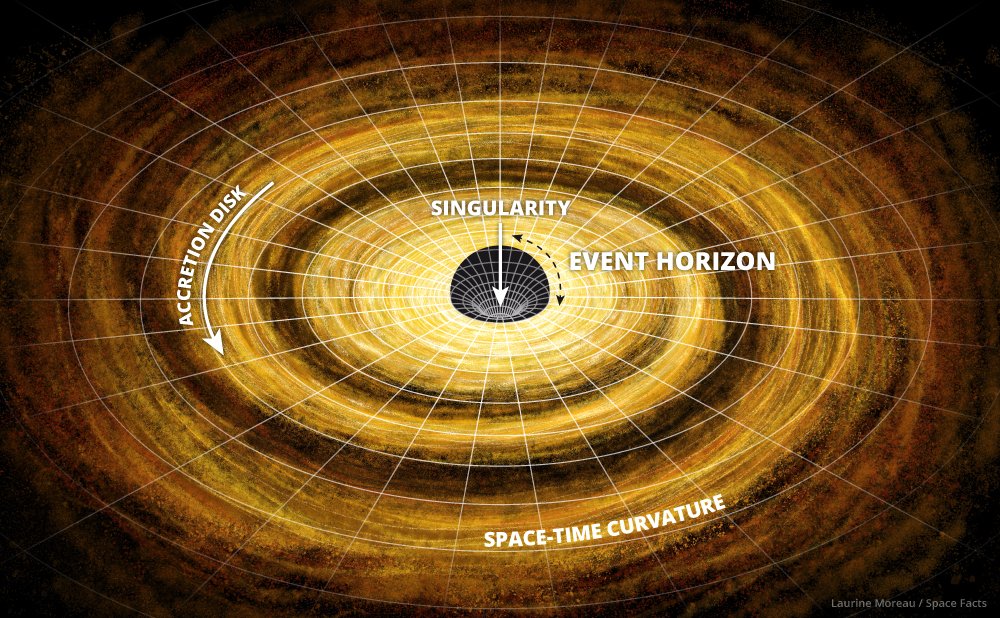
A black hole is a region in space where the gravitational pull is so strong that nothing, not even light, can escape from it. This phenomenon occurs when a massive star undergoes gravitational collapse at the end of its life cycle, resulting in an incredibly dense core. The boundary surrounding this area is known as the event horizon, which marks the point of no return for matter and radiation. Once any object crosses this threshold, it is inexorably drawn toward the event horizon and ultimately the singularity, which is the center of the black hole where density becomes infinite.
Black holes can be classified into three main types: stellar black holes, supermassive black holes, and intermediate black holes. Stellar black holes form when a massive star exhausts its nuclear fuel and collapses under its own gravity. In contrast, supermassive black holes, found at the centers of galaxies, can contain millions to billions of solar masses. The exact mechanism of their formation remains a topic of research, but they likely grew from smaller black holes over time or through the merging of stars and smaller black holes. Intermediate black holes are thought to exist in between these two extremes, although they are less understood.
The study of black holes not only helps enhance our understanding of the universe’s structure but also challenges existing laws of physics, particularly concerning general relativity. The enigmatic nature of black holes leads scientists to explore various theoretical concepts such as Hawking radiation, which suggests that black holes can emit particles and gradually lose mass. The investigation into these cosmic phenomena continues to ignite curiosity in both the scientific community and the general public, as each discovery opens new questions about the fabric of space and time.
How Are Black Holes Formed?
Black holes are fascinating astronomical phenomena characterized by their incredibly strong gravitational pull, which is so intense that nothing, not even light, can escape from them. The formation of these enigmatic entities primarily occurs through the life cycle of massive stars. When a star exhausts its nuclear fuel, it undergoes a series of transformative stages that can ultimately lead to the creation of a black hole.
The process begins when a star, significantly larger than our Sun, ends its life cycle in a dramatic explosion known as a supernova. As the core of the star collapses under the weight of its own gravity, it can become incredibly dense. If the residual mass of the core exceeds a specific threshold, known as the Tolman-Oppenheimer-Volkoff limit, it morphs into a black hole.
There are three primary types of black holes, each distinguished by their formation method and scale. The most commonly known are stellar black holes, formed from the remnants of massive stars after a supernova. They typically range in size from about three to a few tens of solar masses.
Supermassive black holes, on the other hand, are found at the centers of galaxies and possess masses equivalent to millions or even billions of solar masses. Their formation remains a topic of research, but it is believed they may have resulted from the merging of smaller black holes or the direct collapse of gas in the early universe.
Lastly, primordial black holes are hypothetical entities that may have formed shortly after the Big Bang, from dense regions in the early universe. They could vary considerably in size and mass, potentially differing significantly from their stellar and supermassive counterparts.
The Scale of Black Holes
Black holes are some of the most enigmatic objects in the universe, with a scale that often defies human comprehension. These astronomical entities greatly vary in size and mass, from stellar black holes formed from the remnants of massive stars to supermassive black holes that reside at the centers of galaxies. Understanding the scale of black holes is essential for appreciating their impact on cosmic structures and dynamics.
Stellar black holes typically range from about three to several tens of solar masses, which means they can be several times heavier than our Sun. In contrast, supermassive black holes, such as those located in the centers of galaxies, can possess masses equivalent to millions or even billions of suns. The black hole at the center of the Milky Way, known as Sagittarius A*, is a notable example. This supermassive black hole weighs approximately 4.1 million solar masses, making it a dominant force within our galaxy.
Astronomers utilize various methods to measure the size and mass of black holes, often through observations of the motions of stars and gas around them. By employing techniques such as stellar dynamics and Doppler effects, they can infer the gravitational influence exerted by the black hole, thus estimating its mass. Additionally, the Event Horizon Telescope (EHT) has provided groundbreaking images of black holes, further contributing to our understanding of their dimensions.
In summary, the scale of black holes is vast and varied, spanning stellar and supermassive categories. The methodologies employed for their measurement shed light on their magnitude and the profound role these cosmic giants play in the universe’s development. Comprehending their size allows for a greater appreciation of black holes and their significant gravitational pull that shapes galaxies.
The Effects of Black Holes on Space-Time
Black holes are one of the most intriguing phenomena in astrophysics, primarily due to their profound effects on space-time. According to Einstein’s theory of general relativity, mass curves the fabric of space-time, and a black hole, with its immensely concentrated mass, creates a distortion that is unparalleled in the universe. This warping of space-time leads to significant gravitational effects on surrounding objects, influencing both their trajectories and the optical characteristics of light.
One of the most remarkable effects of black holes on space-time is gravitational lensing. This phenomenon occurs when the intense gravity of a black hole causes the path of light emitted from distant stars or galaxies to bend around it. As a result, astronomers can observe warped or multiple images of the same astronomical object. This effect not only aids in the observation of objects behind a black hole but also provides insight into the mass and structure of the black hole itself, as the lensing effect is directly related to the mass of the gravitational field.
Furthermore, black holes can affect the motion of nearby stars and gas clouds, pulling them into a spiral motion around the event horizon, the point of no return. This interaction often results in the emission of high-energy radiation, such as X-rays, which can provide information about the nature of the black hole. The distortion of space-time not only alters the pathways of these objects but can also produce extreme tidal forces that may lead to the destruction of stars that venture too close.
Thus, the effects of black holes on space-time extend far beyond their immediate vicinity, influencing the behavior and characteristics of various celestial bodies and the trajectory of light itself. The study of these phenomena not only enhances our understanding of black holes but also contributes to a greater comprehension of the structure and evolution of the entire universe.
The Discovery of Black Holes
The concept of black holes has evolved significantly since the early 20th century, influenced heavily by advancements in theoretical physics and observational astronomy. Initially, the suggestions that such entities could exist stemmed from the equations derived from Albert Einstein’s general theory of relativity. In 1916, Karl Schwarzschild provided a solution to Einstein’s equations that hinted towards the possibility of these dense regions in space from which nothing could escape, leading to the conceptual birth of black holes.
However, it was not until the 1960s that the term “black hole” became widely known, primarily due to John Archibald Wheeler, who popularized the name in his lectures and writings. During this time, astronomers began to accumulate substantial evidence supporting the existence of black holes, particularly through the study of high-energy phenomena in space. One such milestone occurred with the discovery of quasars, which indicated the presence of massive black holes at the centers of distant galaxies, shedding light on the dynamics of these cosmic giants.
The technological advancements throughout the 20th century significantly propelled black hole research. The detection of X-ray binaries—systems where a black hole was pulling matter from a companion star—provided a crucial observational bridge linking theory to tangible evidence. The first solid candidate for a black hole, Cygnus X-1, was identified in 1964. Moreover, the detection of gravitational waves in 2015 marked a landmark achievement in astrophysics, providing direct evidence of black hole mergers and further cementing their existence as scientifically valid.
Through robust theoretical frameworks and enhanced observational capabilities, the journey toward confirming the existence of black holes showcases not only the ingenuity of numerous scientists but also the collaborative nature of scientific discovery. This intricate history continues to inspire future explorations of these mysterious features of our universe.
Myths and Misconceptions About Black Holes
Black holes, among the most enigmatic phenomena in the universe, have sparked intrigue and inspired numerous myths and misconceptions. A prevalent misconception is that black holes are cosmic vacuum cleaners, indiscriminately sucking in everything in their vicinity. While it is true that the gravitational pull of a black hole is immense, it is essential to understand that they do not actively pull in objects like a vacuum. For an object to be affected by a black hole’s gravity, it must come extremely close, much like how the gravitational pull of Earth only affects objects within a certain proximity.
Another common myth is that once something crosses the event horizon—the point of no return—it is lost forever. This notion paints a dramatic, yet inaccurate picture of black holes. While it is true that escaping from within this boundary is impossible for traditional matter, it does not imply that information is irretrievably lost. According to theoretical physicist Stephen Hawking, black holes can emit radiation due to quantum effects, a phenomenon known as Hawking radiation, which suggests that black holes could potentially lose mass and information over time.
Popular media often depicts black holes as destructive forces, swallowing entire stars or planets in a matter of seconds. Such dramatizations contribute to a general misunderstanding of their actual effects. In reality, while black holes can indeed consume surrounding matter, they generally do so at a much slower rate, often over millions of years, and under specific conditions. Furthermore, the existence of supermassive black holes at the centers of galaxies does not inherently lead to the obliteration of the entire galaxy but rather serves to stabilize the orbital motions of stars around them.
These misconceptions stem from both a lack of public understanding and sensationalized portrayals in film and literature. Educating the public about the actual science surrounding black holes is crucial to demystify these cosmic giants and foster a more profound appreciation of their role in the universe.
Observing Black Holes
Black holes, by their very nature, present unique challenges for astronomers attempting to study them. Traditional observational methods that rely on visible light become futile because black holes do not emit light detectable by conventional means. Instead, astronomers rely on indirect techniques to infer their presence and study their properties. Radio telescopes and space observatories play critical roles in this quest, allowing scientists to observe phenomena related to black holes, rather than the objects themselves.
The Event Horizon Telescope (EHT) is a remarkable example of modern technology used to observe black holes. This global network of radio telescopes was designed specifically to capture images of the shadow of a black hole against the backdrop of glowing gas and radiation. A significant milestone in this area was achieved in April 2019 when the EHT collaboration released the first-ever image of a black hole located in the center of the galaxy M87. This groundbreaking achievement provided empirical evidence supporting the existence of black holes and confirmed various predictions based on Einstein’s theory of general relativity.
To gather such an image, the EHT utilized a technique known as very long baseline interferometry (VLBI), which combines measurements from multiple radio observatories scattered across the globe. This collaboration allows astronomers to create a virtual Earth-sized telescope capable of achieving the precision necessary to observe the subtle gravitational effects near a black hole. The image generated is not of the black hole itself but of the accretion disk surrounding it, highlighting the event horizon—the point of no return for matter and light.
Future observations using EHT and advancements in telescope technology promise to provide further insights into the characteristics and behaviors of black holes. These observations will not only deepen our understanding of these enigmatic entities but also explore the fundamental laws of physics under extreme conditions.
The Role of Black Holes in the Universe
Black holes play a significant role in the evolution of the universe and the dynamics of galaxies. Their immense gravitational pull impacts both the formation of stars and the development of galactic structures. To understand their contributions, we must first consider the influence of supermassive black holes, which reside at the centers of most large galaxies, including our Milky Way.
Supermassive black holes are believed to have a profound effect on galaxy formation. As matter falls toward a black hole, it forms an accretion disk, which can lead to the release of vast amounts of energy in the form of radiation. This energy can, in turn, affect star formation rates in the surrounding regions and help regulate the growth of galaxies. Consequently, the presence of a black hole can either stimulate or inhibit the formation of new stars, determining the evolutionary trajectory of the galaxy.
Furthermore, black holes influence the distribution of matter within galaxies. Their gravitational interactions can lead to the redistribution of stars and gas. These dynamics are particularly evident in active galactic nuclei, where the intense energy output from material falling into a black hole can cause powerful winds and jets. Such phenomena can initiate feedback processes, altering the composition and dynamics of the galaxy.
Additionally, black holes can serve as cosmic engines, driving large-scale structures such as galaxy clusters. Their interactions with dark matter and ordinary matter contribute to the large-scale structure of the universe. Through these varied mechanisms, black holes are not mere endpoints of stellar evolution; they are pivotal to our understanding of cosmic behavior and the development of the universe as a whole.
Future Research and Mysteries of Black Holes
The study of black holes represents one of the most intriguing areas of modern astrophysics, raising numerous questions that remain unanswered. One of the primary mysteries is the relationship between black holes and quantum mechanics, particularly how these two fundamental aspects of physics coexist. Theories suggest that the extreme conditions near black holes may provide crucial insights into the fabric of spacetime and the fundamental laws that govern the universe.
Another pivotal concept in black hole research is Hawking radiation, a theoretical prediction made by physicist Stephen Hawking. According to this theory, black holes emit radiation due to quantum effects near the event horizon. This phenomenon hints at a potential mechanism for black holes to lose mass and eventually evaporate, yet direct evidence of Hawking radiation has yet to be observed. Future studies are expected to focus on detecting this elusive radiation, which could deepen our understanding of black hole physics and the principles underpinning quantum gravity.
As technological advances in observational tools continue to progress, researchers are keen to explore the enigmatic dynamics surrounding supermassive black holes located at the centers of galaxies. These investigations may uncover more about their formation, growth, and their role in galaxy evolution. Advanced telescopes, such as the Event Horizon Telescope, are already shedding light on these distant cosmic giants, providing unprecedented imaging capabilities that could answer longstanding questions about their properties.
The future of black hole research is full of potential, from exploring the interface between gravity and quantum mechanics to uncovering the mysteries surrounding gravitational waves emitted during black hole mergers. The combination of theoretical advancements and observational breakthroughs will undoubtedly advance our knowledge of these fascinating cosmic objects.