
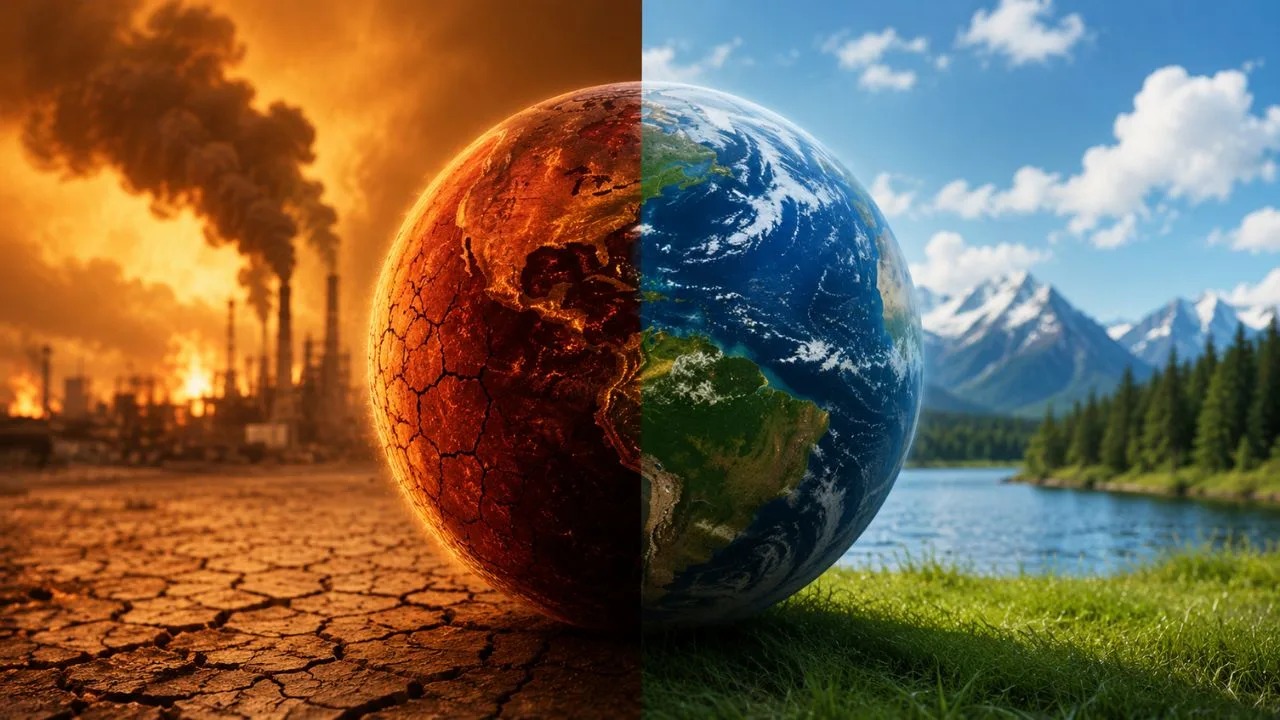

Climate change and global warming are closely related terms, but they do not have exactly the same meaning. Global warming describes the long-term increase in Earth’s average surface temperature, while climate change includes that warming and the wider changes it causes throughout the climate system.
Those wider changes include rising sea levels, warming oceans, melting glaciers, declining ice cover, shifting rainfall patterns, changing seasons, and increasing risks from some types of extreme weather. In simple terms, global warming is one major part of climate change, while climate change is the broader environmental story.
Scientists use both expressions because they describe different but connected aspects of the same problem. Temperature is a central indicator, but focusing only on global temperature can hide important effects involving water, ecosystems, food production, coastlines, human health, infrastructure, and local weather patterns.
The distinction has become increasingly relevant. The World Meteorological Organization reported that 2015 through 2025 were the hottest 11 years on record and that 2025 was approximately 1.43°C warmer than the 1850–1900 average, ranking as the second or third warmest year in major datasets.
The Difference Between Global Warming and Climate Change in Simple Words
Global warming means Earth is becoming warmer over the long term. Scientists measure this change using temperature observations collected over land, across the ocean, and through several independent monitoring systems. The term usually refers to the warming caused primarily by increasing concentrations of human-produced greenhouse gases.
Climate change means long-term changes in the wider climate system. These changes can involve temperature, rainfall, snowfall, drought, ocean conditions, sea level, ice, ecosystems, and the frequency or intensity of some extreme events. Climate change therefore includes global warming but is not limited to temperature.
A helpful comparison is to think of global warming as the increase in the planet’s temperature and climate change as the consequences and interconnected changes associated with that additional heat. The warming influences the atmosphere, land, oceans, glaciers, ice sheets, and living systems.
The terms are often used interchangeably in everyday conversation because today’s global climate change is being driven largely by human-caused warming. Scientifically, however, “climate change” provides the more complete description of what is happening across Earth’s interconnected systems.
What Is Global Warming?
Global warming is the long-term rise in Earth’s average surface temperature. It does not mean that every location becomes warmer every day or that winters immediately disappear. It describes a change in the global average measured across many regions and over a sufficiently long period.
The current warming trend began becoming particularly clear during the industrial era, when human societies started burning much larger quantities of coal, oil, and natural gas. These activities release carbon dioxide and other greenhouse gases that trap additional heat in the climate system.
Global warming is measured using more than one thermometer or research organization. NASA, NOAA, and other scientific institutions independently analyze land and ocean observations. Although their exact yearly rankings may differ slightly because of methodology, they show the same clear long-term warming trend.
The global average may sound abstract, but even a seemingly small increase represents an enormous addition of heat across the atmosphere, ocean, land, and ice. That extra energy changes evaporation, rainfall, heat extremes, ocean conditions, ice loss, and many other parts of Earth’s climate.
What Is Climate Change?
Climate change is a significant and lasting change in average climate conditions or their variability. It can involve temperature, rainfall, wind, humidity, snow, sea ice, ocean circulation, and the occurrence of extreme conditions over several decades or longer.
Earth’s climate has changed naturally throughout its history. Volcanic eruptions, changes in solar energy, shifting continents, variations in Earth’s orbit, and internal ocean-atmosphere patterns have influenced past climates on different timescales. The existence of natural climate change does not explain the cause of every modern trend.
Today, the expression usually refers to rapid, human-caused climate change resulting primarily from greenhouse gas emissions. The IPCC has concluded that human influence has unequivocally warmed the atmosphere, ocean, and land, causing widespread changes throughout the climate system.
Climate change is broader than warming because a warmer planet does not produce identical conditions everywhere. Some regions may experience heavier rainfall, while others face increased drought risk. Certain areas may warm faster, and local natural variability can temporarily strengthen or weaken regional trends.
How Global Warming Causes Wider Climate Change
The climate system is driven partly by the movement of energy. When additional greenhouse gases trap more heat, the increase does not remain evenly distributed near the surface. Much of the excess energy enters the ocean, while other portions affect the atmosphere, land, and frozen regions.
Warmer air can hold more water vapor, affecting the water cycle and creating conditions that can increase heavy precipitation. Higher temperatures also increase evaporation in many locations, which can dry soils and worsen heat or drought under suitable regional conditions.
Ocean warming contributes to sea-level rise because seawater expands as it becomes warmer. Melting mountain glaciers and ice sheets add more water to the ocean, creating long-lasting risks for coastal communities, infrastructure, ecosystems, and freshwater supplies.
Global warming therefore operates as a major driving force behind modern climate change. The increase in average temperature begins a chain of physical and biological responses, which is why scientists use a broader term when discussing the complete range of consequences.
Climate Change vs. Global Warming: Key Differences
The first difference concerns scope. Global warming refers specifically to rising global average temperature, while climate change covers changes in temperature, precipitation, sea level, oceans, ice, ecosystems, seasons, and extreme-event risks.
The second difference concerns how the terms are measured. Global warming is commonly tracked through global temperature datasets, while climate change is monitored using many indicators, including ocean heat, atmospheric greenhouse gases, sea level, glacier mass, sea ice, rainfall, and ecosystem changes.
The third difference concerns communication. “Global warming” emphasizes additional planetary heat, while “climate change” helps explain why that heat can produce different regional outcomes. A warmer world can experience heavier rainfall in one area, water shortages in another, and shifting seasonal patterns elsewhere.
The final difference concerns the relationship between the terms. Global warming is not separate from climate change or an alternative scientific theory. It is the temperature-related component and primary driver of the broader human-caused climate changes currently being observed.
Weather and Climate Are Not the Same Thing
Weather describes short-term atmospheric conditions at a particular time and place. It includes today’s temperature, rain, snow, wind, humidity, storms, and cloud cover. Weather can change within minutes, hours, or days.
Climate describes the typical range and pattern of weather observed over a much longer period, commonly 30 years or more. It includes averages, seasonal patterns, variability, and extremes that help describe what conditions are normally expected in a particular place.
One cold day is therefore a weather event, not evidence that global warming has stopped. In the same way, one extremely hot afternoon cannot by itself prove long-term climate change. Scientists examine patterns across large areas, many measurements, and extended periods.
Climate change shifts the background conditions within which weather occurs. It can change the likelihood, intensity, duration, or scale of certain events, even though natural variability continues to influence the weather experienced on any individual day.
What Causes Current Global Warming?
The main cause of current global warming is the increase in heat-trapping greenhouse gases produced by human activity. The most important long-lived greenhouse gas emitted by people is carbon dioxide, although methane, nitrous oxide, and several industrial gases also contribute.
Burning coal, oil, and natural gas for electricity, heating, transport, manufacturing, and other activities releases carbon dioxide. Deforestation and land-use changes can add emissions while also reducing the capacity of forests and ecosystems to absorb atmospheric carbon.
Agriculture, fossil-fuel production, waste, and livestock contribute significant methane emissions. Fertilizer use and other agricultural or industrial processes release nitrous oxide. These gases influence Earth’s energy balance by slowing the escape of heat into space.
The IPCC concluded that human activities, principally through greenhouse gas emissions, unequivocally caused global warming. It estimated that global surface temperature during 2011–2020 was approximately 1.1°C above the 1850–1900 level.
Understanding the Greenhouse Effect
The greenhouse effect is a natural process that makes Earth warm enough to support life. Certain gases in the atmosphere absorb and re-emit heat that would otherwise escape more directly into space, helping maintain a habitable surface temperature.
The problem is not that the greenhouse effect exists. The problem is that human activities are strengthening it by increasing the concentration of heat-trapping gases. This enhanced greenhouse effect causes additional warming beyond natural background conditions.
Carbon dioxide can remain influential in the climate system for very long periods, which is why accumulated emissions matter. Methane remains in the atmosphere for a shorter period than carbon dioxide but traps substantially more heat per unit over relevant timescales.
Water vapor is also an important greenhouse gas, but it generally acts as a feedback rather than the initial driver of present warming. As the atmosphere and oceans warm, evaporation increases atmospheric water vapor, which can amplify the original warming.
Is Current Climate Change Natural or Human-Caused?
Natural factors continue to influence climate. Volcanic eruptions can temporarily cool the planet by adding reflective particles to the atmosphere, while ocean patterns such as El Niño and La Niña redistribute heat and affect temperature and rainfall from year to year.
Solar energy also varies, but observations show that recent global warming cannot be explained by changes in the Sun. The expected atmospheric pattern from stronger solar output differs from the observed pattern associated with increasing greenhouse gases.
Climate models can reproduce the major long-term warming trend only when human influences are included. Natural factors alone cannot account for the scale and pattern of warming observed since the mid-20th century.
The scientific conclusion does not deny natural climate variability. Instead, it recognizes that natural variability now operates on top of a strong human-caused warming trend. It can temporarily accelerate, slow, or rearrange warming without removing its underlying cause.
What Evidence Shows the Planet Is Warming?
Temperature records provide one major line of evidence, but the scientific conclusion does not depend on temperature alone. Independent datasets show long-term warming across global land and ocean surfaces, with recent decades substantially warmer than earlier periods.
The ocean has absorbed most of the additional heat accumulated within the climate system. NOAA reported that upper-ocean heat content reached a record level in 2025, even though natural conditions influenced the exact ranking of surface temperature that year.
Other evidence includes rising global sea level, retreating mountain glaciers, loss of ice from Greenland and Antarctica, declining Arctic sea ice, changing snow cover, ocean acidification, and shifts in biological and seasonal patterns.
Scientists also examine physical fingerprints that help identify causes. The observed patterns across the atmosphere, ocean, land, and frozen regions align with the expected effects of higher greenhouse gas concentrations rather than with solar changes or another single natural explanation.
Climate Change Includes Ocean Warming and Sea-Level Rise
The ocean is central to climate change because it stores an enormous amount of heat. Ocean warming influences marine ecosystems, coral reefs, fisheries, sea ice, storms, oxygen levels, and the distribution of many marine species.
Sea level rises when warming water expands and when glaciers and ice sheets lose mass. The amount of rise varies by location because of ocean circulation, land movement, gravity, and regional processes, but the long-term global trend is upward.
Higher sea levels increase the baseline from which tides and storm surges operate. This means coastal flooding can become more frequent or severe even when a particular storm is not stronger than historical storms.
Sea-level change is also long-lasting. The IPCC reports that sea level will continue rising for centuries to millennia because of deep-ocean warming and ice-sheet responses, although the eventual amount depends strongly on future warming.
Climate Change Includes Melting Ice and Changing Snow
Mountain glaciers are retreating in many regions, affecting landscapes, ecosystems, tourism, and the seasonal water supplies used by communities, agriculture, and hydropower. Glacier loss is one of the visible consequences included within the broader meaning of climate change.
Greenland and Antarctica contain enough frozen water to influence global sea level substantially. Their response unfolds across different timescales, but continued warming raises the risk of greater and potentially irreversible ice loss.
Arctic sea ice floats on the ocean and does not directly raise sea level when it melts. However, its decline reduces the bright surface that reflects sunlight, alters ecosystems, and contributes to further regional warming through an important climate feedback.
Snow cover and permafrost are also changing. The IPCC has assessed reductions in snow cover and permafrost alongside increasing hot extremes, heavy precipitation, and marine heatwaves as part of the wider observed and projected climate response.
Does Climate Change Cause Extreme Weather?
Climate change does not create every storm, flood, wildfire, heatwave, or drought from nothing. Extreme events have always occurred because of natural atmospheric and ocean processes, and no two events have exactly the same combination of causes.
However, global warming can alter the background conditions that shape extremes. It has already increased the frequency and intensity of hot extremes, and it can influence heavy rainfall, drought risk, fire weather, marine heatwaves, and coastal flooding in regionally specific ways.
Scientists use extreme-event attribution to estimate how climate change affected the probability or intensity of a particular event. Rather than asking whether climate change was the event’s only cause, researchers examine how the event differs from what might have occurred in a cooler world.
The answer depends on the event type and location. The influence is especially clear for heat extremes, while hurricanes, floods, droughts, and wildfires involve several interacting factors, including natural variability, land management, development, infrastructure, and exposure.
Why Can Global Warming Produce Heavy Snow or Cold Spells?
Global warming describes the worldwide long-term average, not the elimination of cold weather. Earth’s atmosphere continues to circulate heat and moisture unevenly, allowing cold air outbreaks and snowstorms to occur in individual regions.
Weather varies around the rising long-term average. A warming trend can be compared with gradually raising the floor of a room while a ball continues bouncing above and below it. The ball can still move downward even though its average position becomes higher.
Snowstorms also depend on moisture as well as temperature. Air can remain cold enough for snow while containing more water vapor, creating conditions for heavy snowfall in some situations. This does not mean every snowstorm is strengthened by global warming.
The important question is whether the long-term frequency, timing, intensity, or geographical distribution of cold and snow is changing. One local winter event cannot overturn global evidence collected over many decades.
Why Scientists Use the Term “Climate Change”
“Global warming” accurately describes the rise in global average temperature, but it does not communicate every consequence. People may incorrectly assume that warming should produce a uniform temperature increase in every place, season, and year.
“Climate change” captures the broader disruption more effectively. It includes warming while recognizing effects on rainfall, drought, oceans, ice, seasons, ecosystems, agriculture, health, and extreme-event patterns.
The term also reflects how the scientific field studies the complete Earth system. Researchers examine interactions among the atmosphere, ocean, cryosphere, land, carbon cycle, and biosphere rather than analyzing surface temperature in isolation.
Using “climate change” does not mean scientists stopped believing in global warming. NASA and NOAA continue to use both terms, with global warming referring to planetary heating and climate change describing the wider range of associated changes.
What the Latest Climate Data Shows
The WMO’s State of the Global Climate 2025 report confirmed that 2015–2025 were the hottest 11 years in the observational record. It placed the 2025 global average surface temperature at approximately 1.43°C above the 1850–1900 average.
NOAA ranked 2025 as the third-warmest year in its dataset and reported record-high upper-ocean heat content. Arctic and Antarctic annual sea-ice extent both ranked among the three lowest years in the NOAA record.
The precise ranking of an individual year can vary among datasets because research groups use different analytical methods and coverage adjustments. These minor differences do not affect the conclusion that recent years are exceptionally warm within the historical record.
A single year can also be influenced by El Niño, La Niña, volcanic activity, aerosols, and other short-term factors. Long-term human-caused warming is identified through the sustained trend across multiple years and climate indicators, not through one annual record alone.
Does One Year Above 1.5°C Mean the Paris Target Has Failed?
The Paris Agreement’s temperature goal concerns limiting the long-term increase in global average temperature to well below 2°C while pursuing efforts to limit it to 1.5°C above pre-industrial levels. It is not defined by one unusually warm month or year.
An individual year can exceed 1.5°C because of the combination of long-term warming and short-term natural variability. The IPCC notes that a temporary annual temperature above a level does not necessarily mean that the corresponding long-term global warming level has been reached.
That distinction should not be used to minimize record heat. A year near or above 1.5°C demonstrates how close the climate system is to the long-term threshold and provides a preview of conditions that become more typical as average warming increases.
The difference between 1.5°C and 2°C is also meaningful. The IPCC has found that risks to ecosystems, water, health, food systems, coastlines, and human communities increase with every additional increment of global warming.
Why Half a Degree of Global Warming Matters
Half a degree may sound minor when compared with daily weather changes, but a global average represents an enormous quantity of additional heat. Local land temperatures and extreme events can change by more than the global average.
The IPCC found that heatwaves, heavy precipitation, ecosystem losses, water stress, and several other risks are greater at 2°C of warming than at 1.5°C. Some effects increase gradually, while others may accelerate or approach critical thresholds.
At higher warming levels, adaptation also becomes more difficult and less effective. Communities may face overlapping heat, water, food, health, migration, and infrastructure pressures that are harder and more expensive to manage.
Climate policy therefore does not operate through a simple safe-versus-dangerous switch. Every fraction of a degree avoided can reduce future damage, exposure, disruption, and the risk of irreversible changes.
Climate Change Impacts People Unequally
Climate change is global, but its risks are not distributed evenly. Geography, income, age, health, occupation, infrastructure, governance, and access to resources influence how severely a person or community is affected.
People living in low-lying coastal areas may face flooding and saltwater intrusion, while farmers may experience changing rainfall or heat stress. Outdoor workers, older adults, children, and people with existing health conditions can face greater risks during extreme heat.
The IPCC estimated that approximately 3.3 to 3.6 billion people live in contexts highly vulnerable to climate change. Vulnerability is often greatest where climate hazards interact with poverty, conflict, inequality, weak services, or dependence on climate-sensitive livelihoods.
Historical responsibility is also unequal. Regions and groups have contributed different amounts to accumulated greenhouse gas emissions, while many communities that contributed relatively little can face substantial losses and limited adaptation resources.
What Is Climate Change Mitigation?
Climate change mitigation means reducing greenhouse gas emissions or increasing the removal of greenhouse gases from the atmosphere. Its purpose is to limit future global warming and reduce the scale of long-term climate risks.
Mitigation can include replacing fossil-fuel energy with low-carbon sources, improving energy efficiency, electrifying transport and heating, reducing methane emissions, protecting forests, changing industrial processes, and improving land management.
Carbon dioxide emissions are especially important because their cumulative total largely determines long-term warming. Reaching net-zero carbon dioxide means balancing remaining human-caused carbon emissions with durable removals.
Mitigation does not reverse every effect immediately. Some processes, particularly sea-level rise, respond over much longer periods. However, rapid and sustained emissions reductions can limit future warming and reduce the severity of many projected impacts.
What Is Climate Change Adaptation?
Climate adaptation means adjusting human and natural systems to actual or expected climate impacts. Its purpose is to reduce harm, manage risk, strengthen resilience, and make communities better prepared for changing conditions.
Examples include heat-health plans, flood defenses, drought-resistant crops, improved drainage, water conservation, early-warning systems, wildfire planning, climate-resilient infrastructure, and restoring protective coastal ecosystems.
Adaptation and mitigation serve different but complementary purposes. Mitigation limits how much the climate changes, while adaptation helps people and ecosystems manage changes that are already occurring or can no longer be avoided.
Adaptation has limits. The IPCC reports that its effectiveness generally decreases as warming and climate risks increase. Delayed mitigation can therefore create conditions that become increasingly costly, difficult, or impossible to adapt to successfully.
Can Climate Change Still Be Limited?
Future warming depends strongly on future greenhouse gas emissions. The climate is not controlled by one predetermined outcome; choices involving energy, transport, buildings, industry, agriculture, land, and consumption influence the level of additional warming.
The IPCC has found that deep, rapid, and sustained emissions reductions would produce discernible changes in greenhouse gas concentrations and air quality within years, followed by detectable differences in warming trends over time.
Some climate changes are already unavoidable or effectively irreversible for people alive today, particularly aspects of sea-level rise and ecosystem loss. That does not make action pointless because the severity of future impacts still differs greatly between lower- and higher-emission pathways.
The practical message is neither that everything is easily reversible nor that nothing can be improved. Every reduction in warming lowers certain risks, and every well-designed adaptation measure can help protect people, infrastructure, economies, and ecosystems.
What Individuals, Businesses, and Governments Can Do
Individuals can reduce emissions through choices involving energy, transport, food, products, and waste, especially when affordable alternatives are available. They can also prepare for local heat, flooding, storms, or water risks and support community resilience.
Businesses can measure and reduce operational and supply-chain emissions, improve efficiency, protect workers, assess physical climate risks, and avoid misleading environmental claims. Climate planning should be connected to financial, operational, and customer decisions rather than treated only as a public-relations exercise.
Governments have broader influence over electricity systems, transport networks, buildings, industrial standards, land use, research, emergency planning, public health, and infrastructure. Policy can make lower-carbon and climate-resilient choices more affordable and accessible.
Effective action requires both mitigation and adaptation. Personal decisions matter, but large-scale emissions and resilience are also shaped by institutions, technologies, investments, regulations, urban planning, and the availability of public services.
Common Myths About Climate Change and Global Warming
The first myth is that scientists replaced “global warming” with “climate change” because warming stopped. Both terms have long-standing scientific meanings and continue to be used because one describes temperature rise while the other describes the wider consequences.
The second myth is that one cold winter disproves global warming. Weather varies from day to day and year to year, while global warming is identified through long-term averages and many independent indicators across the planet.
The third myth is that climate has always changed, so humans cannot be responsible now. Natural climate change is real, but scientists identify causes using observations, physical mechanisms, climate models, and distinctive fingerprints. Current warming cannot be explained by natural influences alone.
The fourth myth is that nothing can be done because some change is already unavoidable. Climate risks escalate with each additional increment of warming, meaning that reducing emissions and strengthening adaptation can still prevent substantial future harm.
Final Thoughts on Climate Change vs. Global Warming
Global warming is the long-term increase in Earth’s average temperature, driven today mainly by human greenhouse gas emissions. It is a specific and measurable part of the larger climate problem.
Climate change includes global warming and the many connected changes occurring throughout the atmosphere, ocean, land, ice, ecosystems, and water cycle. Rising seas, glacier loss, changing rainfall, ocean warming, and shifting extreme-event risks all belong to the broader concept.
Understanding the terminology makes climate information easier to interpret. A cold day does not disprove warming, one heatwave does not establish a global trend, and one warm year does not independently define a long-term climate threshold.
The clearest summary is simple: global warming describes the rise in planetary temperature, while climate change describes the warming and everything it changes. Both terms remain scientifically valid, but climate change provides the more complete picture.
Frequently Asked Questions
1. Are climate change and global warming the same thing?
Not exactly. Global warming is the long-term rise in Earth’s average temperature, while climate change includes that warming and wider changes involving rainfall, oceans, ice, sea level, ecosystems, and weather patterns.
2. Is global warming causing climate change?
Yes. Current human-caused global warming is the primary driver of today’s broader climate changes. Additional heat affects the atmosphere, oceans, water cycle, glaciers, ice sheets, ecosystems, and sea level.
3. Does cold weather disprove global warming?
No. Cold weather is a short-term local condition, while global warming is a worldwide long-term trend. Natural weather variability continues even as the average global temperature rises.
4. What is the main cause of modern climate change?
The main cause is human greenhouse gas emissions, particularly from burning coal, oil, and natural gas. Deforestation, agriculture, industry, and land-use changes also contribute.
5. Why does the difference between 1.5°C and 2°C matter?
Climate risks increase with every fraction of additional warming. At 2°C, many heat, water, ecosystem, coastal, and human-health impacts are projected to be more severe than at 1.5°C.