
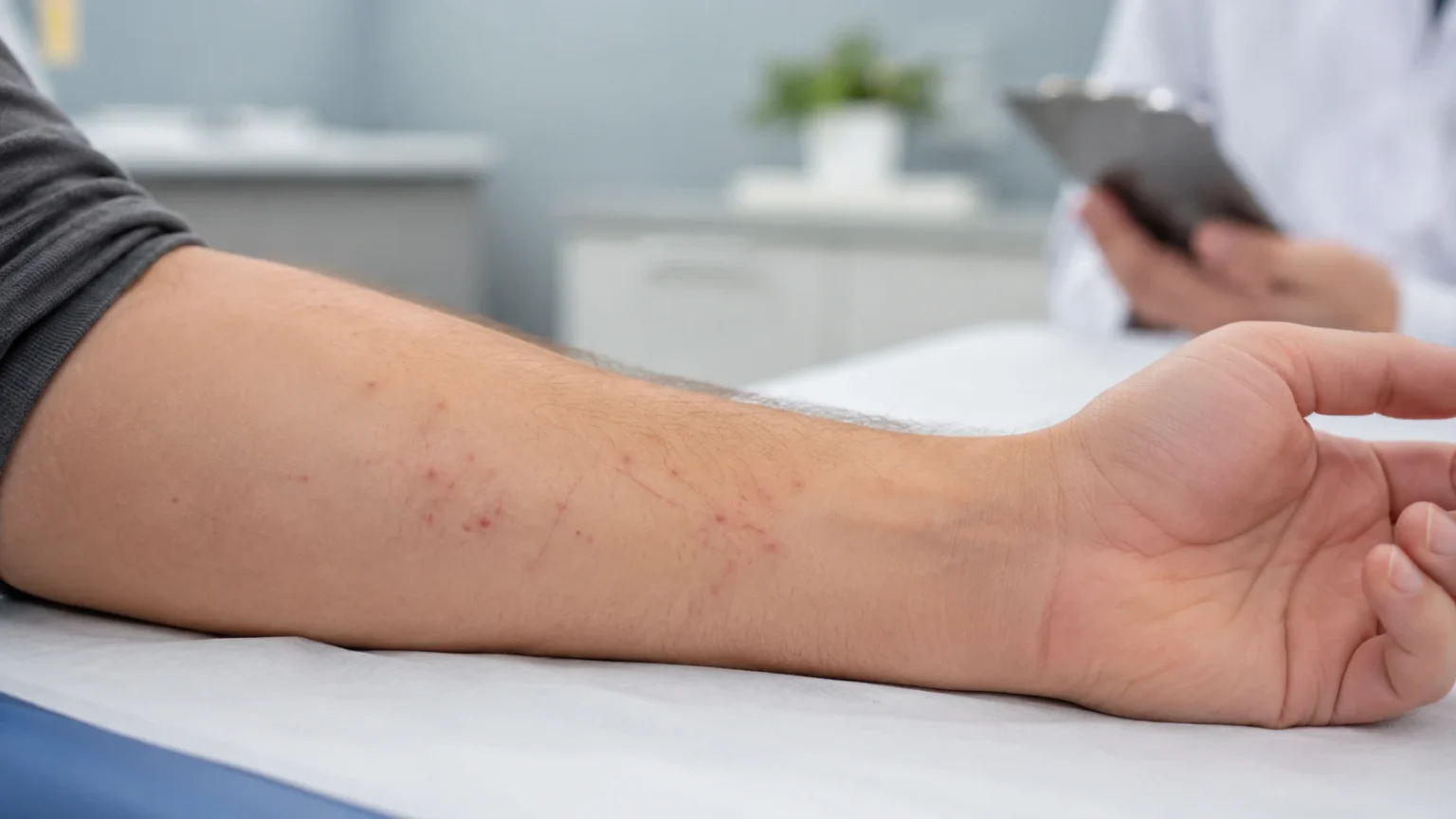

Scabies Pictures: What the Rash Looks Like
What Scabies Pictures Can Help You Recognize
Scabies pictures can help you recognize the common signs of this contagious skin condition, including tiny bumps, intense itch, scratch marks, and narrow burrow-like lines. The rash is caused by microscopic Sarcoptes scabiei mites that tunnel into the outer layer of skin. Your body reacts to the mites, their eggs, and their waste products, which causes the itching and inflammation. Photos may show a pimple-like rash, short wavy lines, small blisters, or crusted areas, depending on the form of scabies. However, many skin conditions can look similar in a picture. A healthcare professional should confirm the diagnosis before you assume an itchy rash is scabies.
One of the most common symptoms of scabies is severe itching that becomes worse at night. This nighttime itch can be an important clue, but it is not unique to scabies. Eczema, allergic reactions, dry skin, bedbug bites, and other rashes can also itch intensely. The combination of itching, a rash in typical body locations, and close contact with someone who is also itchy makes scabies more likely. Pictures are most useful when they are viewed alongside symptoms and exposure history. If you only compare color or one bump, it is easy to misdiagnose yourself.
Scabies rash can look different at different stages. Early on, you may notice only a few itchy bumps or a faint line between the fingers. After days or weeks of scratching, the skin may become red, darker, scabbed, thickened, or irritated. A secondary bacterial infection can sometimes develop in skin that has been repeatedly scratched. This can make the original rash harder to recognize in photos. If you see yellow crusting, increasing pain, warmth, swelling, pus, or fever, contact a healthcare professional promptly.
Skin tone also affects how scabies appears. On lighter skin, bumps or inflamed patches may look pink, red, or salmon-colored. On brown or Black skin, redness can be less obvious and may look purple, gray, dark brown, or deeper than the surrounding skin. The rash may be easier to feel than to see, especially when it consists of tiny raised bumps. Scratching can create visible dark marks, thickened skin, or areas of color change over time. A good scabies image guide should show multiple skin tones rather than suggesting that every rash appears bright red.
It is important to remember that scabies is not caused by poor hygiene. Anyone can get it through close, prolonged skin-to-skin contact, regardless of cleanliness, age, income, or background. The mites are very small and cannot be seen easily with the naked eye. You may have scabies even if your home is clean and you bathe regularly. Understanding this can reduce shame and encourage faster treatment. The earlier scabies is recognized and treated correctly, the easier it is to stop it from spreading to close contacts.
Classic Scabies Rash Pictures: Bumps, Burrows, and Scratch Marks
Classic scabies often appears as many small itchy bumps that may resemble pimples, tiny insect bites, or an allergic rash. These bumps are medically called papules and can occur in clusters or spread across several areas of the body. In photos, they may look red, pink, purple, brown, gray, or skin-colored depending on the person’s skin tone. The bumps may be smooth or scabbed over from repeated scratching. They can be easy to miss when the skin is dry, darkly pigmented, or already affected by eczema. Touching the skin may reveal more texture than a picture shows.
Burrows are one of the most recognizable scabies signs. They are short, thin, irregular, wavy lines that form when a female mite tunnels just beneath the skin surface. A burrow may look grayish, skin-colored, dark, reddish, or slightly raised. In some images, there may be a tiny dark dot at one end, but this is not always visible. Burrows are most often found between the fingers, on the sides of the hands, around the wrists, and on the feet. They can be subtle, so not seeing one does not rule out scabies.
Scratch marks are another common feature in scabies pictures. Because the itch can become intense at night, people may scratch while asleep or without realizing how much they are doing it. This can cause linear marks, broken skin, bleeding spots, scabs, and thickened patches. The rash may then look more like dermatitis or eczema than a typical scabies eruption. Scratching does not spread the mites through the body, but it can damage the skin barrier and raise the risk of bacterial infection. Keeping nails short can help reduce skin injury while you are waiting for diagnosis and treatment.
Classic scabies does not usually cause one large, uniform patch. Instead, the rash tends to appear in multiple small areas, particularly where the skin is thin, folded, or in close contact with other skin. You may see bumps on the hands and wrists while also noticing itch around the waist, buttocks, armpits, or genitals. This distribution is often more informative than the exact appearance of one lesion. A healthcare professional will examine several areas rather than focusing only on the place that feels itchiest. Sharing the full pattern helps them distinguish scabies from other itchy skin conditions.
The Centers for Disease Control and Prevention lists intense nighttime itching and a pimple-like rash as common scabies symptoms. Typical sites include the spaces between fingers and skin folds around the wrists, elbows, knees, and armpits. The rash can also appear on the waist, buttocks, shoulder blades, nipples, or penis. CDC scabies guidance explains that even people without symptoms may spread scabies. That is why a possible scabies rash should be assessed promptly rather than watched for weeks without a plan.
Where Scabies Rash Usually Appears on the Body
The hands are one of the most common places to see scabies. Pictures often show bumps or burrows in the web spaces between the fingers, along the sides of the fingers, around the knuckles, or on the wrists. These areas are frequently affected because the mites favor thin skin and because close contact often involves hands. Itching between the fingers is not proof of scabies, but it is a useful clue when combined with nighttime itch and affected household members. Look at both hands rather than only one spot. The rash can be uneven, but it often appears in more than one typical location.
The wrists, elbows, armpits, waistline, and lower abdomen are also common scabies sites. You may notice clusters of bumps where clothing rubs, where skin folds, or around areas that stay warm. The rash can look like small bites, rough patches, or scattered pimples. In some people, the skin may become dry and eczematous because of the body’s allergic reaction to the mites. This can make scabies look less like textbook photos. If the rash keeps spreading or becomes more itchy at night, make an appointment for evaluation.
Scabies can affect the buttocks, groin, genitals, nipples, and skin around the waist. These areas may be embarrassing to discuss, but they are medically important because they are typical places for scabies lesions. In adults, itchy nodules or bumps on the penis or scrotum can be a particularly useful diagnostic clue. Genital itching can also have many other causes, including fungal infections, dermatitis, sexually transmitted infections, and irritation from products. Do not rely on online images to decide what the cause is. A clinician can examine the area respectfully and recommend the correct treatment.
The head and neck are less commonly involved in healthy adults and older children. However, scabies can affect the scalp, face, neck, palms, and soles in infants and very young children. Older adults, people who are bed-bound, and people with weakened immune systems may also have a less typical distribution. In babies, the rash can include small blisters, bumps, or pustules on the hands and feet. This can be confusing because childhood rashes have many causes. Any infant with a widespread itchy rash should be assessed by a pediatric clinician rather than treated from an online checklist.
Scabies may be difficult to recognize when someone has eczema, psoriasis, very dry skin, or another chronic skin condition. Existing rashes can mask the small bumps and burrows, while scratching can make everything look more inflamed. This is one reason clinicians often ask whether anyone else in the household, close friend group, care setting, or sexual network has similar itching. The rash pattern and contact history can be as valuable as the picture itself. If you suspect scabies, take clear photos for a clinician before applying multiple creams. This can help preserve information that may support an accurate diagnosis.
Scabies Pictures on Different Skin Tones
Scabies can affect people of every skin tone, but online image results do not always show this clearly. On lighter skin, the rash may look red, pink, or inflamed, making bumps and scratch marks easier to notice. On darker skin, the same inflammation may appear purple, gray, dark brown, or slightly different from the surrounding skin. Sometimes the most obvious sign is texture rather than color. You may feel tiny rough bumps, raised lines, or thickened areas even when the redness is subtle. This is why touch, location, and itch pattern matter as much as appearance.
In brown or Black skin, scabies-related itching may lead to post-inflammatory hyperpigmentation after bumps heal. These darker marks can remain long after the active infestation is treated. They can be mistaken for new bites or a sign that treatment failed, even when the mites are gone. New bumps, new burrows, or itch that continues to worsen are more concerning than fading color changes alone. A clinician can help distinguish ongoing scabies from normal healing, eczema, or another condition. Be patient with color changes, as they often fade more slowly than the itch itself.
Pictures may also underrepresent scabies in people with very dry skin, eczema, or chronic scratching. In these cases, the rash can look diffuse, flaky, cracked, or thickened instead of showing obvious individual bumps. This is sometimes called scabies-associated dermatitis, which occurs because the body reacts to the mites and their products. You may notice that usual eczema treatment is not working or that others around you have started itching too. These clues should raise suspicion for scabies. Do not assume a stubborn itchy rash is simply dry skin if the pattern or household history suggests otherwise.
When looking for scabies images, seek educational sources that label the body location, skin tone, and stage of the rash. A single close-up photo without context can be misleading. It may show a severe case, a scratched lesion, an infant rash, or crusted scabies rather than the more common form. Images should help you understand possibilities, not encourage you to compare every bump to one exact picture. A clinician can use examination, dermoscopy, or skin scraping when needed to confirm the diagnosis. Diagnosis is often based on the overall pattern rather than one perfectly visible burrow.
The NHS notes that scabies spots may be harder to see on brown or Black skin, although the bumps can still be felt. It also emphasizes that intense itching and a raised rash are common signs. NHS scabies information can help you understand typical symptoms and treatment basics. If a rash is affecting sleep, spreading through close contacts, or causing broken skin, seek medical advice regardless of its color. Your symptoms are valid even if the rash does not match a picture exactly.
Scabies in Babies, Children, and Older Adults
Scabies can look different in babies and young children than it does in healthy adults. Infants may develop bumps, blisters, pustules, or scaling on the palms, soles, scalp, face, neck, and body. These locations are less typical in adults, which can lead caregivers to miss the possibility of scabies. Babies may be fussy, sleep poorly, scratch or rub their skin, or seem uncomfortable without being able to describe the itch. A rash in an infant should always be assessed carefully because many childhood skin conditions can look alike. Do not use adult scabies products on a baby without pediatric guidance.
Children may develop itchy bumps on the hands, wrists, elbows, waist, buttocks, and feet. They can also get scratch marks, crusting, or secondary skin infections because it is difficult for them to stop scratching. School-age children may be embarrassed to mention itching, especially if the rash involves the groin, buttocks, or hands. Caregivers should use calm, non-shaming language and explain that scabies is common and treatable. It is not caused by being dirty or doing anything wrong. Quick treatment helps protect the child and reduces spread to siblings, friends, and caregivers.
Older adults may have less typical scabies symptoms, particularly if they have mobility limitations, live in a care setting, or have a weakened immune system. The itch may be mild, absent, or difficult to report in some cases. Rash distribution can include the scalp, neck, back, or other areas that are less common in younger adults. Skin may already be fragile, dry, or affected by other conditions, making the rash harder to identify. Care teams should consider scabies when several residents or staff members develop new itching. Delayed recognition can contribute to outbreaks in long-term care facilities.
People with weakened immune systems may be at higher risk for crusted scabies, a severe and highly contagious form. Unlike classic scabies, crusted scabies can cause thick, flaky, grayish, or yellowish crusts that crumble easily. It may involve the hands, feet, scalp, back, or large areas of skin. Itch may be less intense or even absent, which makes the condition easier to miss. Because there can be a very large number of mites, it can spread more easily than classic scabies. Urgent medical treatment is needed to protect the person and prevent an outbreak.
Family members and close contacts often need treatment at the same time, even if they have no symptoms yet. Scabies symptoms can take weeks to develop after a first exposure, so a person may be contagious before they realize anything is wrong. This is why treating only the person with visible bumps can lead to reinfestation. A dermatologist or clinician can give instructions based on age, pregnancy status, immune health, and household circumstances. The American Academy of Dermatology explains that close contacts need treatment to stop new outbreaks. Read its treatment guidance for more details.
Scabies vs Eczema, Bedbugs, and Other Look-Alike Rashes
Scabies and eczema can both cause itch, dry patches, redness or discoloration, and scratching. The main difference is that eczema is not contagious and usually relates to an impaired skin barrier, immune sensitivity, or irritation. Scabies is caused by mites and often spreads through close contact. Scabies itch may be especially intense at night and often appears in typical areas such as finger webs, wrists, waist, buttocks, or genitals. Eczema can occur anywhere and may improve with moisturizers and eczema-focused treatment. However, the two conditions can coexist, so professional evaluation is important when treatment is not working.
Bedbug bites may also be confused with scabies because both can cause itchy bumps. Bedbug bites often appear on exposed skin after sleeping and may form clusters or lines. Scabies usually affects the hands, wrists, skin folds, waistline, buttocks, or genitals and causes persistent itch that may worsen at night. Bedbugs do not create burrows in the skin, while scabies mites may leave short, wavy tracks. Evidence of bedbugs, such as small blood spots, shed skins, or bugs in bedding, can help point toward a different cause. Still, only a healthcare professional can reliably assess a rash when the pattern is unclear.
Fungal infections such as ringworm or jock itch can cause itching, scaling, and spreading patches. Ringworm often has a more defined, ring-shaped edge with clearer skin in the center, although it does not always look perfectly circular. Scabies typically causes multiple small bumps and intense itch rather than one expanding ring. Using steroid cream on an untreated fungal infection can make it harder to recognize and sometimes worse. Conversely, treating scabies only with antifungal cream will not eliminate the mites. This is why trying random creams can delay the correct diagnosis.
Contact dermatitis can develop after exposure to a new soap, detergent, fragrance, metal, plant, clothing material, or skin-care product. The rash may itch, burn, sting, or form small blisters, and it often appears where the product touched the skin. Unlike scabies, contact dermatitis usually does not spread to close contacts through ordinary touch. However, it can look very similar in photos, especially when the skin is inflamed or scratched. A careful history of new products, work exposures, jewelry, and laundry changes can help a clinician sort out the cause. Do not assume that “natural” or fragrance-free products cannot trigger a reaction.
Other infections and inflammatory conditions can also mimic scabies, including folliculitis, hives, psoriasis, viral rashes, and some sexually transmitted infections. A new rash that comes with fever, severe pain, mouth sores, eye irritation, extensive blistering, or trouble breathing needs urgent medical attention. These symptoms are not typical of uncomplicated scabies and may point to a more serious condition. If you are pregnant, immunocompromised, caring for an infant, or unsure whether a rash is scabies, contact a clinician early. A correct diagnosis protects both your skin and the people around you. It is always safer to confirm than to guess.
How Scabies Is Diagnosed and Treated
A clinician may diagnose scabies by examining the skin and asking about your symptoms, household contacts, and recent close physical contact. They may look for burrows, typical rash locations, nodules, scratch marks, or signs that several people around you are itching. In some cases, they may use a dermatoscope, skin scraping, tape test, or microscope to look for mites, eggs, or mite material. A negative test does not always rule out scabies because mites can be difficult to find. Diagnosis is often based on the full clinical picture. This is why accurate history matters as much as a good photo.
Scabies treatment requires medication that kills the mites. The specific treatment depends on your age, weight, pregnancy or breastfeeding status, immune health, and local medical guidance. Common options include medicated creams or lotions applied carefully to the skin, while oral medication may be prescribed in certain cases. Follow the exact instructions on the prescription or package because the treatment needs to cover the correct areas for the right amount of time. Missing parts of the body can allow mites to survive. Do not share medications or use another person’s treatment plan without medical advice.
Many scabies treatments are applied over most of the body, often from the neck down in adults and older children. Infants and young children may need the scalp, face, palms, and soles treated as well, but instructions differ by product and age. Pay attention to areas that are easy to miss, including between fingers and toes, under nails, groin folds, buttocks, soles, and skin around the waistline. Ask a clinician if you need help applying treatment to your back or other difficult areas. Incomplete application is one common reason scabies appears to return. Read the directions carefully before starting rather than rushing through the first application.
All close contacts need treatment at the same time when scabies is confirmed or strongly suspected. This generally includes household members, sexual partners, and people with prolonged skin-to-skin contact. Someone can carry and spread scabies before they develop itching or visible bumps. Treating only one person allows the mites to circulate back through close contacts and cause reinfestation. Wash recently used clothing, bedding, and towels according to your clinician’s guidance, or isolate unwashable items as directed. Practical household steps matter, but treating all relevant people is the most important part of stopping the cycle.
Itching can continue for several weeks after successful treatment because your immune system may still react to dead mites and leftover mite material. This does not automatically mean treatment failed. However, new burrows, new bumps, worsening itch after an initial improvement, or untreated close contacts can suggest reinfestation or incomplete treatment. Contact your clinician if you are unsure whether symptoms are part of healing or if the rash is spreading. The CDC notes that scabies symptoms are caused by the body’s reaction to mites and their products. Its symptom guide provides a useful overview of common signs and locations.
Crusted Scabies: What Severe Scabies Rash Looks Like
Crusted scabies is a severe form of scabies that looks different from the classic pimple-like rash. Instead of a few bumps and intense itch, it may cause widespread thick, crusted, flaky, grayish, yellowish, or scaly plaques. The skin may crack, bleed, or become very thick in areas such as the hands, feet, scalp, elbows, knees, back, or trunk. Crusted scabies is highly contagious because there can be far more mites in the skin than in ordinary scabies. It requires urgent, aggressive medical treatment. Do not try to manage suspected crusted scabies only with home cleaning or over-the-counter itch remedies.
People with crusted scabies may not have the classic intense nighttime itching. This can be surprising because many people assume scabies always causes severe itch. Older adults, people living in institutions, people with neurological conditions, and people with weakened immune systems may be more likely to develop this form. The skin changes can be mistaken for psoriasis, eczema, severe dry skin, fungal infection, or another scaling disorder. A clinician should examine widespread crusting promptly, especially if more than one person in a care setting is itchy. Early recognition can prevent a large outbreak.
Pictures of crusted scabies may show thick plaques that crumble when touched. The lesions can be fissured, meaning they have deep cracks that may be painful and prone to infection. The skin may look gray or dirty because of scale accumulation, but this is not a sign of poor hygiene. It is a result of the body’s inability to control the rapidly multiplying mites. Scratching and skin breakdown can allow bacteria to enter, raising the risk of serious complications. People with suspected crusted scabies may need a combination of topical and oral treatment under close medical supervision.
Crusted scabies can spread through direct contact and through contaminated items more easily than classic scabies. Care homes, hospitals, residential facilities, and households may need coordinated treatment and infection-control measures. Staff and close contacts may require assessment even if they do not have symptoms yet. The affected person may need assistance with treatment because coverage of large areas of thickened skin can be difficult. Do not delay care because of embarrassment or fear of stigma. Fast medical attention protects the person with the rash and everyone around them.
The American Academy of Dermatology reports that crusted scabies may involve hundreds or thousands of mites, compared with far fewer mites in classic scabies. The CDC advises quick and aggressive treatment because of the risk of complications and outbreaks. CDC’s clinical overview explains why this form needs urgent action. Seek prompt medical evaluation for widespread crusting, unexplained thick scaling, or a rash in a vulnerable person who lives in a shared-care environment. The earlier it is identified, the safer and more manageable treatment becomes.
How to Stop Scabies From Spreading at Home
If scabies is diagnosed, follow the treatment instructions exactly and make a plan to treat close contacts at the same time. This is one of the most important steps for preventing reinfestation. Tell household members, recent sexual partners, and anyone with prolonged close skin contact, even if they do not have symptoms yet. The conversation may feel awkward, but early notice helps prevent a larger spread. Avoid blame because scabies is common and can happen to anyone. Focus on practical next steps, such as treatment timing and cleaning recently used items.
Wash recently used clothes, towels, bedding, and other washable fabrics according to the recommendations you receive. Hot washing and high-heat drying are commonly used to kill mites on fabrics, but follow local or clinician guidance for your situation. Items that cannot be washed may be sealed away for the recommended period. You do not need to throw away furniture, mattresses, clothing, or personal belongings in most cases. Extreme cleaning can create stress without adding meaningful benefit. The priority is correct treatment for people and close contacts.
Avoid prolonged skin-to-skin contact until treatment has started and your clinician says it is appropriate to resume normal activities. This may include cuddling, shared sleeping, intimate contact, or close caregiving without protective steps. Scabies usually spreads through extended close contact rather than casual contact such as a brief handshake. Still, follow public-health advice if you are part of an outbreak in a school, childcare setting, care home, or other shared environment. Communication with relevant staff can help ensure others know what to watch for. Do not hide a diagnosis out of shame, because secrecy can prolong transmission.
After treatment, continue to monitor for new symptoms in yourself and close contacts. Itch can linger, but new burrows or fresh bumps in typical areas may need reassessment. Keep your follow-up appointment if your clinician recommends one, especially if you have crusted scabies, immune suppression, pregnancy, a baby in the home, or repeated exposure in a care setting. Do not keep reapplying medicated cream more often than instructed, as overuse can irritate the skin. If you are uncertain whether you are healing or reinfected, ask before repeating treatment. Clear follow-up prevents unnecessary worry and incorrect use of medications.
The emotional side of scabies also matters. The intense itch, disrupted sleep, cleaning tasks, and fear of spreading it can be exhausting. Remind yourself that scabies is treatable and that it does not reflect your hygiene or worth. Ask a trusted person for help with applying treatment or washing laundry if the process feels overwhelming. Keep information simple when telling others: explain that scabies is a treatable skin condition that requires close contacts to be treated. Practical support and accurate information can make the experience much easier to manage.
FAQs
What does scabies rash look like at first?
Early scabies may look like tiny itchy bumps, small blisters, or short wavy burrows, often between the fingers or on the wrists. Nighttime itch and close contacts with similar symptoms are important clues.
Can scabies look like eczema?
Yes. Both can cause itching, dry skin, bumps, and scratch marks. Scabies is contagious and often affects typical sites such as finger webs, wrists, waist, buttocks, and genitals.
Can you see scabies mites on your skin?
Usually not. Scabies mites are tiny, and you are more likely to see the rash, burrows, or scratch marks than the mites themselves.
How long does itching last after scabies treatment?
Itching can continue for several weeks after the mites are killed. New burrows, new bumps, or worsening symptoms may suggest reinfestation or incomplete treatment and should be checked by a clinician.
Do all household members need scabies treatment?
Close household and skin-to-skin contacts usually need treatment at the same time, even without symptoms. This helps prevent reinfestation and further spread.