
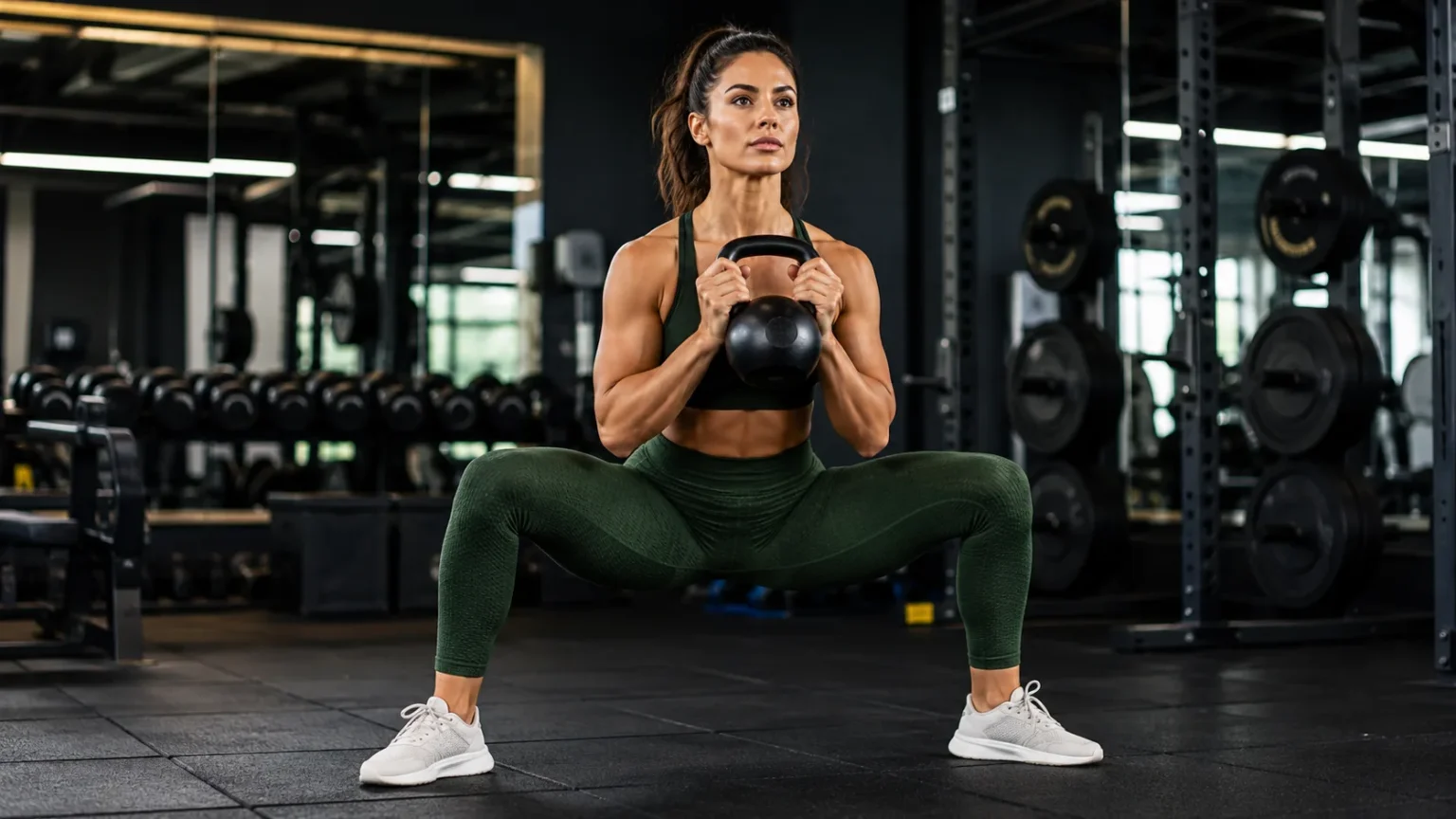

Sumo Squat: Benefits, Proper Form & Mistakes to Avoid
The sumo squat is a lower-body exercise performed with the feet wider than in a traditional squat and the toes turned outward. That wider stance changes how the hips, knees, and ankles move, making the exercise a useful option for training the glutes, quadriceps, hamstrings, and inner-thigh muscles.
You can perform sumo squats using only your body weight or add resistance with a dumbbell, kettlebell, barbell, or other equipment. This flexibility makes the movement suitable for beginners learning squat mechanics as well as experienced lifters looking for another way to challenge the lower body.
Good form matters more than simply standing as wide as possible. Your stance should match your hip mobility and anatomy, your knees should track comfortably in the direction of your toes, and your torso should remain controlled as you lower and stand.
When programmed appropriately, sumo squats can support lower-body strength, muscular endurance, hip mobility, and everyday movements such as standing, lifting, and changing levels. The key is understanding what the exercise actually does and avoiding technique mistakes that turn a useful squat variation into an uncomfortable one.
What Is a Sumo Squat?
A sumo squat is a squat variation performed with a relatively wide foot position and externally rotated toes. The name comes from the broad stance associated with sumo wrestling, although gym technique does not require an exaggerated stance.
As you descend, your hips move downward while your knees bend and track outward over your feet. The torso usually remains relatively upright compared with some other squat styles, although the exact angle depends on your proportions, mobility, stance, and load.
The movement can be performed as a bodyweight sumo squat or loaded with resistance. A dumbbell or kettlebell is often held vertically in front of the body, making the exercise easy to learn without needing a squat rack.
The sumo squat is not automatically superior to a traditional squat. It simply changes your position and muscle emphasis, giving you another movement pattern that can be useful depending on your goals, mobility, comfort, and training program.
What Muscles Do Sumo Squats Work?
The muscles worked during sumo squats include the quadriceps, gluteus maximus, adductors, hamstrings, and several smaller muscles that stabilize the hips and pelvis. Your core muscles also help maintain trunk position as you move through each repetition.
The quadriceps straighten the knees as you stand, while the glutes contribute strongly to hip extension. Because of the wider stance, the hip adductors along the inner thighs can play an important role in controlling the descent and helping you return to standing.
Your hamstrings contribute to hip and knee control, although squats are generally not an isolated hamstring exercise. Muscles around the ankles and lower legs also work to keep your feet stable and maintain balance throughout the movement.
The exact amount of work performed by each muscle varies with stance width, squat depth, foot angle, resistance, limb proportions, and individual technique. This is why two people can perform visually similar sumo squats but feel the exercise in slightly different areas.
7 Sumo Squat Benefits Worth Knowing
One major sumo squat benefit is that the exercise trains several lower-body muscle groups at once. Instead of isolating a single muscle, each repetition requires the hips, knees, core, and lower legs to coordinate during a functional multi-joint movement.
The wider position can also provide a useful way to train the adductors, commonly called the inner-thigh muscles. Strong adductors contribute to hip control and participate in many athletic and everyday movements, including running, changing direction, and standing from low positions.
Sumo squats can also improve movement variety within a strength program. Repeating exactly the same squat stance for months is not necessary, and using different variations can expose your muscles and joints to slightly different demands without abandoning the basic squat pattern.
Another advantage is accessibility. Sumo squats require little equipment, can be scaled easily, and can fit into home workouts, gym programs, circuits, and strength sessions. Beginners can start with body weight, while advanced trainees can progressively increase resistance as technique improves.
1. Sumo Squats Strengthen the Glutes
The gluteus maximus is one of the major muscles responsible for extending the hip as you rise from the bottom of a squat. In a properly performed sumo squat, the glutes work throughout the movement to help control and reverse the descent.
The wider stance may feel particularly natural for some people when trying to load the hips. However, simply turning your toes farther outward or forcing an extremely wide stance will not automatically make your glutes work harder.
To make sumo squats for glutes effective, focus on controlled depth and a strong, stable ascent. Drive through the whole foot and extend your hips naturally as you reach standing rather than aggressively pushing the pelvis forward at the top.
Progressive resistance is also important when strength or muscle development is the goal. Once bodyweight repetitions become easy, adding a dumbbell, kettlebell, or other appropriate resistance can continue challenging the glutes and surrounding lower-body muscles.
2. Sumo Squats Train the Inner Thighs
The hip adductors run along the inner thighs and help control the position and movement of the legs. In a wide-stance squat, these muscles contribute to hip movement and can experience substantial tension, particularly as you move into deeper ranges.
This is why people commonly associate sumo squats with inner-thigh training. The exercise can strengthen the adductors as part of a larger lower-body movement, although it should not be treated as a magical way to remove fat from one specific area.
Body-fat reduction cannot be reliably directed toward the inner thighs simply by training those muscles. Exercise can strengthen and develop the underlying muscles, while changes in body fat depend on broader factors such as overall activity, nutrition, and energy balance.
If your inner thighs feel excessively strained rather than productively challenged, narrow your stance slightly. Your ideal position is the one that allows you to squat comfortably without forcing the hips, knees, or groin into an awkward range.
3. Sumo Squats Build Lower-Body Strength
Squatting requires coordinated force from multiple joints, making it valuable for building general lower-body strength. Sumo squats challenge the hips and knees simultaneously instead of training each area through separate isolation exercises.
With enough resistance, the exercise can become progressively demanding. A beginner might start with bodyweight repetitions, then progress to a goblet-style dumbbell sumo squat before eventually using heavier resistance if appropriate.
Stronger lower-body muscles can make everyday activities feel easier. Getting out of chairs, climbing stairs, lifting objects from low positions, and maintaining stable movement all depend partly on the strength of the legs and hips.
Strength improvements still require progression. Performing exactly the same easy set indefinitely will eventually provide less stimulus, so gradually adjusting resistance, repetitions, sets, tempo, or movement difficulty can help maintain progress.
4. Sumo Squats Can Improve Hip Mobility
A properly selected sumo stance requires the hips to move through abduction and external rotation while you squat. Practicing this position can help some people become more comfortable moving through a wider range of hip motion.
However, hip mobility should not be forced. Individual hip anatomy differs, which means one person’s comfortable stance may feel awkward or restrictive to another person even when both have healthy mobility.
Start with a moderate stance and gradually experiment with width. If you can descend while keeping your heels down, knees tracking comfortably, and pelvis controlled, the position is probably more useful than a much wider stance that creates pinching or instability.
Mobility should feel like controlled movement rather than pain. Sharp discomfort in the hips, groin, knees, or lower back is a reason to stop, adjust the exercise, and seek professional guidance if the problem continues.
5. Sumo Squats Challenge Your Core
Although sumo squats are primarily a lower-body exercise, the core plays an important supporting role. Your abdominal and back muscles work to control the torso and maintain a stable relationship between the rib cage and pelvis.
Core demand generally increases when resistance is added. Holding a heavy kettlebell or dumbbell in front of the body creates an additional load that your trunk must control throughout the squat.
This does not mean sumo squats replace dedicated core exercises. Instead, they provide integrated trunk training while you perform a larger compound movement, making them useful within full-body and lower-body strength programs.
Before descending, create gentle abdominal tension as though preparing your torso to resist movement. Maintain that tension while breathing naturally rather than excessively arching the lower back or collapsing the chest.
6. Sumo Squats Can Support Balance and Stability
A squat requires your body to remain controlled while several joints move at the same time. The wide stance of a sumo squat creates a different balance challenge from a narrow or conventional squat and requires stable foot contact.
Your feet should remain firmly connected with the floor throughout the movement. Avoid allowing the arches to collapse dramatically inward or shifting all your body weight onto your toes or heels.
The hips also contribute to stability by helping control knee position. Keeping the knees moving in line with the toes can create a smoother movement than allowing them to collapse inward during the ascent.
Balance improvements depend on how the exercise is performed. Slow, controlled repetitions with appropriate resistance typically provide better movement practice than rushing through high-repetition sets with unstable technique.
7. Sumo Squats Are Easy to Modify
One reason sumo squats are popular is their versatility. The movement can be performed without equipment, which makes it convenient for home workouts, warm-ups, hotel workouts, or exercise sessions where gym equipment is unavailable.
Adding a dumbbell or kettlebell immediately changes the difficulty. Holding weight near the center of your body also makes progression straightforward because you can increase resistance as your strength improves.
Tempo can be adjusted as well. Lowering for three or four seconds, briefly pausing at the bottom, or performing controlled pulse variations can increase muscular challenge without requiring extremely heavy weights.
The exercise can therefore grow with your ability. Instead of abandoning bodyweight training when it becomes easy, you can manipulate load, range of motion, tempo, repetition count, and exercise variation to create a more challenging sumo squat workout.
How to Do a Sumo Squat With Proper Form
Begin by standing with your feet wider than shoulder width. Turn your toes outward to a comfortable angle rather than automatically forcing them to point as far sideways as possible.
Brace your midsection gently and keep your chest comfortably lifted. Begin lowering by bending your hips and knees together, allowing your knees to move in the same general direction as your toes.
Descend as far as you can while maintaining control, keeping your feet planted and avoiding pain. Your exact depth will depend on mobility, proportions, experience, and whether you are using additional resistance.
To stand, press your feet firmly into the floor and extend your knees and hips together. Finish tall without leaning backward or aggressively thrusting your hips forward, then reset before beginning the next repetition.
How Wide Should Your Sumo Squat Stance Be?
There is no perfect sumo squat stance width that works for everyone. A useful starting point is wider than your normal squat stance, with enough toe turnout to allow your knees to track comfortably over your feet.
Your anatomy matters. Hip socket structure, femur length, ankle mobility, and previous training experience can all influence which stance feels strongest and most natural.
Going excessively wide can reduce stability and create uncomfortable tension through the groin or hips. If you struggle to reach a useful depth or your knees cannot track comfortably, bring your feet slightly closer together.
Experiment in small increments rather than copying someone else’s exact setup. The goal is not to achieve the widest possible stance; it is to find a position that allows controlled, repeatable squatting without pain.
How Deep Should You Go in a Sumo Squat?
Squat depth should be based on control rather than a rigid rule. Descend until you reach the deepest position you can maintain without losing foot stability, experiencing pain, or dramatically changing your spinal or pelvic position.
Some people can comfortably squat until the thighs are around parallel with the floor or lower. Others may initially use a shallower range while improving mobility, balance, and strength.
Greater depth can increase the range through which your muscles work, but deeper is not automatically better if technique breaks down. A controlled moderate-depth squat is more useful than forcing additional inches while losing stability.
Over time, your comfortable range may improve with practice. If depth remains limited by pain rather than ordinary stiffness, avoid forcing the movement and consider having your technique or symptoms assessed by a qualified professional.
Sumo Squat vs Regular Squat: What’s the Difference?
A regular squat generally uses a narrower stance than a sumo squat, with less outward rotation of the feet. Both exercises train the glutes and quadriceps while requiring the hips, knees, ankles, and trunk to work together.
The wider stance in the sumo variation changes hip positioning and can increase the role of the adductors. It may also allow some lifters to maintain a more upright torso, although individual body proportions strongly influence squat mechanics.
A traditional squat may feel more natural for certain people, while others prefer a moderately wider position. Neither exercise needs to replace the other, and both can appear within the same training program.
Your goals should guide the choice. If you want movement variety or greater exposure to a wide-stance pattern, sumo squats are useful. If your primary sport or training program emphasizes conventional squatting, the traditional stance may deserve more practice.
Sumo Squat vs Goblet Squat
A goblet squat describes how the resistance is held rather than one exact foot position. You hold a dumbbell or kettlebell near the chest while performing a squat, which may use either a conventional or relatively wide stance.
A dumbbell sumo squat is therefore sometimes performed in a goblet-like position. Other people hold a single dumbbell vertically with both hands hanging between their legs, particularly when using a very wide stance.
Goblet loading can encourage an upright torso because the resistance sits in front of the body. It is also beginner-friendly because dropping or setting down a dumbbell is generally simpler than managing a heavily loaded barbell.
Both options can effectively train the lower body. Choose the setup that allows comfortable range of motion, secure handling of the weight, and progressive overload without sacrificing technique.
Dumbbell Sumo Squat: How to Add Resistance
Stand in your chosen sumo stance and hold one dumbbell securely with both hands. You can keep the dumbbell near your chest or allow it to hang vertically between your legs depending on your comfort and equipment.
Keep your shoulders controlled and brace your trunk before descending. Lower slowly while maintaining stable feet and keeping your knees aligned with your toes instead of allowing the added weight to pull you forward.
At the bottom, avoid bouncing off your joints simply to start the next repetition. Push through the floor and stand under control, allowing your hips and knees to extend together.
When you can comfortably complete your planned repetitions with strong form, increase the dumbbell weight gradually. Progress should make the exercise more challenging without immediately changing the quality of your movement.
Kettlebell Sumo Squat: Is It Different?
A kettlebell sumo squat follows almost the same lower-body pattern as the dumbbell version. The biggest difference is simply the shape and grip of the weight, which some people find easier to hold between the legs.
You can hold the kettlebell by the handle with both hands and allow it to hang naturally as you squat. Keep the shoulders relaxed and avoid deliberately reaching the weight toward the floor by rounding your back.
The kettlebell should move vertically because your body is squatting, not because your arms are swinging it. Your hands primarily secure the weight while the legs and hips perform the exercise.
As with the dumbbell variation, use gradual progression. Increasing load too quickly may cause your stance, depth, or torso position to change before your lower body has adapted to the heavier resistance.
7 Common Sumo Squat Mistakes to Avoid
One common mistake is standing too wide. An exaggerated stance may look more like a sumo position, but it can restrict comfortable depth and place unnecessary tension through the hips or groin.
Another mistake is letting the knees collapse significantly inward as you stand. Your knees should generally track in the direction of your toes so that the hip, knee, and foot remain coordinated.
Rounding the lower back, lifting the heels, and rushing through repetitions are also common problems. These issues often appear when someone uses more weight or depth than they can currently control.
Finally, avoid treating discomfort as proof that the exercise is working. Muscular effort is expected, but sharp joint, groin, back, or knee pain deserves attention rather than being pushed through repeatedly.
Mistake 1: Turning Your Toes Out Too Far
Your feet should turn outward enough to accommodate your hip position, but extreme external rotation is unnecessary. Forcing the toes sideways can make it harder to maintain comfortable alignment through the knees and ankles.
The correct angle varies from person to person. Some people feel comfortable with modest turnout, while others naturally require a little more because of differences in hip anatomy.
Watch how your knees move during the squat. If they struggle to track in line with your toes or you feel twisting through the knee, experiment with a smaller foot angle or narrower stance.
Your stance should feel stable before adding weight. Solving alignment problems with lighter loads is easier than trying to correct them while holding a challenging dumbbell or kettlebell.
Mistake 2: Letting Your Knees Collapse Inward
As you descend and stand, your knees should remain controlled rather than suddenly drifting far inside the line of your feet. Significant inward collapse can make the movement less stable and may indicate that the load or stance needs adjusting.
Think about allowing the knees to follow the direction of the toes without aggressively pushing them outward. Excessive outward forcing is not necessary either; natural alignment and control are the goals.
Reducing the weight may solve the problem immediately. When a person can perform clean bodyweight repetitions but loses knee position with added resistance, the load has probably increased faster than technique.
Strengthening the hips and practicing slower squats can also help. Repeating good movement patterns consistently is usually more productive than relying on one exaggerated coaching cue.
Mistake 3: Leaning Too Far Forward
A small amount of forward torso lean is normal in virtually every squat. The problem occurs when the chest drops dramatically because the hips shoot backward or the weight pulls you out of position.
A stance that is too wide can contribute to this problem, as can limited ankle or hip mobility. Heavy resistance may also cause the torso to collapse forward when the lifter cannot maintain sufficient trunk control.
Keep the weight balanced over your base of support and think about lowering between your legs rather than reaching your chest toward the floor. Your torso should move naturally while remaining controlled.
If your lower back rounds significantly or the exercise starts resembling a bent-over movement, reduce the load or range. Better control should come before heavier resistance.
Mistake 4: Lifting Your Heels Off the Floor
Your feet create the foundation of the squat. Allowing your heels to repeatedly rise can reduce stability and shift your weight farther forward than intended.
Limited ankle mobility, stance selection, or poor balance may contribute to heel lifting. Sometimes simply changing foot width or reducing squat depth allows someone to maintain better contact with the floor.
Think about keeping three areas connected with the ground: the heel, the base of the big toe, and the base of the little toe. This creates a stable platform without forcing your weight exclusively into your heels.
If heel lifting persists despite technique adjustments, address the underlying limitation rather than continuing to add load. Stable movement provides a better foundation for long-term strength development.
Mistake 5: Squatting Too Fast
Fast repetitions can be useful in certain athletic contexts, but beginners usually benefit from learning the sumo squat technique at a controlled pace. Moving too quickly can hide balance problems and make it harder to notice poor alignment.
Try lowering over roughly two or three seconds while learning the exercise. A controlled descent gives you enough time to feel whether your feet remain stable and your knees track comfortably.
You do not need to pause for several seconds at the bottom unless your program calls for it. Simply avoid bouncing uncontrollably or relying on momentum to escape a position you cannot otherwise manage.
Once your technique is consistent, movement speed can be intentionally adjusted. Tempo should serve your training goal rather than becoming fast simply because you are trying to finish the set quickly.
Mistake 6: Using Too Much Weight
Adding resistance makes sumo squats more challenging, but heavier is not automatically better. If additional weight immediately reduces depth, stability, or alignment, it may be more than you can currently control.
Start with a load that allows every repetition to look similar. The final repetitions should feel difficult without turning into completely different movements from the first few repetitions.
Increase resistance gradually as your strength improves. Small progress performed consistently is generally easier to sustain than repeatedly attempting weights that force your technique to break down.
Remember that progression can also come from extra repetitions, slower tempo, additional sets, or improved range of motion. Load is only one tool for making an exercise harder.
Mistake 7: Going Too Deep for Your Mobility
Deep squats can be useful, but forcing depth beyond your available mobility can cause the feet, knees, hips, or lower back to compensate. The deepest possible squat is not automatically the healthiest or most effective squat.
Stop at the point where you can maintain good control. If your heels rise, your pelvis suddenly tucks dramatically, or you experience pinching or sharp discomfort, reduce the depth.
Mobility may improve gradually through consistent strength training and appropriate mobility exercises. You do not need to force your body into someone else’s range to benefit from sumo squats.
Your comfortable depth may also change depending on stance and load. Treat range of motion as an individual training variable rather than a competition.
Are Sumo Squats Good for Beginners?
Yes, sumo squats for beginners can be a useful lower-body exercise when the stance is comfortable. The bodyweight version requires no equipment and allows new exercisers to learn basic hip and knee coordination.
However, beginners should not assume that wider means better. Start only slightly wider than your usual standing position and experiment until you find an angle that allows smooth movement.
A chair or bench can provide a useful depth target while learning. Lower yourself toward the surface under control, lightly touch or stop just above it, and then return to standing.
Once you can perform consistent bodyweight repetitions without pain, consider adding light resistance. Progress gradually and prioritize repeatable technique rather than chasing a particular weight or repetition number.
How Many Sumo Squats Should You Do?
The right number of sumo squat reps depends on your goal and resistance level. Beginners using body weight might start with two or three controlled sets of roughly 8 to 15 repetitions.
For strength and muscle development, use resistance that makes the target repetition range genuinely challenging while still allowing good technique. The precise number matters less than progressive training and adequate recovery.
Higher repetitions can be useful for muscular endurance, but very high-repetition sets are not necessary for everyone. If form deteriorates significantly because of fatigue, ending the set can be more productive than chasing an arbitrary number.
You also do not need to perform sumo squats every day. Include them as part of a balanced training program that provides sufficient recovery and also addresses other movement patterns.
How Often Should You Do Sumo Squats?
Many people can include sumo squats in lower-body training one to three times per week depending on training volume, intensity, experience, and recovery. There is no universal frequency that fits every program.
If the exercise is heavily loaded, you may need more recovery between sessions. Light bodyweight squats used in a warm-up create much less fatigue than challenging weighted sets performed close to your current strength limit.
Pay attention to how your muscles and joints recover. Persistent soreness, declining performance, or discomfort may indicate that volume, resistance, or frequency needs adjustment.
Sumo squats also do not need to appear in every lower-body session. Rotating them with traditional squats, lunges, split squats, hip hinges, and other exercises can create a more complete program.
Are Sumo Squats Good for Weight Loss?
Sumo squats use large lower-body muscle groups and can contribute to the energy expenditure of a workout. However, no single exercise can guarantee weight loss or specifically burn fat from the thighs, hips, or stomach.
Changes in body weight depend largely on overall energy balance over time. Nutrition, daily movement, structured exercise, sleep, and other lifestyle factors all contribute to the bigger picture.
Strength training remains useful during fat-loss efforts because it challenges the muscles and supports physical function. Sumo squats can therefore be one component of a broader resistance-training program.
Rather than performing endless repetitions hoping to target one area of fat, focus on building sustainable habits. A combination of resistance training, cardiovascular activity, daily movement, and appropriate nutrition is more realistic than relying on one squat variation.
Can Sumo Squats Make Your Inner Thighs Smaller?
Sumo squats can strengthen and develop the adductor muscles located along the inner thighs. What they cannot reliably do is instruct your body to remove fat specifically from that area.
This idea is known as spot reduction, and it is a common fitness misconception. Training a particular muscle changes that muscle, but fat loss does not necessarily occur directly above the area being exercised.
If overall body fat decreases, changes may eventually become visible around the thighs depending on genetics and individual fat distribution. Where the body loses fat first or last differs substantially among people.
Use sumo squats because they strengthen your lower body, not because they promise to shrink one exact body part. That expectation is more realistic and makes it easier to evaluate progress based on strength, movement quality, and overall fitness.
Sumo Squat Variations to Keep Your Workouts Challenging
Once you have mastered the standard movement, several sumo squat variations can change the difficulty. Dumbbell sumo squats and kettlebell sumo squats are the simplest ways to add external resistance.
A sumo squat with a pause involves stopping briefly at the bottom before standing. Removing momentum can make a relatively light weight feel more challenging and encourages better positional control.
Tempo sumo squats slow the lowering phase, increasing the amount of time your muscles remain under tension. You can also perform elevated versions when appropriate to increase available range of motion with a hanging dumbbell or kettlebell.
Advanced lifters may use barbell wide-stance squats within structured strength programs. Regardless of the variation, master the basic movement first rather than choosing a complex version simply because it looks more difficult.
Who Should Be Careful With Sumo Squats?
Sumo squats are not automatically appropriate for every person. People experiencing active hip, groin, knee, ankle, or lower-back pain should avoid forcing the movement simply because it is generally considered a useful exercise.
A wide stance may aggravate certain hip or groin problems in some individuals. Conversely, other people may find it more comfortable than a narrow squat because of their anatomy and mobility.
Pregnancy, recent surgery, significant injuries, and certain medical or musculoskeletal conditions may also change which exercises are appropriate. Individualized advice becomes more important when your training involves specific health considerations.
If an exercise repeatedly produces sharp pain, instability, numbness, or unusual symptoms, stop and seek guidance from an appropriate healthcare or exercise professional. Exercise should challenge your muscles without requiring you to ignore meaningful warning signs.
How to Add Sumo Squats to Your Workout
Sumo squats can appear near the beginning of a workout when they are one of your main strength exercises. In that position, you are relatively fresh and can use more challenging resistance while maintaining good technique.
They can also appear later as an accessory exercise after another squat or hinge movement. A moderate-weight dumbbell sumo squat, for example, can add additional work for the glutes, quadriceps, and adductors after your primary lift.
For home workouts, combine bodyweight or dumbbell sumo squats with movements such as lunges, glute bridges, Romanian deadlifts, calf raises, and appropriately selected core exercises.
Whatever position you choose, avoid adding exercises without considering total workload. A well-designed lower-body workout balances training stimulus with recovery rather than simply including as many leg exercises as possible.
Sumo Squat: The Bottom Line
The sumo squat is a versatile lower-body exercise that uses a wider stance and outwardly turned feet. It trains the quadriceps, glutes, adductors, and other muscles responsible for controlling the hips, knees, and trunk.
Its main benefits include building lower-body strength, challenging the inner-thigh muscles, developing the glutes, adding variety to squat training, and providing an exercise that can easily progress from bodyweight to weighted versions.
Proper form matters. Use a stance that matches your mobility, keep your feet stable, allow the knees to track with the toes, control your descent, and avoid forcing excessive width or depth.
Most importantly, choose the variation that feels strong and comfortable for your body. A well-controlled moderate stance will usually provide more value than trying to imitate an exaggerated sumo position that creates pain or instability.
Frequently Asked Questions About Sumo Squats
Sumo squats are simple to recognize but can create confusion because stance recommendations differ between lifters. Individual anatomy is one reason one person’s ideal position may look different from another person’s.
The wider stance changes the exercise, but it does not stop the quadriceps or glutes from working. Instead, several lower-body muscles continue sharing the load while the adductors take on an important role.
Progress also depends on more than the exercise itself. Appropriate resistance, training frequency, nutrition, recovery, and consistency all influence whether you become stronger or develop more muscle.
Use the following answers as general guidance rather than rigid rules. Your ideal stance, depth, resistance, and training volume should ultimately match your mobility, experience, and goals.
Are sumo squats better than regular squats?
Neither is universally better. Sumo squats use a wider stance and can place greater emphasis on the adductors, while regular squats provide a different hip and knee position. Both can be useful.
Do sumo squats grow your glutes?
Sumo squats train the glutes and can contribute to muscle growth when they are performed with enough resistance, progressive overload, adequate recovery, and appropriate nutrition.
Do sumo squats work the inner thighs?
Yes. The hip adductors along the inner thighs contribute significantly during a wide-stance squat, particularly as they control and produce movement through the hip.
How many sumo squats should beginners do?
A beginner could start with about 2–3 sets of 8–15 controlled bodyweight repetitions. The exact number should be adjusted according to fitness level, technique, and recovery.
Should you feel sumo squats in your knees?
Your knees participate in the movement, but sharp or persistent knee pain is not something to push through. Adjust your stance, depth, or resistance and seek professional advice if discomfort continues.