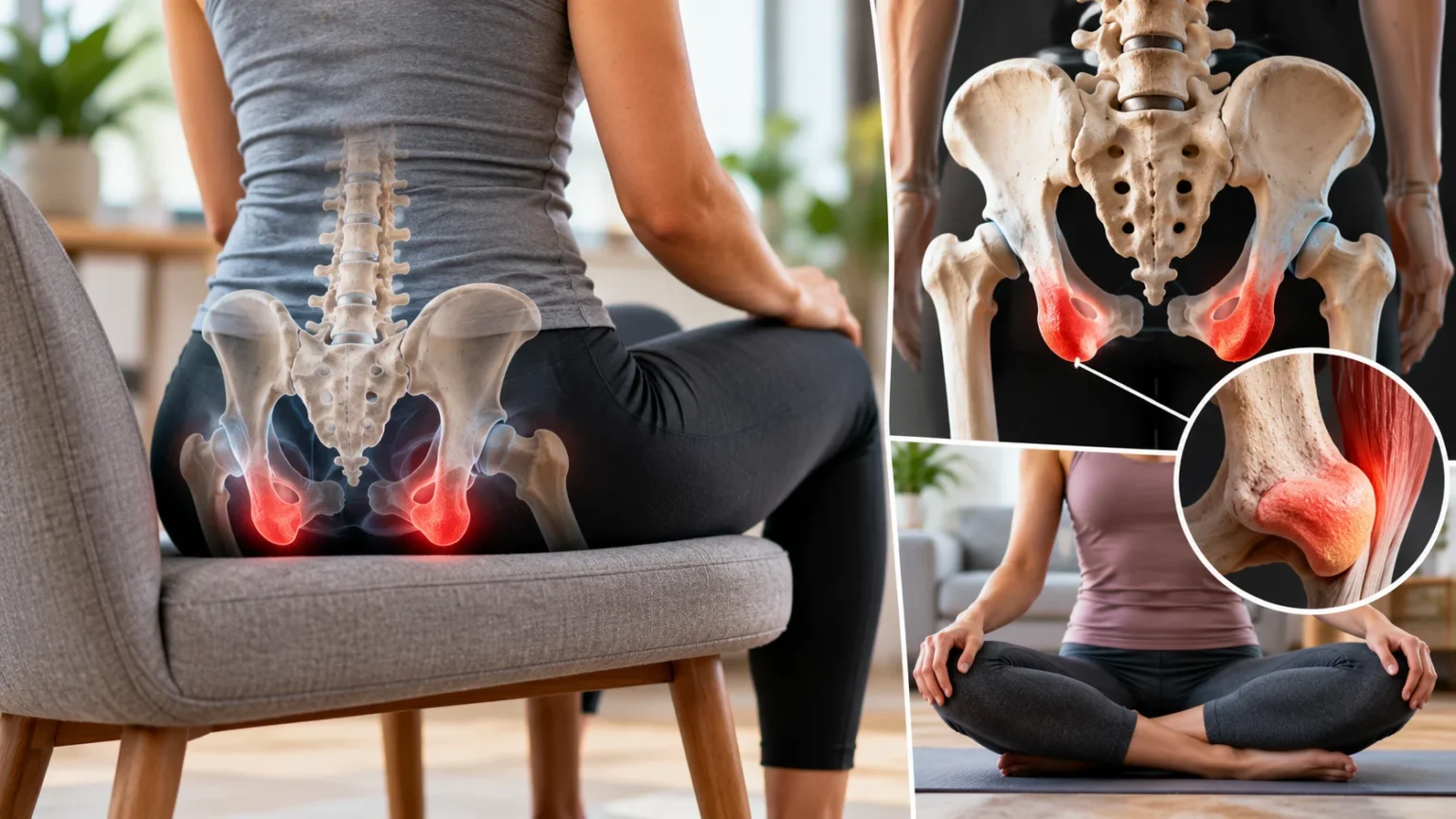

Sit bones are the hard, bony points you can feel underneath your pelvis when sitting on a firm surface. Anatomically, they are called the ischial tuberosities, and they form part of the pelvis. These structures help support body weight while sitting and provide important attachment points for muscles and ligaments involved in movement.
Although sit bones are usually unnoticed during everyday life, they can become more noticeable after long periods of sitting, cycling, exercise, or irritation around the surrounding tissues. Understanding their anatomy and function can make it easier to recognize why discomfort develops and when simple activity adjustments or professional evaluation may be appropriate.
What Are Sit Bones?
Sit bones are the lower, rounded portions of the pelvis that bear much of your body weight when you sit upright. Their medical name is ischial tuberosities. Each sit bone is part of the ischium, one of the three bones that join together during development to form each side of the pelvis.
You have two sit bones, one on the left and one on the right. When sitting on a hard chair or floor, you may be able to feel them as two firm points beneath the buttocks. Soft tissue, muscles, and fat normally provide cushioning between these bones and the surface beneath you.
Their shape and exact position vary slightly between individuals because pelvic anatomy differs naturally from person to person. Sit bones are not abnormalities or extra bones. They are normal anatomical structures that play an important role in supporting seated posture and connecting the pelvis to several powerful muscles.
Where Are the Sit Bones Located?
The sit bones are located at the lower rear portion of the pelvis, underneath the buttocks. They sit below the hip joints and slightly toward the back of the body. When you sit upright with your pelvis in a relatively neutral position, much of your weight is transferred through these bony points.
You can often locate your sit bones by sitting on a firm surface and gently rocking your pelvis from side to side. You may notice two distinct areas of pressure underneath you. These are the ischial tuberosities, although muscles and other tissues around the area can make the exact borders difficult to identify.
The sit bones are close to several important structures, including the hamstring tendons, pelvic floor muscles, and nerves that travel through the buttock region. Because so many tissues occupy this relatively small area, pain near the sit bones does not always come directly from the bone itself.
What Is the Anatomy of the Ischial Tuberosity?
The ischial tuberosity is a thickened, rough area of bone designed to tolerate pressure and provide attachment points for surrounding tissues. It forms part of the lower ischium. Its uneven surface gives tendons and ligaments a secure place to attach, helping transmit forces between the pelvis and lower limbs.
Several hamstring muscles originate from or near the ischial tuberosity. These include portions of the semitendinosus, semimembranosus, and biceps femoris muscles. Because the hamstrings play major roles in hip extension and knee bending, the sit bones experience substantial pulling forces during walking, running, jumping, and strength training.
Other connective tissues also attach around this area, including structures associated with the pelvic floor and sacrotuberous ligament. A small fluid-filled structure called a bursa lies near the ischial tuberosity and helps reduce friction. Irritation of this bursa can sometimes contribute to pain while sitting.
What Do Sit Bones Do?
One of the primary functions of the sit bones is supporting body weight during sitting. When your pelvis is positioned upright, pressure is distributed through the ischial tuberosities into the chair, floor, or saddle beneath you. This allows the surrounding muscles and soft tissues to share the demands of maintaining a seated position.
Sit bones also serve as attachment points for muscles that help move and stabilize the hips. The hamstrings connect here and contribute to activities such as standing up, walking, running, and climbing stairs. These attachments allow force generated by the muscles to transfer effectively between the pelvis and legs.
The surrounding area also contributes to pelvic stability. Muscles and ligaments connected near the ischial tuberosities help support coordinated movement between the trunk and lower limbs. Although the sit bones themselves do not actively move, they form part of the structural foundation that makes efficient movement possible.
Sit Bones and Sitting Posture
Your sit bones can provide a useful reference point when thinking about seated posture. When you sit with your weight balanced over both ischial tuberosities, the pelvis is often closer to a neutral position. This may make it easier to maintain a comfortable spinal position without excessive slumping or rigid upright tension.
Leaning far backward can shift more pressure toward the tailbone and surrounding soft tissues, while leaning excessively forward can increase demand on the hips and lower back. Neither position is automatically harmful for short periods. Problems are more likely when one posture is maintained for long stretches without movement.
Comfortable sitting usually involves variation rather than holding one exact position all day. Changing posture, standing periodically, and taking brief walking breaks can reduce prolonged pressure on the sit bones. A supportive chair and appropriate seat height can also make longer periods of sitting more manageable.
Why Can Sit Bones Hurt?
Pain around the sit bones can develop from several different causes. Prolonged sitting on hard surfaces may create pressure and temporary tenderness in the area. People who spend many hours at desks, drive long distances, or sit on firm benches may notice aching directly underneath one or both buttocks.
Exercise can also contribute, particularly activities that heavily load the hamstrings. Sprinting, deadlifts, lunges, running hills, and sudden increases in training volume can place more tension on tendons attached near the ischial tuberosity. This may lead to discomfort where the hamstrings connect to the pelvis.
Other possible sources include bursa irritation, local muscle tension, nerve-related symptoms, or referred pain from nearby joints or the lower back. Because several conditions can produce similar sensations, persistent sit bone pain should not automatically be treated as a simple pressure problem without considering the broader symptom pattern.
What Is Ischial Bursitis?
Ischial bursitis occurs when the bursa near the sit bone becomes irritated or inflamed. A bursa is a small fluid-filled sac that helps tissues move smoothly over one another. Repeated pressure from prolonged sitting can sometimes irritate this structure and create tenderness around the lower buttock.
Pain from ischial bursitis may become more noticeable while sitting, particularly on hard surfaces. Some people describe a deep ache or localized tenderness directly around the sit bone. The discomfort may also increase after activities that repeatedly load the hip or surrounding muscles.
Treatment depends on the severity and cause of the irritation. Reducing prolonged pressure, modifying activities, and gradually returning to normal movement may help mild symptoms. Persistent or worsening pain should be evaluated by a healthcare professional because hamstring tendon problems and other conditions can produce similar symptoms.
Sit Bones and Hamstring Attachment
The hamstring muscles have important attachments around the sit bones, which explains why the area can feel sore after demanding lower-body exercise. These muscles run along the back of the thigh and help extend the hip and bend the knee. Their upper tendons transfer force directly through the ischial tuberosity.
High-speed running, sudden acceleration, deep hip flexion, and heavy strength exercises can increase tension at the hamstring origin. If training volume rises too quickly, the tendon area may become sensitive. Pain is often felt deep in the lower buttock, particularly during sitting, running, or movements that stretch the hamstrings.
Appropriate warm-ups and gradual training progression can help prepare the muscles for higher loads. Simple warm-up stretches may be used as part of a broader preparation routine alongside light movement and sport-specific drills. Aggressive stretching should be avoided when the tendon attachment is already painful.
Sit Bones and Cycling
Cyclists often become very aware of their sit bones because these structures contact the bicycle saddle. A properly fitted saddle is designed to support the pelvis near the ischial tuberosities rather than placing excessive pressure on sensitive soft tissues. Saddle width is therefore an important part of cycling comfort.
A saddle that is too narrow may fail to adequately support the sit bones, while one that is excessively wide can interfere with comfortable pedaling. Riding position, saddle height, clothing, and time spent cycling also affect pressure distribution. New riders commonly experience temporary soreness while adapting to longer periods on the bike.
Persistent numbness, severe pain, or increasing discomfort should not simply be accepted as normal cycling soreness. Adjusting bike fit or saddle design may help, especially when symptoms consistently appear during rides. Professional bike fitting can be useful for cyclists who continue to experience pressure-related discomfort despite basic adjustments.
Can Sit Bone Pain Come From Long Periods of Sitting?
Yes, prolonged sitting can make the sit bone area uncomfortable, especially on firm or poorly cushioned surfaces. Continuous pressure compresses the soft tissues between the ischial tuberosities and the seat. This may lead to temporary soreness, tenderness, or a feeling that the lower buttocks need relief from pressure.
People who work at desks can reduce continuous loading by changing position regularly. Standing for short periods, walking around the room, and using a comfortable chair may help. A cushion can sometimes reduce pressure, although the best shape and firmness depend on individual comfort and the underlying reason for symptoms.
Sitting less is not always the complete solution because movement tolerance and surrounding muscle strength also matter. The goal is usually to avoid staying in one position for excessive periods. If pain remains severe even after reducing pressure, other causes such as tendon or nerve irritation should be considered.
Exercises That Support the Sit Bone Area
Exercises that strengthen the hips, glutes, and hamstrings can support the tissues surrounding the sit bones. Bridges, controlled hip hinges, and appropriately loaded leg exercises may improve strength when performed comfortably. Exercise selection should depend on your current fitness level and whether pain is present.
Hamstring strengthening is particularly relevant because these muscles attach near the ischial tuberosities. Progressing resistance slowly can help the muscles and tendons adapt to greater loads over time. Heavy stretching or high-intensity strengthening should not be introduced suddenly if the area is already irritated.
Mobility work can also support comfortable movement around the hips and pelvis. Gentle hip rotations, walking, and controlled range-of-motion exercises may reduce stiffness after long periods of sitting. Any exercise that creates sharp, worsening, or radiating pain should be modified or stopped until the cause is better understood.
When Should Sit Bone Pain Be Checked?
Mild soreness caused by prolonged sitting or unfamiliar exercise may improve with activity changes and time. However, pain that continues for several weeks, repeatedly returns, or interferes with normal walking, sitting, or exercise should be assessed. Persistent symptoms may involve tendons, bursae, nerves, or other nearby structures.
Seek medical attention sooner if the pain follows a fall, collision, or other significant injury. Severe bruising, swelling, weakness, or inability to comfortably bear weight may require evaluation. Sudden intense pain during sprinting or another forceful movement can also suggest a muscle or tendon injury rather than ordinary soreness.
Numbness, tingling, pain that travels down the leg, or changes in bowel or bladder control require additional attention. These symptoms may indicate nerve involvement or another medical issue. A healthcare professional can examine the pelvis, hips, lower back, and surrounding tissues to determine the most likely source of symptoms.
Conclusion
Sit bones, or ischial tuberosities, are normal parts of the pelvis that support body weight during sitting and provide attachment points for important muscles and ligaments. They are especially closely connected with the hamstrings and surrounding pelvic tissues. Although you rarely notice them, they contribute to both sitting and lower-body movement.
Discomfort around the sit bones can develop from prolonged pressure, cycling, exercise, hamstring tendon irritation, or inflammation of the nearby bursa. Simple changes such as taking movement breaks, adjusting seating, or modifying training may help mild symptoms. The most appropriate approach depends on what is causing the discomfort.
Persistent, severe, or unusual pain should not be ignored. Symptoms involving weakness, significant swelling, numbness, trauma, or pain that travels down the leg may require professional evaluation. Understanding the anatomy and function of the sit bones can help you recognize what is normal and when additional care may be appropriate.
FAQs
What are sit bones called anatomically?
Sit bones are medically called the ischial tuberosities. They are the lower, rounded parts of the pelvis that support much of your body weight when you sit upright.
Why do my sit bones hurt when sitting?
Long periods on a hard surface can create pressure around the ischial tuberosities. Pain can also come from nearby tendons, bursae, muscles, or nerves, especially when symptoms persist.
Are sit bones connected to the hamstrings?
Yes. Several hamstring muscles attach near the ischial tuberosities. These attachments allow the hamstrings to help extend the hip, bend the knee, and support activities such as running and lifting.
Can cycling make your sit bones sore?
Yes. Cycling places direct pressure on the sit bones through the saddle. Temporary soreness is common in newer riders, while persistent pain may indicate that bike fit or saddle width needs adjustment.
When should I see a doctor for sit bone pain?
Seek evaluation if pain is severe, persistent, follows an injury, or occurs with swelling, weakness, numbness, or radiating symptoms. Ongoing pain that interferes with sitting or walking should also be assessed.