
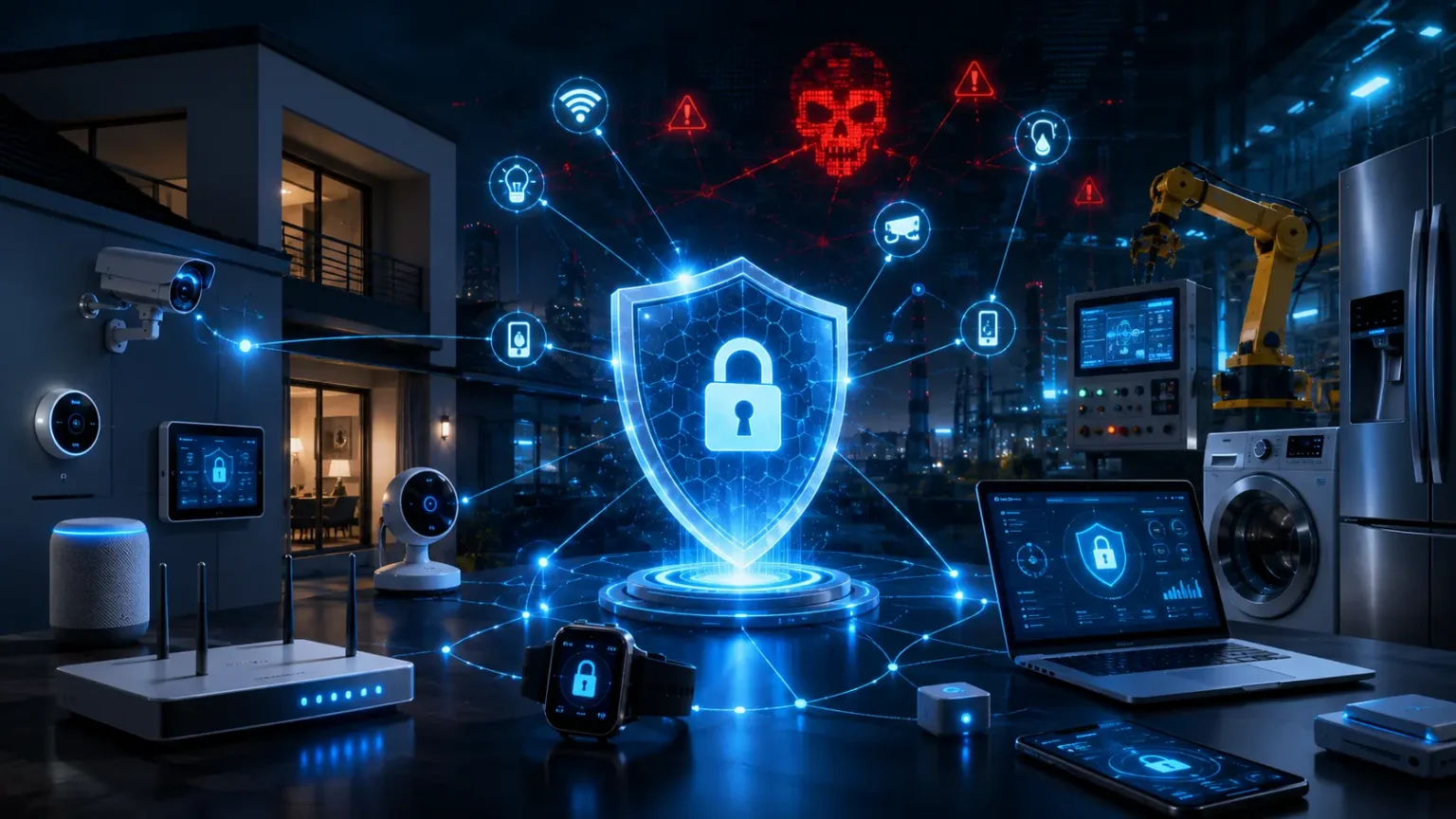

IoT Cybersecurity: Risks, Threats & Best Practices
From smart thermostats and security cameras to industrial sensors and connected medical equipment, Internet of Things devices have quietly become part of everyday life. These devices can improve convenience, automation, efficiency, monitoring, and decision-making, but every new connection also creates another potential point that attackers may attempt to compromise.
IoT cybersecurity is the practice of protecting connected devices, their software, networks, cloud services, applications, and data against unauthorized access and cyberattacks. Unlike traditional computers, many IoT products operate continuously in the background, which means users may forget they are connected to the internet or assume they require little maintenance after installation.
The challenge becomes more serious because IoT devices vary enormously. A connected light bulb has different risks from an industrial controller, medical monitoring device, smart vehicle component, or security camera. Some devices have powerful processors and sophisticated security controls, while others have limited computing resources and may remain deployed for years with minimal user interaction.
Effective IoT security therefore requires more than installing antivirus software. Organizations and consumers need strong authentication, secure configuration, software updates, network segmentation, encrypted communication, vulnerability management, device visibility, data protection, and a clear understanding of how long manufacturers will continue supporting connected products.
What Is IoT Cybersecurity?
IoT cybersecurity refers to the technologies, processes, policies, and design practices used to protect internet-connected physical devices and the systems surrounding them. These connected products can collect information, communicate with cloud platforms, interact with mobile applications, receive commands, and sometimes control physical processes in homes, businesses, hospitals, factories, and cities.
The security boundary extends beyond the device itself. A smart camera may depend on firmware, a wireless network, a mobile application, cloud storage, user accounts, APIs, and a manufacturer’s update service. A weakness in any one of those components can potentially undermine the security of the complete IoT product.
That is why modern Internet of Things security focuses increasingly on the entire product lifecycle. Cybersecurity should begin when a connected device is designed and continue through manufacturing, deployment, operation, software updates, vulnerability handling, maintenance, and eventual retirement. Security added only after a product reaches customers is often much harder to implement effectively.
For users and businesses, the goal is to maintain appropriate confidentiality, integrity, availability, and control. Private information should remain protected, device settings should not be changed by unauthorized people, important services should remain available, and suspicious behavior should be detectable before a compromised device creates a larger security problem.
Why IoT Cybersecurity Matters More in 2026
Connected technology is becoming more deeply integrated into physical environments. Businesses use sensors to track equipment, retailers monitor inventory, healthcare providers rely on connected devices, cities deploy intelligent infrastructure, and households use cameras, speakers, appliances, locks, and energy-management systems. This growth means cybersecurity failures can increasingly affect the physical world as well as digital information.
Another concern is product lifespan. A smartphone might be replaced every few years, but an industrial sensor, building-control system, camera, or medical device may remain operational much longer. If the manufacturer stops releasing security updates while the device remains connected, vulnerabilities can accumulate and become increasingly difficult for the owner to manage.
Security expectations are also shifting toward secure-by-design and lifecycle responsibility. Manufacturers are increasingly expected to reduce risky defaults, provide security updates, communicate support periods, handle vulnerability reports, and design products that customers can configure securely. The burden of cybersecurity should not fall entirely on users who may have little technical expertise.
Transparency is becoming more important as well. Consumers and businesses want to know whether devices receive updates, how data is handled, what security features are included, and how long support will continue. Cybersecurity labeling and emerging product-security regulations reflect a broader move toward making connected-device security easier to evaluate before purchase.
What Are the Biggest IoT Cybersecurity Risks?
One of the biggest risks is weak authentication. Devices may use simple passwords, default credentials, shared administrator accounts, or authentication systems that were designed for convenience rather than security. Attackers who obtain the correct credentials may gain control without needing to exploit a complicated technical vulnerability.
Unpatched software creates another major risk. IoT devices contain operating systems, firmware, libraries, communication protocols, and third-party components that may develop known security weaknesses. When devices cannot receive updates—or owners never install available patches—publicly known vulnerabilities can remain exposed for long periods.
Poor network architecture can magnify the damage from one compromised device. If a smart camera, sensor, printer, or building-management system shares unrestricted network access with sensitive servers and employee computers, attackers may attempt to use the IoT device as an entry point for moving deeper into the environment.
Privacy represents another significant concern because many connected products continuously collect information about users or environments. Smart speakers, wearables, cameras, vehicles, health devices, and location-aware sensors may process highly personal data. Insecure storage, excessive collection, weak encryption, or poorly controlled cloud access can therefore turn an IoT security incident into a serious privacy problem.
Common IoT Cybersecurity Threats and Attacks
Malware is one of the most familiar IoT threats. Attackers can compromise vulnerable connected devices and install malicious software that allows remote control, surveillance, credential theft, or participation in larger attacks. Devices with weak passwords and unnecessary exposure to the internet are particularly attractive because automated tools can continuously search for them.
IoT botnets demonstrate how individual devices can become part of a much larger threat. Attackers may compromise thousands of cameras, routers, recorders, or other connected devices and control them together. Those devices can then generate enormous amounts of traffic, scan for additional targets, or participate in distributed denial-of-service attacks.
Credential attacks are another common problem. Attackers can try manufacturer defaults, common password combinations, previously leaked passwords, or automated credential-stuffing techniques. When users reuse the same credentials across multiple services, the compromise of an unrelated account can potentially place a connected device at risk as well.
Attackers may also target the systems surrounding IoT devices rather than the hardware directly. Vulnerable mobile applications, insecure APIs, cloud dashboards, update servers, vendor accounts, or remote-management platforms can provide powerful access. IoT threat modeling should therefore consider the complete ecosystem instead of treating the physical device as the only attack surface.
Why Default Passwords Are Dangerous for IoT Devices
Default passwords make device installation easier, but they can create significant security problems when every unit ships with identical or predictable credentials. Attackers can often locate manuals or credential lists online and automatically test common usernames and passwords against exposed devices.
A better design gives every device unique credentials or requires users to establish a strong password during initial setup. This prevents a single publicly known password from unlocking thousands of products. Manufacturers can also provide more secure onboarding methods that reduce reliance on reusable static credentials.
Users should change default credentials whenever a device still allows them. Passwords should be unique rather than copied from email, banking, social media, or other accounts. A password manager can make unique credentials easier to maintain when many connected devices and cloud services need separate logins.
Where available, multifactor authentication adds another layer of security to important IoT accounts and management platforms. MFA is particularly valuable for cloud dashboards, security-camera accounts, remote-access systems, and administrator portals because compromising these accounts may provide control over multiple connected devices at once.
Firmware Updates and Patch Management Are Essential
Firmware is software embedded inside hardware that helps control how a device functions. Like other software, firmware can contain security vulnerabilities discovered after the product has already been sold. Manufacturers therefore need a reliable mechanism for providing security updates throughout an appropriate support period.
Secure updates should be authenticated so attackers cannot easily replace legitimate firmware with malicious code. Devices should also handle interrupted or failed updates safely. Update processes that are unreliable or excessively difficult may discourage customers from applying security patches, leaving known vulnerabilities unresolved.
Organizations managing hundreds or thousands of IoT devices need a structured IoT patch management process. Teams should know which device models are deployed, their firmware versions, available updates, business importance, and support status. Critical weaknesses affecting exposed or sensitive devices should receive priority rather than relying on occasional manual updates.
End-of-support planning is equally important. When a manufacturer stops releasing security fixes, organizations should evaluate whether the device can remain safely deployed. Isolating the product, removing internet access, applying compensating controls, or replacing unsupported hardware may be necessary when long-term exposure becomes unacceptable.
Network Segmentation Can Limit IoT Attacks
Network segmentation separates systems according to purpose, sensitivity, or risk rather than allowing every connected device to communicate freely. A smart television, security camera, industrial sensor, employee laptop, database server, and financial application rarely need identical network access, so treating them as though they do creates unnecessary exposure.
For home users, segmentation might mean placing smart-home devices on a separate guest or IoT wireless network when the router supports it. This can reduce direct communication between less-trusted connected devices and computers containing sensitive personal information. The exact configuration depends on the capabilities of the network equipment.
Businesses can apply more detailed controls using VLANs, firewalls, network access control, microsegmentation, and policy-based communication rules. An IoT sensor that only needs to contact a specific management server should not automatically receive unrestricted access to every internal system simply because it is located inside the corporate network.
Segmentation is especially useful when perfect device security cannot be guaranteed. A vulnerable camera may still become compromised, but limiting its network permissions can reduce what an attacker can reach afterward. This reflects an important cybersecurity principle: defenses should reduce both the likelihood and the potential impact of compromise.
IoT Device Visibility and Asset Management
Organizations cannot protect connected devices they do not know exist. Employees, departments, contractors, building-management teams, and operational groups may deploy smart devices without always notifying cybersecurity teams. Over time, this can create a large collection of unmanaged assets with unknown configurations and software versions.
IoT asset management begins by discovering and identifying connected devices. Useful information can include manufacturer, model, location, owner, network address, operating system or firmware version, business purpose, communication patterns, support status, and whether the device can access sensitive resources.
Inventory information should remain current because IoT environments change constantly. Devices are installed, moved, repaired, replaced, disconnected, and forgotten. A spreadsheet created during one security audit can quickly become outdated unless discovery and ownership processes are incorporated into normal operations.
Once security teams understand their IoT environment, they can prioritize risk more intelligently. An internet-connected medical system deserves different attention from a temperature sensor on an isolated network. Asset visibility allows organizations to focus controls where compromise would create the greatest safety, privacy, operational, or financial consequences.
Data Privacy and Encryption in IoT Security
IoT products can generate enormous amounts of information about people, buildings, machinery, vehicles, and business operations. Some data may appear harmless individually but become sensitive when combined over time. Device usage patterns can potentially reveal behavior, schedules, location, health information, or operational details.
Organizations and manufacturers should therefore practice data minimization. A connected product should collect only the information genuinely required for its function and legitimate business needs. Collecting unnecessary data increases privacy exposure and creates more information that must be protected throughout storage, processing, sharing, and deletion.
Encryption helps protect IoT data while it moves across networks and while it is stored, but encryption alone is not enough. Systems also need secure key management, strong authentication, appropriate authorization, and restrictions on which users or services can access sensitive information.
Users should understand where their information goes whenever possible. Some devices process data locally, while others continuously send information to cloud platforms or third parties. Clear privacy settings, understandable policies, manageable retention periods, and transparent sharing practices make it easier for people to make informed decisions about connected technology.
Industrial IoT Security Requires Extra Care
The Industrial Internet of Things, or IIoT, connects sensors, machines, controllers, monitoring systems, and industrial equipment to digital networks. Manufacturers, energy providers, utilities, logistics businesses, and other industries use these systems to improve efficiency, predictive maintenance, automation, safety, and operational visibility.
Industrial IoT creates distinct cybersecurity challenges because availability and physical safety can be more important than in ordinary consumer environments. A compromised entertainment device may be inconvenient, while disruption to a production line, water system, building-control platform, or industrial process can create substantial operational consequences.
Legacy equipment adds another difficulty. Industrial systems may remain operational for decades and can depend on older protocols or operating systems that were not originally designed for internet connectivity. Applying conventional patches may also require planned downtime, testing, or vendor approval because an unexpected change could interfere with critical processes.
Effective IIoT security therefore combines asset discovery, segmentation, controlled remote access, monitoring, secure configuration, vulnerability management, incident response, and close coordination between IT and operational technology teams. Security controls should protect systems without introducing changes that create unacceptable safety or availability risks.
Healthcare and Medical IoT Cybersecurity
Healthcare environments increasingly use connected medical devices, patient monitors, imaging systems, infusion technology, wearable sensors, telehealth platforms, and smart facility equipment. These technologies can improve care and monitoring, but their cybersecurity requirements are particularly important because sensitive information and patient safety may both be involved.
Medical IoT security must consider confidentiality, integrity, availability, and clinical impact. A device that becomes unavailable during routine maintenance may create a very different consequence from a consumer gadget going offline. Risk assessments should therefore consider how cybersecurity events could affect healthcare delivery rather than focusing only on whether information might be stolen.
Hospitals and healthcare organizations also face device-management challenges because products from many manufacturers may operate on the same network. Some systems are difficult to patch immediately, while others depend on vendor maintenance. Accurate inventories and strong network segmentation become particularly valuable in these mixed technology environments.
Manufacturers have an important responsibility as well. Connected healthcare products should include appropriate authentication, secure update mechanisms, logging, vulnerability-management processes, and clear support information. Cybersecurity works best when it is considered throughout product design and clinical deployment rather than added only after a security incident occurs.
Secure-by-Design Is Changing IoT Cybersecurity
Secure-by-design means cybersecurity is treated as a fundamental product requirement from the beginning rather than an optional feature added near launch. Engineers consider foreseeable threats during architecture, development, testing, deployment, and support so customers receive products that are easier to operate securely.
This approach encourages manufacturers to reduce dangerous defaults. Devices should avoid universal passwords, unnecessary exposed services, excessive privileges, and insecure configurations that customers are expected to fix themselves. Security-sensitive settings should work safely without requiring buyers to become cybersecurity specialists.
Lifecycle planning is another major component. Manufacturers need to consider how vulnerabilities will be reported, how security updates will reach customers, how long products will remain supported, and what happens when devices reach end of life. A secure device on launch day can gradually become insecure if its software is never maintained.
Secure-by-design also changes how responsibility is distributed. Consumers and businesses still need to configure and operate products carefully, but manufacturers are increasingly expected to create a strong security foundation. The long-term direction of IoT security is toward products that are secure by default rather than products that become secure only after extensive customer configuration.
IoT Cybersecurity Best Practices for Businesses
Start with a complete inventory. Identify every IoT and connected operational device, determine who owns it, understand what it does, and document which networks, applications, and cloud services it communicates with. Unknown assets create unmanaged risk, so visibility should come before purchasing additional security technology.
Next, reduce unnecessary exposure. Change default credentials, disable unused services, restrict administrative interfaces, remove direct internet access where it is not required, and segment IoT systems from high-value business resources. Remote access should be controlled, monitored, and protected with strong authentication whenever possible.
Create a formal patching and vulnerability-management process for connected devices. Monitor vendor advisories, track firmware versions, prioritize high-risk vulnerabilities, and identify devices that no longer receive security support. Procurement teams should also consider update policies and support periods before purchasing new equipment.
Finally, prepare for incidents. Organizations should monitor unusual IoT traffic, preserve useful logs, establish escalation procedures, and understand how compromised devices can be isolated quickly. Response plans should include operational teams because simply disconnecting a device may not be safe when it controls an important physical or business process.
IoT Cybersecurity Best Practices for Home Users
Home users should begin with the router because it connects many smart devices to the internet. Change default router credentials, install firmware updates, use modern Wi-Fi security settings, and disable unnecessary remote-management features. A poorly secured router can undermine protection across multiple connected products.
Every smart-device account should use a strong, unique password, with MFA enabled where supported. Avoid reusing passwords between cameras, smart-home platforms, email, and other important services. If one company experiences a credential leak, unique passwords help prevent attackers from automatically accessing unrelated accounts.
Keep smart devices updated and periodically review the manufacturer’s support information. Automatic security updates can be useful when available and trustworthy. If an important device stops receiving security fixes, consider whether keeping it connected still makes sense, especially for cameras, locks, routers, and other products with significant access.
Finally, think before buying. Ask whether the device genuinely needs internet connectivity, how long the manufacturer promises updates, what information it collects, and whether security settings are understandable. The easiest insecure IoT device to manage is often the one you decided you did not actually need to connect in the first place.
How Businesses Should Evaluate IoT Devices Before Buying
Security should become part of IoT procurement, not something reviewed only after equipment arrives. Buyers should ask manufacturers about authentication, software updates, vulnerability disclosure, encryption, logging, data handling, remote access, support periods, and secure configuration before approving a product.
Update commitments deserve particular attention. Ask how updates are delivered, whether security patches are signed, how quickly critical vulnerabilities are addressed, and when product support ends. A cheaper device with a short or unclear support period may create higher long-term costs than a product designed for sustained maintenance.
Businesses should also understand dependencies. A device may require a cloud subscription, mobile application, proprietary management server, or third-party platform. Consider what happens if that service changes ownership, becomes unavailable, stops receiving updates, or reaches end of life before the physical device itself needs replacement.
Finally, evaluate whether the product can fit into existing security architecture. Can it use appropriate identity controls? Can administrators change passwords? Does it support network segmentation? Are logs available? Can unnecessary interfaces be disabled? Security becomes much easier when procurement teams select devices designed to support organizational controls from the beginning.
How to Build an IoT Cybersecurity Strategy
A strong strategy begins with risk rather than technology. Identify which connected devices support important business functions, what information they process, who depends on them, and what could happen if they were compromised, modified, unavailable, or used as an entry point into other systems.
Next, establish minimum security requirements for every IoT deployment. These may include unique credentials, secure updates, encryption, asset identification, restricted network access, vulnerability reporting, logging, and defined support periods. Higher-risk environments can add more demanding requirements according to their business and safety needs.
Assign ownership clearly. Cybersecurity teams cannot manage IoT risk alone when facilities, operations, healthcare teams, engineers, developers, procurement departments, and third-party vendors all deploy connected technology. Each device should have a business owner as well as clearly defined technical and security responsibilities.
Finally, measure and improve the program continuously. Track unsupported devices, patching delays, internet-exposed assets, insecure configurations, incident trends, and progress in replacing legacy equipment. IoT cybersecurity is not a one-time project because devices, threats, software, networks, and business requirements continue changing after deployment.
What Is Changing in IoT Cybersecurity in 2026?
The biggest shift is toward lifecycle cybersecurity. Security discussions increasingly extend beyond whether a product is safe when purchased to how vulnerabilities, updates, maintenance, repair, data management, and end-of-life issues are handled throughout years of operation. This is particularly important for devices expected to remain deployed much longer than conventional consumer electronics.
Another important development is greater transparency for consumers. Cybersecurity labeling initiatives are intended to help buyers identify connected products that meet defined security requirements. Over time, security information may become a more visible part of product selection alongside price, performance, energy efficiency, and design.
Regulation is changing manufacturer responsibilities as well. Product-security rules are increasingly emphasizing secure development, vulnerability handling, update processes, and ongoing security obligations for connected hardware and software. Businesses selling IoT products internationally therefore need to treat cybersecurity compliance as part of product strategy rather than a separate technical concern.
For buyers, the practical result is positive: asking detailed cybersecurity questions is becoming normal. Consumers and enterprises should expect clearer answers about support periods, software updates, data protection, default security, and vulnerability reporting. IoT security is gradually becoming a product-quality issue rather than an invisible technical feature.
The Future of IoT Cybersecurity
IoT environments will continue expanding as more physical objects become software-controlled and network-connected. Smart buildings, connected vehicles, industrial automation, healthcare technology, agriculture, energy systems, and intelligent infrastructure will create enormous benefits while also increasing the importance of cyber-physical resilience.
Artificial intelligence may play a larger role on both sides of IoT security. Defenders can use automated analytics to identify unusual device behavior across large networks, while attackers may use AI to accelerate reconnaissance, social engineering, or vulnerability research. Security teams will need strong fundamentals even as detection technologies become more sophisticated.
Device identity is also likely to become increasingly important. Large environments need reliable ways to determine which machine is communicating, whether it is authorized, what software it is running, and what resources it should reach. Zero-trust principles can help organizations treat device access as something continuously evaluated rather than automatically trusted.
Ultimately, the future of IoT cybersecurity will depend on shared responsibility. Manufacturers need safer products and meaningful support, organizations need disciplined deployment and monitoring, regulators need practical requirements, and consumers need usable security information. Connected technology will remain valuable only when people can trust it to operate safely throughout its useful life.
Final Thoughts on IoT Cybersecurity
IoT technology connects the digital and physical worlds, which makes its cybersecurity challenges unusually important. A vulnerable device can expose personal information, disrupt business operations, become part of a botnet, provide attackers with network access, or create risks within environments where reliability and safety matter.
The most common weaknesses are often preventable. Default passwords, outdated firmware, excessive network access, unnecessary internet exposure, poor device inventories, weak authentication, and unclear support practices can all increase IoT security risks. Addressing these basics frequently provides more value than searching immediately for highly complex security tools.
For businesses, the strongest approach combines secure procurement, asset management, segmentation, patching, monitoring, incident response, and lifecycle planning. For individuals, strong passwords, MFA, router security, updates, privacy awareness, and thoughtful purchasing decisions provide a practical foundation for protecting smart devices.
The central lesson is straightforward: IoT cybersecurity should begin before a device connects to the network and continue until the device is permanently retired. Security works best when it is designed into products, maintained throughout their lifecycle, and supported by informed decisions from both manufacturers and users.
What is IoT cybersecurity?
IoT cybersecurity is the practice of protecting internet-connected devices, networks, applications, cloud services, and data against unauthorized access, malware, manipulation, privacy breaches, and other cyber threats.
What are the biggest security risks in IoT?
Major IoT risks include weak or default passwords, outdated firmware, insecure network services, poor authentication, exposed interfaces, unencrypted data, cloud vulnerabilities, inadequate device visibility, and unsupported products.
How can IoT devices be secured?
Use unique passwords, MFA where available, regular firmware updates, network segmentation, encryption, secure configuration, limited remote access, continuous monitoring, and devices from manufacturers that provide ongoing security support.
Why are IoT devices vulnerable to cyberattacks?
IoT devices can be vulnerable because some have limited security features, weak default settings, long lifespans, exposed services, outdated software, or insufficient update mechanisms. Their constant network connectivity can increase exposure.
What is the best way to improve IoT security?
Start by knowing every connected device, changing default credentials, applying updates, restricting network access, and removing unsupported equipment. Businesses should also build security requirements into procurement and lifecycle management.