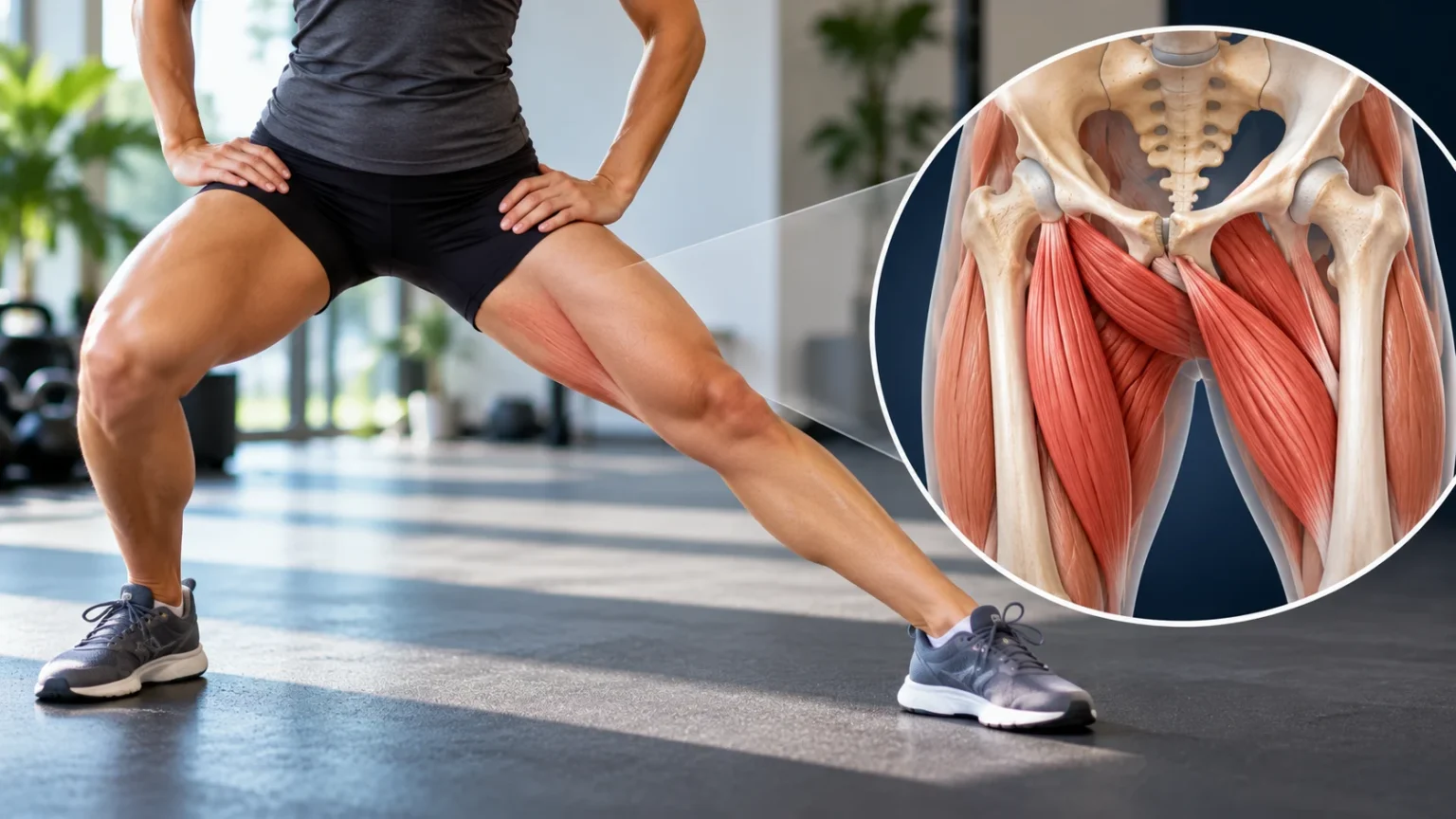

The hip adductor muscles are an important group of muscles located mainly along the inner thigh. They help move the leg toward the body’s midline, stabilize the pelvis, and support everyday movements such as walking, running, climbing stairs, and changing direction. Although they are often associated with groin stretches, their role in movement is much broader.
Strong and flexible hip adductors contribute to balance, lower-body control, and efficient movement. They work together with the glutes, hip flexors, hamstrings, and core muscles to keep the hips and pelvis stable during activity. When these muscles become weak, tight, overloaded, or injured, people may notice groin discomfort, reduced mobility, or difficulty with certain movements.
Understanding hip adductor anatomy and function can make exercise, rehabilitation, and injury prevention easier to approach. Learning which muscles belong to the adductor group, what they do, and how they respond to training can help you make better decisions about mobility and strengthening. This guide explains the key facts in clear, practical terms.
What Are the Hip Adductor Muscles?
The hip adductors are a group of muscles located primarily on the inner side of the thigh. Their main job is hip adduction, which means bringing the leg inward toward the centerline of the body. They also contribute to other movements depending on hip position, including flexion, extension, rotation, and stabilization during weight-bearing activities.
The major muscles commonly included in the adductor group are adductor longus, adductor brevis, adductor magnus, gracilis, and pectineus. These muscles originate from different areas of the pelvis and attach to various parts of the femur or lower leg. Their shared location allows them to work together while still performing slightly different functions.
The adductors are active during both simple and demanding activities. They help control the legs while standing, stabilize the pelvis during walking, and produce force during running, jumping, and side-to-side movement. This makes them important not only for athletes but also for anyone who wants reliable hip and lower-body function.
Main Hip Adductor Muscles Explained
Adductor longus is one of the most recognizable inner-thigh muscles and lies relatively close to the surface. It helps pull the thigh toward the midline and can also assist with hip flexion in certain positions. Because of its location and workload during sports, it is commonly involved in groin strains and overuse problems.
Adductor brevis sits deeper than adductor longus and also contributes strongly to hip adduction. It connects the pelvis to the upper portion of the femur and assists in controlling the leg during movement. Although smaller than some neighboring muscles, it plays an important role in coordinated hip motion and stability.
Adductor magnus is the largest muscle in the adductor group and has a broad attachment along the femur. Different portions can assist with hip adduction, flexion, and extension depending on the position of the leg. Its size and structure allow it to contribute significantly to powerful lower-body movements such as running, squatting, and rising from a seated position.
Other Muscles Involved in Hip Adduction
The gracilis is a long, thin muscle that runs from the pelvis down the inner thigh and crosses both the hip and knee joints. It helps adduct the hip while also assisting with knee flexion and inward rotation of the lower leg. Because it crosses two joints, its function changes slightly depending on leg position.
The pectineus is positioned toward the upper inner thigh and contributes to hip adduction and flexion. It is sometimes grouped with the hip flexors as well as the adductors because of its anatomical position and function. The muscle is particularly active during movements that combine lifting the thigh with bringing it inward.
Other nearby muscles may assist with inward movement or pelvic stability even though they are not traditionally classified as primary hip adductors. Human movement rarely depends on one isolated muscle group. Instead, the adductors constantly coordinate with surrounding muscles to control the position of the hip, pelvis, knee, and trunk.
Anatomy of the Hip Adductor Muscles
Most hip adductors originate from areas of the pelvis, including portions of the pubic bone and ischium. They then travel downward toward the femur, where several attach along a ridge known as the linea aspera. This arrangement allows the muscles to generate inward pulling force while also contributing to control of the hip joint.
The gracilis is different because it continues below the knee and attaches to the upper tibia. Its longer path allows it to influence both hip and knee movement. Adductor magnus is also anatomically distinctive because its different sections have different attachment patterns and can contribute to both hip adduction and extension.
The adductor muscles receive nerve signals mainly through branches of the obturator nerve, although portions of certain muscles have additional nerve supply. Their blood supply comes from several vessels in the pelvic and thigh region. These anatomical relationships help explain why inner-thigh symptoms can sometimes involve muscles, nerves, joints, or nearby soft tissues.
What Do the Hip Adductors Do?
The primary function of the hip adductors is to bring the thigh inward toward the body’s midline. You can feel this action by standing with your legs apart and bringing one leg toward the other. The same muscles also become active when you squeeze your knees together or control the legs during certain resistance exercises.
Hip adduction is only one part of their function. Depending on joint position, different adductors can help flex or extend the hip and contribute to rotation. These additional roles make the muscle group important during complex movements where the leg must change direction while the pelvis remains stable.
The adductors also help control unwanted movement rather than simply producing motion. During walking or running, they can help prevent excessive side-to-side movement of the thigh and pelvis. This stabilizing role becomes particularly important when standing on one leg, changing direction quickly, or managing uneven surfaces.
Role of Hip Adductors in Walking and Running
During walking, the adductors contribute to keeping the pelvis and thigh controlled as body weight shifts from one leg to the other. They help guide the leg into an efficient position rather than allowing it to drift excessively outward. Their work happens alongside the glutes, core, hip flexors, and other stabilizing muscles.
Running places greater force demands on the adductor group because each stride involves faster movement and higher impact. The muscles help control the leg during the stance phase and contribute to repositioning it for the next step. Sprinting, cutting, and acceleration can place even greater demand on the inner-thigh muscles.
Athletes involved in soccer, hockey, basketball, tennis, and similar sports often rely heavily on the adductors. Rapid changes of direction, kicking, skating, and lateral movement can place substantial stress through the groin region. This helps explain why adductor strains are relatively common in sports involving repeated explosive lower-body movements.
Hip Adductors and Pelvic Stability
The pelvis needs to remain relatively controlled while the legs move underneath the body. The adductors contribute to this stability by helping manage the position of the femur and pelvis during standing and movement. Their contribution becomes especially noticeable during single-leg activities such as walking, running, lunging, and stair climbing.
Weakness or poor coordination in one area of the hip can cause other muscles to work harder. The adductors may compensate when the glutes, core, or other stabilizers are not contributing effectively. For this reason, lower-body assessment usually looks at several muscle groups rather than treating the inner thigh as an isolated system.
Joint movement and muscle control are closely connected throughout the body. Just as people may notice harmless joint sounds such as neck cracking in other regions, sensations around the hip can have different causes and do not always indicate muscle damage. Persistent pain, however, deserves proper assessment rather than assumptions.
Tight Hip Adductors: What It Can Feel Like
Tight hip adductors may create a pulling or restricted sensation along the inner thigh or groin. Some people notice discomfort when spreading the legs apart, performing deep squats, taking long strides, or moving laterally. The feeling may be related to muscular stiffness, reduced tolerance to stretch, fatigue, or increased tension after exercise.
Sitting for long periods may also contribute to a sensation of hip stiffness, although the causes can vary between individuals. Muscles do not necessarily become physically shorter simply because they feel tight. Sometimes the nervous system, recent training, joint mobility, or temporary muscle fatigue can influence how flexible or restricted the area feels.
Gentle movement, progressive strengthening, and appropriate mobility work may help when the issue is related to normal stiffness. Aggressive stretching is not always necessary and can sometimes irritate sensitive tissue. If tightness is accompanied by sharp pain, swelling, bruising, weakness, or symptoms that continue worsening, professional assessment may be appropriate.
Weak Hip Adductors and Possible Signs
Weak hip adductors may reduce control during movements that require the leg to move inward or stabilize against lateral forces. You might notice difficulty with side lunges, Copenhagen planks, ball squeezes, or sports involving rapid direction changes. However, perceived weakness can also come from pain, poor coordination, or limited familiarity with a movement.
Muscle weakness is best assessed through controlled strength testing rather than appearance or flexibility alone. Someone can have flexible adductors and still lack strength, while another person may feel tight despite having strong muscles. Strength, mobility, coordination, and endurance are separate qualities that can influence how the hip performs.
A balanced lower-body program should usually train the adductors along with the glutes, quadriceps, hamstrings, calves, and trunk muscles. Focusing only on one area may leave other movement needs unaddressed. Progressive resistance exercises can help the adductors tolerate everyday and athletic loads more effectively over time.
Hip Adductor Strains and Groin Pain
An adductor strain occurs when muscle fibers are overloaded beyond their current capacity, often during sudden or forceful movement. Sprinting, kicking, slipping, changing direction, or stretching aggressively can sometimes trigger the injury. Symptoms may include inner-thigh or groin pain, tenderness, weakness, and discomfort when bringing the legs together.
Strains vary in severity. Mild injuries may produce soreness and small reductions in strength, while more significant strains can involve bruising, swelling, and difficulty walking or performing sports movements. Returning to intense activity too quickly can prolong recovery, especially when strength and movement tolerance have not been fully restored.
Not all groin pain comes from an adductor strain. Hip joint problems, abdominal structures, tendons, nerves, and other tissues can produce symptoms in a similar region. Persistent, severe, or unexplained pain should be evaluated by a qualified healthcare professional so the underlying cause can be identified appropriately.
Exercises That Strengthen the Hip Adductors
Simple adductor strengthening can begin with exercises such as squeezing a soft ball or cushion between the knees. This creates an isometric contraction, meaning the muscles produce tension without significant joint movement. Isometric exercises can be a useful starting point because the intensity can be adjusted easily by changing how hard you squeeze.
Standing band adduction is another useful option. Attach a resistance band to a stable point, loop it around one ankle, and move the working leg inward against resistance while keeping the torso controlled. The movement should remain smooth, and resistance should be light enough to prevent twisting or leaning through the body.
More advanced exercises may include lateral lunges, sliding adductor movements, sumo squats, and Copenhagen plank variations. These movements challenge the adductors through different positions and levels of resistance. Progress gradually because inner-thigh muscles can become significantly sore when exposed to demanding exercises that are new to the body.
Stretching and Mobilizing the Hip Adductors
Adductor stretching often involves moving the legs apart until a comfortable stretch is felt along the inner thighs. A wide-stance side shift, butterfly stretch, or supported kneeling adductor stretch can all target the region. The position should create mild tension rather than sharp pain, pinching, or strong discomfort in the groin.
Breathing slowly and avoiding bouncing can make stretching easier to control. Many people benefit from holding comfortable positions briefly and repeating them rather than forcing a deep stretch immediately. Mobility work can also include gentle movement in and out of the position instead of relying only on long static holds.
Stretching is most useful when it addresses an actual mobility need. If limited movement is caused primarily by weakness, irritation, or joint-related factors, simply stretching harder may not solve the problem. Combining suitable mobility work with strengthening often provides a more complete approach to improving hip function.
Conclusion
The hip adductor muscles are a group of important inner-thigh muscles that support movement, stability, and lower-body control. Adductor longus, brevis, magnus, gracilis, and pectineus work together to bring the thigh inward while contributing to several additional hip and knee movements.
These muscles play an important role in walking, running, balance, sports, and pelvic stability. Strength, flexibility, and coordination all influence how effectively the adductors perform. Problems can develop when the muscles are overloaded, undertrained, irritated, or asked to handle more force than they are prepared for.
A balanced approach that includes progressive strengthening, comfortable mobility, and appropriate recovery can help maintain healthy adductor function. Persistent groin pain, significant weakness, bruising, or difficulty walking should not be ignored. Professional assessment can help determine whether symptoms involve an adductor injury or another structure around the hip and pelvis.
FAQs
Where are the hip adductor muscles located?
The hip adductors are located mainly along the inner thigh, extending from the pelvis toward the femur and, in the case of the gracilis, down to the upper tibia.
What is the main function of the hip adductors?
Their main function is hip adduction, meaning they bring the thigh toward the body’s midline. They also assist with hip stability, rotation, flexion, extension, and control during walking and running.
What causes tight hip adductors?
Adductors may feel tight after exercise, prolonged inactivity, unfamiliar movements, or increased training demands. Reduced mobility, fatigue, muscle sensitivity, and individual movement patterns can also contribute to the sensation.
How do you strengthen the hip adductor muscles?
Exercises such as ball squeezes, standing band adduction, lateral lunges, sumo squats, and Copenhagen planks can strengthen the adductors. Resistance and difficulty should be increased gradually.
When should groin pain be checked by a professional?
Seek professional evaluation if groin pain is severe, persistent, worsening, associated with significant swelling or bruising, or makes walking difficult. Not all groin pain is caused by an adductor strain.