
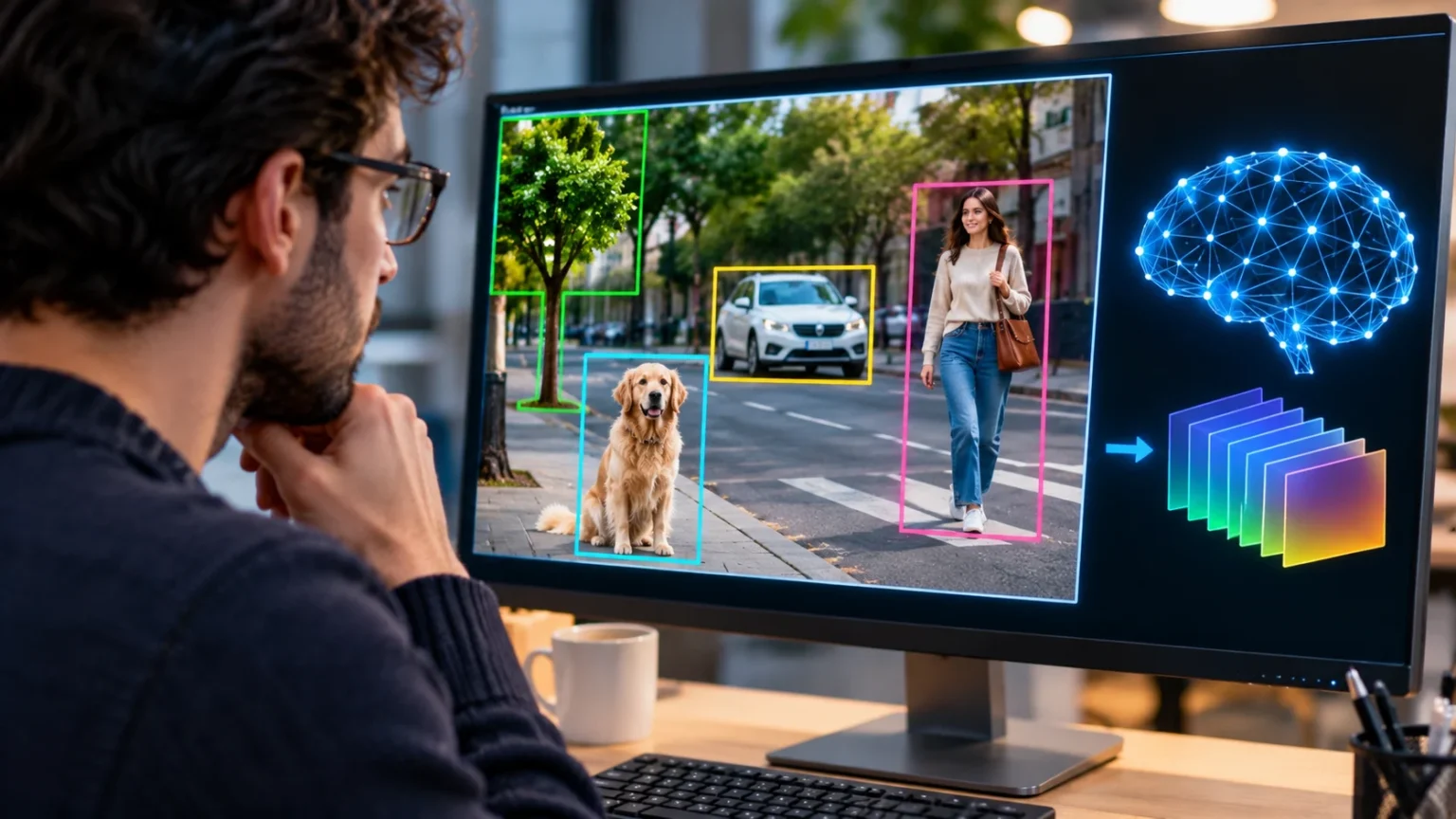

Have you ever wondered how your smartphone recognizes faces, animals, or objects in photographs? Artificial intelligence can examine digital pictures and identify visual patterns within seconds. However, AI does not understand images exactly like humans do. It uses mathematical models, training data, and computer vision techniques to recognize objects and make predictions about what appears in a picture.
Today, AI image recognition plays an important role in smartphones, healthcare, transportation, security, and online shopping. These technologies can identify everyday objects, detect visual patterns, and organize large image collections. Their growing use makes understanding how artificial intelligence interprets images increasingly valuable.
Learning how AI recognizes objects in pictures does not require advanced programming knowledge. The basic process involves converting images into numerical information, identifying visual features, and comparing patterns learned during training. This guide explains how AI object recognition works, the technologies behind it, and the challenges that affect its accuracy.
What Is AI Object Recognition?
AI object recognition is a technology that allows computer systems to identify objects appearing in digital images. It uses artificial intelligence and computer vision to analyze visual information and recognize patterns. Depending on the model, the system may identify animals, vehicles, furniture, plants, or other objects. The goal is to make useful predictions about image content.
Unlike traditional software that follows manually programmed rules for every object, modern AI models learn from examples. During training, they process images and adjust internal parameters to recognize useful visual features. These learned patterns help the system analyze pictures it has not encountered before. The process allows AI to recognize many different object categories.
Object recognition is closely related to image classification and object detection, but these tasks are not identical. Image classification predicts which categories appear in a picture, while object detection identifies objects and estimates their locations. Some systems can also separate individual objects at the pixel level. These capabilities support a wide range of practical applications.
How Does AI Recognize Objects in Pictures?
AI recognizes objects in pictures by analyzing numerical representations of image pixels. A digital image contains values describing brightness and color at different positions. Computer vision models process these values to identify visual patterns associated with particular objects. During this process, the system transforms raw image information into increasingly meaningful features.
For example, when analyzing a picture of a dog, an AI model may detect patterns involving edges, shapes, textures, and object parts. It combines these features to estimate whether the picture contains a dog. The model does not need to compare the image with an identical photograph. Instead, it uses patterns learned from many training examples.
The final prediction depends on the model’s architecture, training data, and the image being analyzed. A well-trained system may recognize objects across different backgrounds, lighting conditions, and camera angles. However, unusual images can still cause mistakes. AI object recognition is therefore a prediction process rather than a guarantee of perfect visual understanding.
What Is Computer Vision in Artificial Intelligence?
Computer vision is a field of artificial intelligence focused on extracting useful information from images and videos. It helps computers analyze visual content and perform tasks that involve recognizing patterns, objects, and scenes. Computer vision supports technologies ranging from image search to medical imaging. Object recognition is one of its most widely used applications.
Computer vision systems combine image processing methods with machine learning models. Traditional image processing may adjust brightness, reduce noise, or highlight edges. Machine learning then helps identify patterns that correspond to meaningful categories. Modern deep learning systems can learn many of these features directly from training data.
Computer vision includes several important tasks beyond recognizing objects. These include image classification, object detection, image segmentation, and visual tracking. Each task answers a different question about an image or video. Together, they allow AI systems to interpret visual information for practical purposes.
How AI Converts Pictures Into Digital Information
Before AI can analyze a picture, the image must be represented in a form computers can process. Digital photographs are made from tiny picture elements called pixels. Each pixel contains numerical values representing brightness or color. The arrangement of these values creates the visible image displayed on a screen.
Color images commonly use red, green, and blue channels to represent different colors. Each channel stores numerical information for individual pixels. When these values are combined, they form the photograph’s visible colors and details. AI models use this numerical information as the starting point for visual analysis.
Image data may also undergo preparation before entering a recognition model. Common steps include resizing images, adjusting numerical ranges, and converting data into suitable formats. These operations help maintain compatibility with the model’s input requirements. Careful preparation can improve efficiency and support more consistent predictions.
How Machine Learning Helps AI Identify Objects
Machine learning allows AI systems to identify patterns by learning from examples rather than relying entirely on manually written instructions. During training, a model receives images and information about their contents. It makes predictions and adjusts its internal parameters based on training feedback. Repeating this process helps the model improve its recognition performance.
Consider a system trained to distinguish cats from dogs. The training dataset contains many images representing both categories. As the model processes these pictures, it learns combinations of visual features associated with each animal. Over time, it may recognize new cat or dog pictures that were not included in training.
Machine learning performance depends heavily on the quality and variety of training examples. Limited datasets may cause models to struggle with unfamiliar environments or unusual object appearances. Diverse examples help improve recognition across different conditions. However, even models trained on extensive datasets can make incorrect predictions.
The Role of Deep Learning in Image Recognition
Deep learning is a branch of machine learning that uses neural networks with multiple processing layers. These networks can learn complex relationships within large amounts of visual data. Instead of relying exclusively on manually selected features, deep learning models develop internal representations during training. This makes them especially useful for image recognition tasks.
Different layers of a deep learning network can represent different levels of visual information. Earlier processing stages may capture simple patterns, while later stages combine information into more complex representations. These features help distinguish objects with different shapes, textures, and appearances. The exact behavior depends on the network architecture.
Deep learning has significantly improved many computer vision applications. Modern models can classify images, locate objects, and perform detailed visual analysis. However, these systems often require substantial computational resources during development. Their accuracy also depends on training methods, dataset quality, and appropriate evaluation.
How Convolutional Neural Networks Recognize Images
Convolutional neural networks, commonly called CNNs, are a type of deep learning architecture designed to process grid-like data such as images. They use mathematical operations called convolutions to extract visual features. These operations help identify patterns across different image regions. CNNs have played a major role in the development of modern image recognition.
A convolutional layer applies learned filters to image information. Some filters may respond strongly to edges, textures, or other visual structures. As information moves through the network, later layers combine these patterns into more complex features. The model uses these representations to support object classification or detection.
CNNs are widely used because their structure takes advantage of spatial relationships between nearby pixels. They can also share learned filters across image regions, improving computational efficiency. Although other architectures are now common, convolutional networks remain important in computer vision. Their applications include industrial inspection, medical imaging, and visual recognition.
How Vision Transformers Analyze Pictures
Vision transformers are another important architecture used in modern AI image recognition. They apply transformer-based methods to visual information, often representing images as collections of smaller patches. The model converts these patches into numerical representations. It then learns relationships between different parts of the image.
A major feature of transformer-based systems is their use of attention mechanisms. Attention helps models combine information from different image regions when developing visual representations. This allows them to consider relationships between distant parts of a picture. Such connections can be useful when objects contain features spread across multiple regions.
Vision transformers are used in image classification, object detection, and other visual tasks. They may require different training strategies and computational resources compared with convolutional networks. Modern systems sometimes combine elements from both architectures. The best approach depends on the application, available data, and performance requirements.
How AI Models Learn From Training Images
Training is the process through which an AI model develops the ability to recognize visual patterns. Developers collect datasets containing pictures relevant to the intended recognition task. These images may include labels identifying objects or other information. The model uses this data to learn relationships between visual features and expected outputs.
During supervised training, the model predicts an answer and compares it with the correct label. A mathematical function measures the prediction error. An optimization algorithm then adjusts model parameters to reduce that error across training examples. This process repeats many times until the model reaches suitable performance.
Training data must represent the conditions the system will encounter in practical use. For example, an animal recognition model should ideally see different breeds, backgrounds, lighting conditions, and camera angles. Diverse training examples help reduce certain recognition errors. Independent testing is still necessary to evaluate whether the model generalizes successfully.
How AI Detects Multiple Objects in One Image
Object detection allows AI systems to identify several objects within a single photograph. Instead of predicting only an overall image category, the model estimates object locations. These locations are often represented by rectangular bounding boxes. Each detected object may also receive a category label and confidence score.
Imagine a street photograph containing cars, bicycles, pedestrians, and traffic signals. An object detection model can analyze the image and estimate where different objects appear. Its output may contain several bounding boxes with predicted categories. This information is useful for understanding complex scenes containing multiple objects.
Modern object detection systems use different approaches to generate predictions. Some evaluate candidate regions, while others predict object locations more directly. Their performance depends on the model, image quality, and training data. Small or partially hidden objects can remain challenging even for advanced recognition systems.
What Is Image Segmentation in AI?
Image segmentation divides a picture into meaningful regions or identifies which pixels belong to particular objects. Unlike basic object detection, segmentation can provide more detailed information about object boundaries. This makes it useful when rectangular boxes are not precise enough. Segmentation supports tasks requiring careful separation of visual elements.
Semantic segmentation assigns category labels to pixels, such as road, building, or vegetation. Instance segmentation goes further by distinguishing individual objects belonging to the same category. For example, a system may separate several cars appearing in one image. These approaches provide different levels of visual detail.
Segmentation is useful in medical imaging, robotics, manufacturing, and satellite image analysis. A medical application might identify specific regions within a scan for further professional review. A robotics system may use segmentation to understand nearby objects. Accuracy remains important because segmentation errors can affect later decisions.
How AI Recognizes Objects From Different Angles
Real-world objects rarely appear in exactly the same position or orientation. A chair may be photographed from the front, side, or above. AI recognition systems must learn features that remain useful across these different views. Training with varied examples helps models recognize objects despite changes in perspective.
Data augmentation is one technique used to improve recognition under different conditions. Developers may transform training pictures through cropping, rotation, flipping, or brightness adjustments. These modifications expose the model to additional visual variations. Appropriate augmentation can improve generalization, although unrealistic transformations may sometimes reduce training effectiveness.
Modern recognition models can often handle moderate changes in viewpoint and lighting. However, extreme angles, unusual backgrounds, or partial visibility may still cause incorrect predictions. Their ability to generalize depends on architecture and training coverage. This is why realistic and varied image datasets are important.
How AI Identifies Objects in Blurry or Dark Pictures
Blurry images contain less detailed visual information than sharp photographs. Important edges and textures may become difficult to distinguish. Similarly, dark images can hide object features and reduce contrast. These conditions make object recognition more challenging for many AI systems.
Some computer vision applications use image enhancement methods before recognition. Brightness adjustment, denoising, and restoration techniques may improve the visibility of certain features. However, enhancement cannot reliably recover every detail missing from an original image. Artificially generated visual information can also introduce misleading patterns.
Recognition models trained on varied image conditions may perform better when processing challenging photographs. Including realistic low-light and blurry examples during training can improve robustness. Even so, predictions should be interpreted carefully when image quality is poor. Confidence scores do not guarantee that the identified object is correct.
Real-World Examples of AI Object Recognition
Smartphones use AI-powered computer vision for several photography and organization features. Some applications identify subjects, categorize images, and support searches for objects appearing in photo collections. Camera software may also recognize certain scenes to adjust photographic settings. The available capabilities depend on the device and application.
Retail and manufacturing businesses use image recognition to support operational tasks. Visual inspection systems can help identify product defects, while inventory applications may recognize items from photographs. These technologies can reduce repetitive manual work in suitable environments. However, human review may remain necessary when identification errors carry significant consequences.
Healthcare and transportation also use computer vision technologies. Medical imaging systems can assist trained professionals by highlighting patterns that may require attention. Driver-assistance systems may detect road signs, vehicles, and other relevant objects. These applications require careful testing because incorrect predictions can have serious consequences.
Benefits of AI Image Recognition Technology
One major benefit of AI object recognition is its ability to process large numbers of images efficiently. Organizations may need to review thousands of photographs or visual records regularly. Automated recognition can help categorize content and identify relevant patterns. This reduces some repetitive tasks and allows people to focus on more complex decisions.
AI image recognition can also improve accessibility when integrated into appropriate applications. Visual description tools may help users understand certain elements in photographs or digital interfaces. These systems can identify objects and generate descriptive information. However, descriptions may contain errors and should not be considered completely reliable.
Another advantage is the flexibility of computer vision across different industries. Similar underlying technologies can support agriculture, retail, healthcare, and manufacturing applications. Organizations can adapt models to particular visual recognition needs. Successful deployment still requires suitable training data, testing, monitoring, and responsible human oversight.
Why AI Sometimes Makes Mistakes Recognizing Objects
AI recognition systems can make mistakes because visual information is often ambiguous. Different objects may share similar colors, shapes, or textures. A model may confuse an unfamiliar animal with a similar species or misinterpret an unusual photograph. These errors reflect limitations in learned patterns rather than human-like misunderstanding.
Training data problems can also reduce recognition accuracy. If a dataset contains inaccurate labels or limited examples, the model may develop unreliable predictions. Uneven representation of environments and object types can cause inconsistent performance. Careful dataset preparation and evaluation help identify these weaknesses.
Other problems include shadows, reflections, background clutter, and partially hidden objects. A system may also become overly dependent on irrelevant visual cues associated with training examples. Testing models under realistic conditions helps reveal such failures. Reliable computer vision requires continuous evaluation rather than assuming that high training accuracy guarantees success.
The Difference Between AI Vision and Human Vision
Human vision involves the eyes, brain, memory, and experience working together to interpret the surrounding environment. People can often recognize objects using context and previous knowledge. AI vision relies on computational models that process numerical visual information. Although both can identify objects, their underlying mechanisms are different.
Humans often adapt quickly to unfamiliar situations by combining visual information with broader understanding. AI systems may perform exceptionally well on specialized recognition tasks but struggle with unexpected conditions. Their predictions depend on learned representations and training objectives. Strong performance on one task does not automatically indicate general visual understanding.
AI models also lack the direct sensory experience that humans develop through physical interaction with the world. They can associate visual patterns with labels without understanding objects in the same way people do. Nevertheless, computational vision can process large datasets efficiently. Human expertise and AI analysis can complement each other in many applications.
The Future of AI Object Recognition
AI object recognition continues to develop through improvements in model architectures, training methods, and computational efficiency. Researchers are working on systems that recognize more object categories under varied conditions. Models that combine image understanding with language processing are also becoming increasingly useful. These developments may expand the capabilities of visual applications.
Multimodal AI systems can process images alongside text and other types of information. This allows users to ask questions about photographs or request explanations of visible objects. Some systems can also connect visual analysis with broader reasoning tasks. However, their responses may contain incorrect assumptions or inaccurate descriptions.
Future progress will also depend on improving reliability, privacy, and responsible deployment. Developers need to evaluate how recognition systems perform across different environments and user groups. Efficient models may make advanced computer vision more accessible on smaller devices. Careful oversight remains important as visual AI becomes more widely integrated into everyday technology.
Conclusion
AI recognizes objects in pictures by processing digital image information and identifying patterns learned during training. Computer vision, machine learning, and deep learning provide the foundations for this technology. Neural networks transform pixel values into features that help classify and locate objects. Different models use different techniques depending on the recognition task.
Object recognition has practical applications in smartphones, manufacturing, healthcare, transportation, and many other industries. It can automate visual analysis, organize information, and support specialized decision-making. However, recognition accuracy depends on training data, image quality, and model design. Understanding these limitations helps people use the technology more responsibly.
As artificial intelligence continues to develop, image recognition systems may become more capable and efficient. Improvements in neural networks and multimodal technologies are expanding what computers can do with visual information. Despite these advances, AI predictions remain imperfect and require appropriate evaluation. Learning how these systems work provides a useful foundation for understanding modern computer vision.
Frequently Asked Questions
How Does AI Identify Objects in a Photo?
AI analyzes pixel values and uses trained machine learning models to detect visual patterns. It combines learned features to predict which objects appear in the photo and, in some systems, their locations.
What Technology Does AI Use to Recognize Images?
AI image recognition commonly uses computer vision, deep learning, convolutional neural networks, and vision transformers. These technologies process digital images and learn patterns that help identify objects.
Can AI Recognize Multiple Objects in One Picture?
Yes, object detection models can identify multiple objects in a single picture. They often provide category labels, estimated locations, and confidence scores for each detected object.
Why Does AI Sometimes Identify the Wrong Object?
AI may make mistakes because of poor lighting, unusual angles, blurry photographs, or limitations in its training data. Similar-looking objects and unfamiliar environments can also reduce recognition accuracy.
Is AI Object Recognition the Same as Facial Recognition?
No, object recognition identifies general categories such as cars, animals, and furniture. Facial recognition focuses on detecting or comparing human faces, often for identity-related purposes, and raises additional privacy concerns.