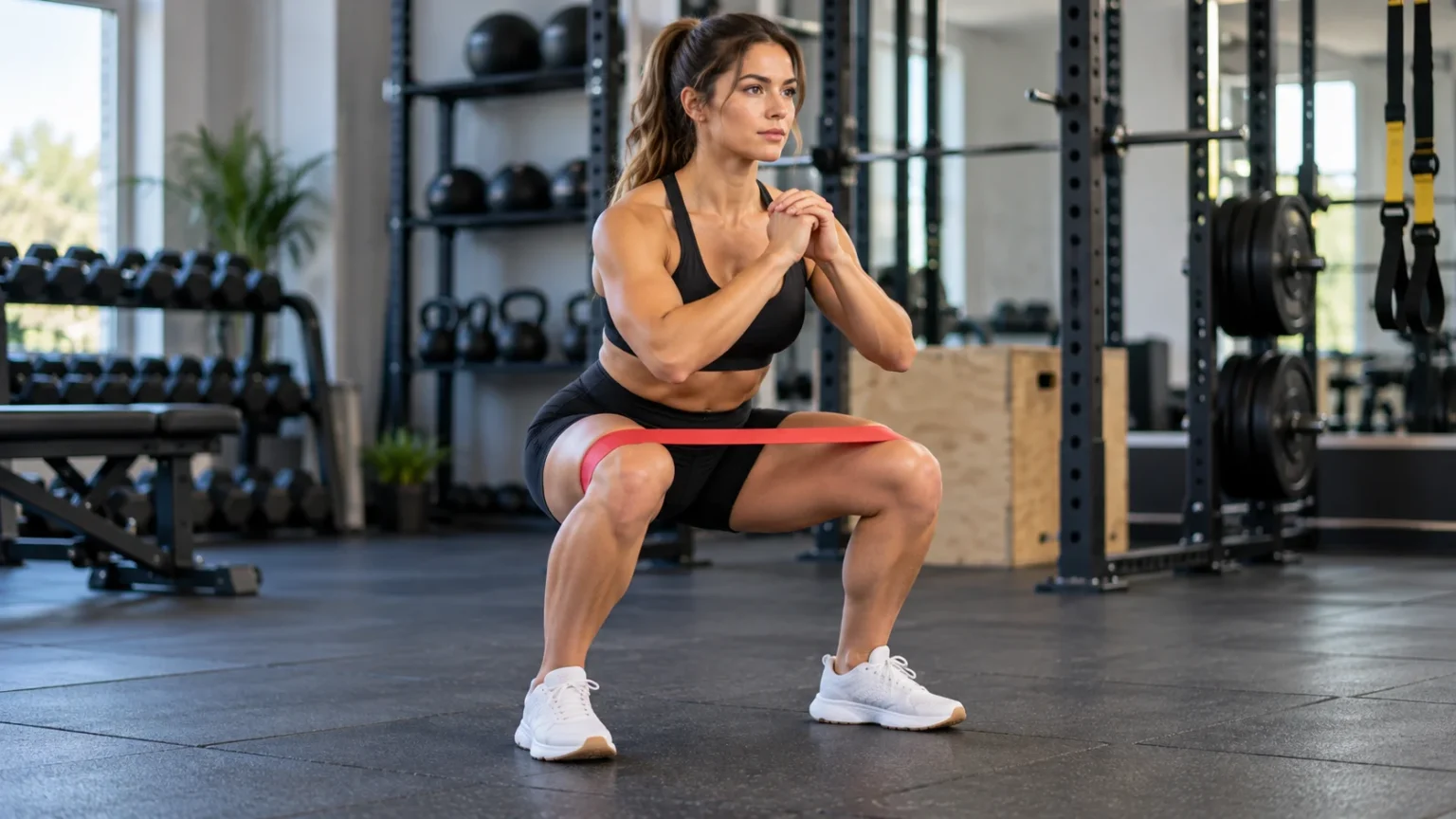

Banded squats are a simple way to make traditional squats more challenging without adding heavy weights. By placing a resistance band around your thighs or using a longer band for added resistance, you can increase muscle activation, improve lower-body control, and add variety to home or gym workouts. They can work well for beginners and experienced lifters alike.
The exercise primarily targets the quadriceps, glutes, and hamstrings while also encouraging the smaller hip muscles to stay active throughout the movement. However, correct band placement and squat technique matter. Understanding how banded squats work can help you get more from the exercise while avoiding common mistakes that reduce its effectiveness.
What Are Banded Squats?
Banded squats are a squat variation performed with a resistance band placed around the legs or positioned to create resistance against the body. A small loop band is commonly placed just above the knees, while longer resistance bands can be anchored beneath the feet and held around the shoulders. Both versions increase resistance during the squat.
When a loop band sits around the thighs, it creates inward tension that your legs must resist throughout the movement. This encourages the hips and glute muscles to remain engaged while you squat down and stand back up. The additional resistance can make an otherwise familiar bodyweight squat feel noticeably more challenging.
Banded squats are popular because they require very little equipment and can be performed almost anywhere. They work well in strength workouts, warm-ups, rehabilitation programs, and home exercise routines. Resistance can also be adjusted easily by changing band strength, positioning, repetitions, or squat depth according to your ability.
Muscles Worked During Banded Squats
The quadriceps are among the main muscles working during a banded squat. Located at the front of the thighs, they help extend the knees as you rise from the bottom position. The deeper you squat within a comfortable range, the more these muscles contribute to controlling the movement and helping you return to standing.
Your gluteus maximus also plays an important role by helping extend the hips as you stand. When a loop band is placed above the knees, the gluteus medius and other hip stabilizers work to resist the band pulling the knees inward. This makes banded squats especially useful for training both larger lower-body muscles and stabilizing muscles around the hips.
The hamstrings, calves, core, and muscles surrounding the ankles also contribute to the movement. Although the hamstrings are not the primary driver of a standard squat, they assist with hip control and lower-body stability. Anyone wanting to train them more directly can also add a focused hamstring workout alongside squats.
Benefits of Banded Squats
One major benefit of banded squats is increased muscle engagement without needing heavy gym equipment. Resistance bands create continuous tension that makes your muscles work throughout the movement. This makes them useful for people who exercise at home, travel frequently, or want to increase squat difficulty before moving to heavier barbells or dumbbells.
Loop bands can also encourage better awareness of knee positioning. Because the band creates inward pressure, you have to actively keep your knees aligned with your feet instead of allowing them to collapse toward each other. This can help reinforce useful movement habits when combined with proper instruction and appropriate resistance.
Banded squats are also easy to adapt to different training goals. You can perform higher repetitions for muscular endurance, slower repetitions for greater time under tension, or stronger-band variations for additional resistance. They also fit naturally into full-body workouts, lower-body sessions, activation routines, and circuits without requiring lengthy equipment setup.
How to Do Banded Squats Correctly
For a basic loop-band squat, place a resistance band around your thighs slightly above the knees. Stand with your feet approximately shoulder-width apart, with your toes pointing slightly outward if that feels natural. Keep your chest comfortably upright, brace your core, and distribute your weight evenly across your feet before beginning the squat.
Push your hips slightly backward while bending your knees and lowering your body under control. Keep gentle outward tension against the band so your knees remain aligned with the direction of your toes. Descend as far as you can while maintaining control, keeping your heels grounded and avoiding excessive rounding through the lower back.
Pause briefly at the bottom if comfortable, then press through your feet and extend your knees and hips to stand. Maintain tension against the band instead of allowing your knees to move inward as you rise. Finish tall without aggressively pushing the hips forward, then reset your position before beginning the next repetition.
How to Choose the Right Resistance Band
Choosing the correct band makes a significant difference in squat quality. A very light band may provide little additional challenge, while an excessively strong band can pull your knees inward and disrupt your natural movement. Begin with resistance that you can control throughout the complete repetition without changing your normal squat mechanics.
Loop bands are convenient for placing around the thighs and are commonly available in several resistance levels. Fabric bands often feel more secure around the legs, while latex bands can provide smooth elastic resistance in a smaller package. Long resistance bands offer more exercise options and can be positioned beneath the feet to make the entire squat more demanding.
Your ideal resistance level may change depending on how you use the exercise. A lighter band may be suitable for warm-ups and technique practice, while a stronger band can provide more challenge during dedicated strength sessions. Progress only when you can complete your planned repetitions with stable knees, controlled tempo, and consistent squat depth.
Important Form Tips for Better Banded Squats
Keep your entire foot connected to the floor throughout the squat. Your heel, the base of your big toe, and the base of your little toe should feel stable rather than allowing your weight to roll dramatically inward or outward. A balanced foot position creates a stronger base and can improve control through the knees and hips.
Pay attention to your knee alignment rather than simply pushing your knees outward as hard as possible. The goal is generally to keep the knees tracking comfortably in line with the feet while resisting unwanted inward collapse. Excessively forcing the knees apart can be just as unnecessary as allowing them to fall inward under band tension.
Control your breathing and trunk position as well. Take a comfortable breath and brace your midsection before descending, then maintain enough tension to keep your torso stable through the repetition. Avoid holding excessive tension longer than necessary, especially during high-repetition sets, and reset your breathing naturally between repetitions when needed.
Common Banded Squat Mistakes to Avoid
Using too much resistance is one of the most common mistakes. A heavy band may look more challenging, but it can cause your movement quality to break down if you cannot maintain proper knee alignment. Resistance should support progressive training rather than force you into awkward positioning or significantly reduce your comfortable squat depth.
Another mistake is thinking only about pushing against the band while ignoring the rest of the squat. Your feet, hips, knees, trunk, and breathing still need to work together. Focusing entirely on spreading the knees apart can lead to poor balance and unnecessary movement instead of a smooth, controlled squat pattern.
Moving too quickly can also reduce the effectiveness of the exercise. Dropping rapidly into the bottom position and bouncing upward may limit muscular control and make it harder to notice technique problems. Slowing the lowering phase slightly can increase time under tension while helping you monitor knee position, balance, and comfortable range of motion.
Banded Squat Variations to Try
Banded bodyweight squats are the simplest variation and a good place to begin. Place a loop band above your knees and perform your normal squat while maintaining gentle outward pressure. Once this version becomes comfortable, you can increase repetitions, use a slightly stronger band, slow the tempo, or hold the bottom position briefly.
Banded goblet squats add external weight by holding a dumbbell or kettlebell in front of your chest. The weight increases the overall strength challenge while the loop band continues to provide resistance around the hips. This combination can be useful for intermediate exercisers who want more lower-body loading without progressing immediately to heavy barbell squats.
You can also try resistance-band front squats using a long band underneath your feet and across the front of your shoulders. The band provides increasing resistance as you stand because it stretches more near the top. Other options include banded sumo squats, squat pulses, tempo squats, and box squats depending on your goals and experience.
How to Add Banded Squats to Your Workout
Beginners can usually start with two or three sets of controlled repetitions using light resistance. Instead of focusing on completing as many repetitions as possible, prioritize movement quality and stop the set when your technique begins to change. Gradually increase repetitions or resistance as your strength and confidence improve over several training sessions.
Banded squats can also be used as a warm-up exercise before heavier lower-body training. Performing a small number of controlled repetitions may help you practice squat mechanics and activate muscles around the hips before weighted squats. However, avoid exhausting yourself during the warm-up if heavy strength exercises are planned afterward.
For home workouts, banded squats can be combined with lunges, bridges, hip hinges, calf raises, and other resistance-band movements. Allow adequate recovery between challenging lower-body sessions so your muscles have time to adapt. Your weekly training frequency should reflect your overall workout volume, resistance level, experience, and recovery rather than following a rigid number.
Are Banded Squats Good for Beginners?
Banded squats can be beginner-friendly when the person already understands the basic squat movement or uses a light enough resistance band. The band provides feedback around the thighs, which can make some people more aware of their knee position. However, adding resistance does not automatically correct poor squat mechanics.
Someone who struggles with balance, mobility, or comfortable squat depth may benefit from practicing an unbanded bodyweight squat first. Holding a stable surface or squatting toward a chair can make the movement easier to learn. Once the basic pattern feels controlled, a light resistance band can gradually introduce an additional challenge.
Beginners should also avoid comparing their band strength or squat depth with other people. Limb proportions, mobility, training history, and individual anatomy influence how a squat looks. A useful starting point is the deepest comfortable position you can control while keeping your feet stable, knees aligned, and movement free from unusual pain.
Banded Squats for Glute Activation
Banded squats are frequently included in glute-focused workouts because the band creates resistance against hip abduction and external rotation. When you maintain appropriate tension against the band, muscles around the side of the hips have to contribute to controlling the legs. This can make the exercise feel different from a standard bodyweight squat.
However, banded squats should not be treated as the only exercise needed for building stronger glutes. Hip hinges, lunges, step-ups, hip thrusts, deadlift variations, and other movements can challenge the glutes through different positions and resistance patterns. A balanced strength program generally produces better results than relying heavily on one exercise.
You also do not need to force excessive outward pressure against the resistance band to activate your glutes. Maintain enough tension to keep your knees moving naturally in line with your feet. Combining controlled technique with progressive resistance over time is more important than trying to create an intense burning sensation during every set.
When to Avoid or Modify Banded Squats
Muscle fatigue during exercise is expected, but sharp or unusual joint pain should not be ignored. If banded squats repeatedly cause knee, hip, ankle, or lower-back pain, stop the exercise and reassess your technique, resistance, and range of motion. Reducing band tension or squat depth may make the movement more comfortable in some cases.
People recovering from an injury or surgery may need individualized guidance before adding resistance-band exercises. A physical therapist or other qualified healthcare professional can determine whether squatting is appropriate and how it should be progressed. Rehabilitation exercises should address the specific injury rather than relying on general fitness recommendations from an online routine.
You should also modify the exercise if fatigue causes your knees to collapse inward, your heels to rise, or your trunk position to change significantly. Ending the set before technique deteriorates is usually more useful than completing extra repetitions with poor form. Quality repetitions provide a better foundation for gradually increasing training difficulty.
Conclusion
Banded squats are a versatile lower-body exercise that combines the familiar squat pattern with additional resistance from an elastic band. They mainly train the quadriceps and glutes while also involving the hamstrings, core, calves, and hip stabilizers. The exercise can be performed at home, in a gym, or as part of a warm-up.
Good technique matters more than using the strongest possible band. Keep your feet stable, maintain comfortable knee alignment, lower yourself under control, and use resistance that allows you to complete every repetition consistently. Beginners can start lightly and gradually increase difficulty as strength, coordination, and confidence improve.
Banded squats can support strength, muscular endurance, movement practice, and lower-body training variety when used appropriately. Combine them with other lower-body exercises for more balanced development rather than depending on squats alone. If the movement causes persistent or sharp pain, stop and consider professional guidance before continuing.
FAQs
What are banded squats good for?
Banded squats can strengthen the quadriceps and glutes while challenging hip stabilizers and lower-body control. They are useful for home workouts, warm-ups, strength routines, and adding resistance without heavy equipment.
Where should the band go for banded squats?
For loop-band squats, the band is commonly placed around the thighs slightly above the knees. Avoid placing excessive resistance directly across the knee joint or using a band you cannot control.
Do banded squats build glutes?
Banded squats can help train the glutes, especially when resistance encourages the hip muscles to stabilize the legs. For greater development, combine them with hip hinges, lunges, step-ups, and hip-extension exercises.
How many banded squats should I do?
Beginners can start with two or three controlled sets using manageable resistance. The exact repetition range depends on your fitness level, training goal, band strength, technique, and other exercises in your program.
Are banded squats better than regular squats?
Neither version is automatically better. Banded squats add elastic resistance and hip-stability demands, while regular squats provide a simple foundation that can be progressively loaded using bodyweight, dumbbells, kettlebells, or barbells.