
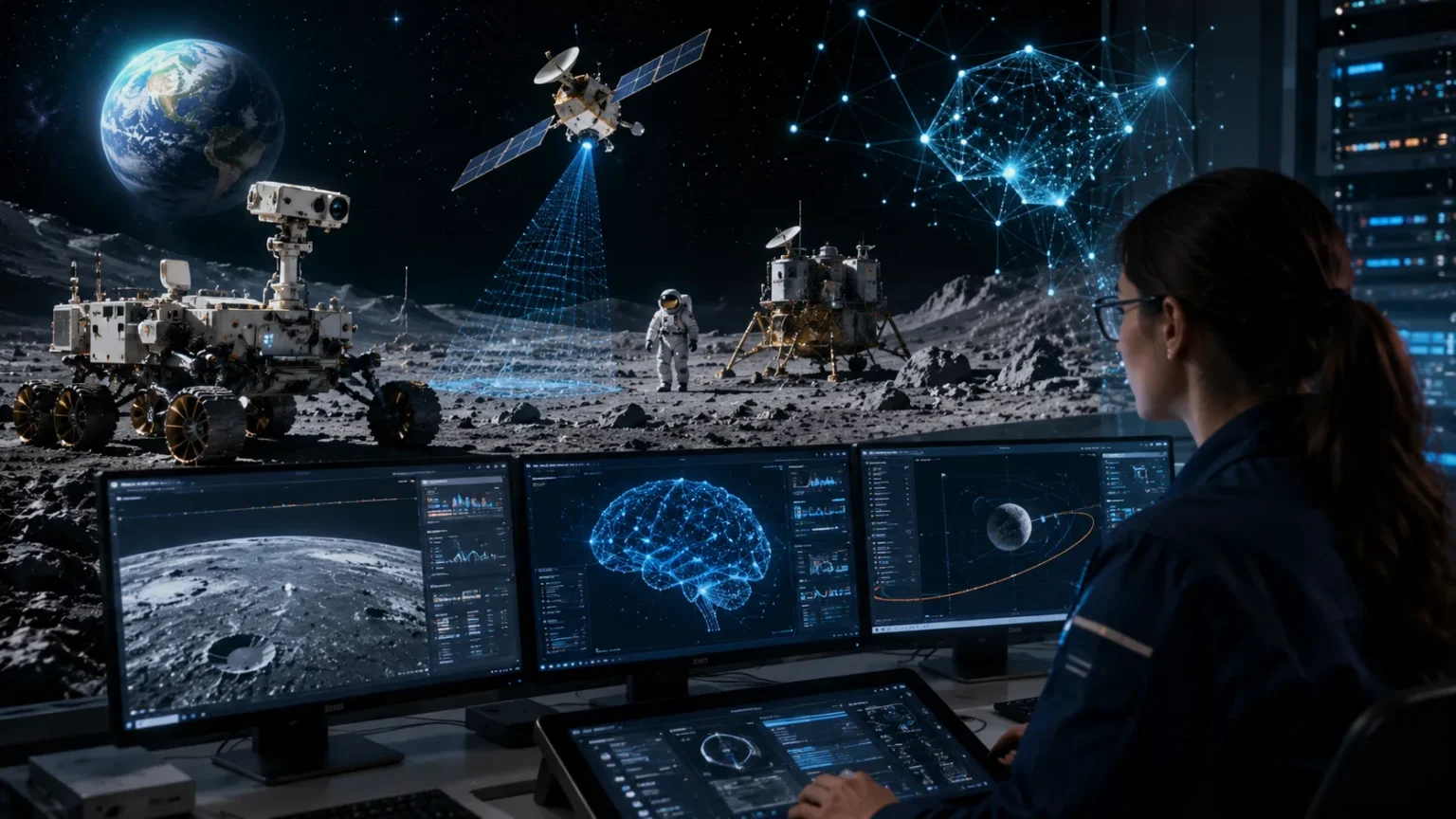

How Is AI Used in Space Exploration?
Meta Description: Discover how AI is used in space exploration, from autonomous Mars rovers and spacecraft navigation to data analysis, satellites, and future missions.
Artificial intelligence is changing how humans explore space by giving spacecraft, rovers, satellites, and mission teams faster ways to analyze information and make decisions. Instead of relying entirely on instructions sent from Earth, modern space technology can increasingly identify patterns, avoid hazards, prioritize scientific observations, and respond to changing conditions with greater independence.
So, how is AI used in space exploration? AI is used for autonomous navigation, spacecraft monitoring, planetary science, satellite image analysis, mission planning, robotics, astronomy, communication management, and many other demanding tasks. Machine learning and computer vision are particularly valuable when enormous quantities of information must be processed quickly.
AI becomes especially useful as missions travel farther from Earth. Communication delays make continuous human control impractical when exploring Mars and more distant destinations. Giving robotic explorers greater autonomy allows them to perform useful work even when mission controllers cannot provide immediate instructions.
The goal is not to remove scientists, engineers, or astronauts from space exploration. Instead, artificial intelligence works as another powerful tool that helps people make better use of limited mission time, computing resources, energy, and scientific opportunities. That combination of human expertise and machine autonomy could become increasingly important in future exploration.
What Does AI Mean in Space Exploration?
Artificial intelligence in space exploration refers to computer systems capable of performing tasks that normally require some form of human reasoning, recognition, prediction, planning, or decision-making. These systems can analyze sensor data, recognize objects, identify unusual events, calculate routes, and recommend or perform appropriate actions.
The term includes several technologies rather than one single system. Machine learning in space, computer vision, autonomous planning, natural language processing, robotics, neural networks, and intelligent fault-detection systems can all fall within the broader category of artificial intelligence used by space organizations.
Some AI systems operate on Earth, where powerful computers process enormous collections of telescope or satellite data. Others run directly aboard spacecraft, satellites, or planetary rovers. Onboard AI can be especially valuable because information does not always need to travel back to Earth before a decision can be made.
The amount of autonomy varies considerably between missions. Some systems simply help scientists classify information, while others can make limited operational decisions within carefully defined rules. Space agencies generally test these technologies extensively because reliability and predictable behavior are critical when equipment operates millions of miles away.
Why Is AI Important for Space Exploration?
Distance is one of the biggest challenges in exploring space. Commands sent to distant spacecraft do not arrive instantaneously because radio signals are limited by the speed of light. As missions travel farther away, the delay becomes too significant for controllers on Earth to manage every movement in real time.
AI helps solve this problem by allowing spacecraft to handle certain decisions themselves. A planetary rover, for example, can analyze nearby terrain and avoid obstacles instead of stopping after every short movement while engineers decide exactly where it should travel next. NASA uses autonomous systems for precisely this kind of planetary exploration.
Space missions also produce enormous volumes of data. Cameras, spectrometers, radar instruments, telescopes, and environmental sensors continuously collect information that scientists must eventually examine. Machine learning can identify interesting patterns or observations within these large datasets much faster than manually reviewing every measurement.
AI can also improve the efficiency of expensive missions. Spacecraft have limited power, storage, communication bandwidth, and operating time, so every observation matters. Intelligent systems can help prioritize high-value scientific information and determine which targets deserve additional attention before an opportunity disappears.
How AI Helps Spacecraft Navigate Autonomously
Autonomous navigation is one of the most valuable applications of AI in space exploration. Computer vision allows spacecraft and robotic vehicles to interpret pictures of their surroundings, while navigation algorithms use those observations to estimate location, identify obstacles, and determine safer routes.
A Mars rover cannot be driven like a remote-controlled car on Earth because communication delays prevent instant commands. Instead, engineers can give a rover a destination while onboard systems evaluate rocks, slopes, sand, and other hazards along the route. The rover can then adjust its movement accordingly.
This level of autonomy helps exploration vehicles travel farther while reducing the amount of detailed route planning required from mission teams. NASA’s Perseverance rover uses autonomous navigation technology to analyze terrain through its cameras and find routes around potential obstacles while traveling across Mars.
AI navigation could become even more important for missions exploring asteroids, moons, caves, and other environments that are poorly mapped. ESA and NASA researchers continue investigating vision-based navigation and machine-learning approaches that could allow future spacecraft to operate effectively in unfamiliar surroundings.
How AI Is Used by Mars Rovers
Mars provides one of the clearest examples of artificial intelligence supporting planetary exploration. Rovers must move through uneven terrain while conserving energy, protecting scientific instruments, identifying valuable targets, and working around long communication delays between Earth and the Red Planet.
Autonomous driving systems allow rovers to evaluate terrain using cameras and onboard computing. Instead of engineers specifying every small movement, the rover can identify potentially dangerous obstacles and select appropriate paths toward a larger destination. This gives mission teams more time for scientific planning.
AI is also moving beyond driving. NASA has tested artificial intelligence that helps Perseverance study Martian rocks by analyzing their composition and deciding when additional measurements could improve scientific understanding. This allows the rover to respond to discoveries while examining a target rather than waiting for another round of Earth-based instructions.
More recently, Perseverance demonstrated another step toward greater autonomy when AI-generated waypoints were used to plan drives across Mars. Such experiments show how future robotic explorers could combine human-defined scientific goals with increasingly capable onboard or AI-assisted planning systems.
How AI Finds the Best Route on Another Planet
Before a robotic vehicle moves, it needs to understand what lies ahead. Cameras capture images of the surrounding terrain, and onboard software interprets those images to distinguish potentially traversable ground from rocks, steep slopes, sand traps, cliffs, or other dangerous features.
Computer vision is particularly important during this process. It allows a rover to extract useful information from images in much the same way that vision systems help autonomous vehicles understand roads on Earth. The environment, however, is dramatically different because there may be no detailed maps or familiar road markings.
Navigation algorithms combine those observations with information about the rover’s position, destination, mobility, and operational limits. The system can evaluate alternative paths and choose one that balances safety with progress rather than simply traveling along the shortest possible route.
Greater autonomous navigation can allow planetary robots to explore larger areas during their operational lives. It may also help future missions enter difficult environments such as lunar craters or Martian caves where communication can become limited and detailed instructions from Earth may be difficult to receive.
How AI Helps Spacecraft Understand Where They Are
Knowing a spacecraft’s location is essential for navigation, but determining position becomes challenging when familiar Earth-based navigation systems are unavailable. Future explorers may need to recognize terrain, stars, planetary landmarks, or nearby objects to estimate their position without continuous ground assistance.
Computer vision can compare images captured by onboard cameras with previously collected maps or recognizable features. Algorithms can then estimate the spacecraft or rover’s location based on similarities between the observed landscape and stored information.
In 2026, NASA’s Jet Propulsion Laboratory described a technology called Mars Global Localization that allows Perseverance to compare panoramic navigation-camera images with orbital maps and determine its location more independently. The approach illustrates how autonomous localization could reduce reliance on human navigation support.
Similar concepts may eventually support exploration on the Moon, Mars, asteroids, and other planetary bodies. Reliable autonomous localization would be especially helpful when robots travel far from previously explored areas or enter environments where communication links and conventional navigation techniques become unreliable.
How AI Helps Scientists Analyze Planetary Rocks
Planetary exploration is not simply about moving from one location to another. Scientists want to understand the chemistry, mineralogy, geological history, and potentially habitable conditions of distant worlds. AI can help instruments recognize scientifically interesting information during these investigations.
Machine-learning algorithms can examine measurements produced by instruments such as spectrometers and compare patterns within the data. When unusual minerals or compositions are detected, an intelligent system may flag the observation for scientists or perform additional measurements when its mission rules permit.
This type of onboard analysis is useful because interesting geological opportunities may not remain available indefinitely. A rover might move away from a target before scientists on Earth have fully reviewed the original measurements. Onboard intelligence can help capture valuable information while the instrument is still positioned correctly.
NASA has demonstrated this idea with Perseverance’s planetary science instruments, where AI has supported autonomous decisions based on real-time analysis of Martian rock composition. It represents an important transition from robots that simply execute commands toward explorers capable of responding to scientific observations themselves.
How AI Is Used in Satellites
Artificial intelligence is also changing how satellites operate around Earth. Modern satellites collect enormous amounts of imagery and sensor information for weather monitoring, environmental science, agriculture, mapping, disaster response, climate research, communications, and many other applications.
Traditionally, much of that information is transmitted to ground stations before detailed processing occurs. However, communication bandwidth is limited, and transmitting enormous collections of low-value or unusable images can consume valuable resources. Onboard AI provides another option.
A satellite equipped with machine-learning software can potentially analyze imagery before sending it to Earth. It may detect clouds, fires, storms, vegetation changes, floods, or other features and prioritize observations that are most useful for scientists and decision-makers.
NASA demonstrated this increasingly autonomous approach in an Earth-observation test where onboard AI analyzed imagery and helped determine where an instrument should look next without direct human involvement. The entire test sequence was completed rapidly while the satellite remained in orbit.
How AI Improves Earth Observation From Space
Earth-observing satellites constantly produce valuable images of oceans, forests, cities, farmland, glaciers, weather systems, and natural disasters. Reviewing this massive flow of data manually would require enormous amounts of time, which makes machine learning particularly suitable for extracting useful information.
AI models can be trained to recognize patterns within satellite imagery. Researchers can then use those systems to help identify changes such as deforestation, wildfire activity, flooding, damaged infrastructure, changing coastlines, or agricultural conditions across large geographic regions.
Rapid analysis can become especially valuable during emergencies. When floods, storms, fires, or other disasters occur, identifying important changes quickly may help organizations understand affected areas. Automated image analysis can reduce the amount of information humans must examine before finding relevant observations.
The technology does not remove the need for scientific interpretation. Satellite imagery can be complicated, and models may misclassify unusual conditions. Human experts remain essential for validating important findings, improving algorithms, and deciding how satellite observations should ultimately be used.
How AI Helps Spacecraft Choose What Data to Send Home
Spacecraft can collect far more information than they are sometimes able to transmit. Communication bandwidth becomes particularly limited for distant missions, meaning scientists must carefully decide which measurements and images are worth sending back to Earth.
AI can analyze data onboard and identify observations that appear scientifically valuable. Instead of transmitting every similar image, a spacecraft might prioritize unusual geological features, unexpected atmospheric activity, or other events that match mission objectives.
NASA’s work on autonomous science systems has explored exactly this idea. Intelligent software can detect scientific events, adjust observations, and select higher-value information for transmission, allowing missions to make more effective use of limited communication opportunities.
This could become increasingly important during deep-space exploration. A probe operating far beyond Mars may have very limited opportunities to communicate with Earth, so the ability to filter and prioritize data locally could dramatically increase the scientific value returned from each communication session.
How AI Detects Problems With Spacecraft
A spacecraft contains numerous interconnected systems responsible for power, communication, propulsion, temperature control, computing, navigation, and scientific instruments. A failure in one component can threaten an expensive mission, making early detection of unusual behavior extremely important.
AI can analyze streams of engineering information and learn patterns associated with normal spacecraft operation. When sensor values begin behaving differently from expected patterns, intelligent monitoring systems can flag the anomaly so engineers can investigate before the situation becomes more serious.
This approach is often called anomaly detection or intelligent health monitoring. It can complement conventional engineering limits that trigger alerts when a specific measurement becomes too high or too low. Machine-learning techniques may recognize more complicated relationships involving several measurements changing together.
ESA has explored AI-based approaches for collecting and analyzing onboard information to improve fault detection and system prognosis. Such technologies could become particularly valuable for distant spacecraft that may need to diagnose or respond to problems before engineers on Earth can intervene.
How AI Supports Mission Planning
Every space mission involves thousands of decisions involving schedules, scientific priorities, spacecraft orientation, power consumption, communication windows, instrument availability, and navigation. Coordinating these constraints manually can become extremely complicated, especially as missions grow more ambitious.
Artificial intelligence can support planners by evaluating large numbers of possible schedules or operational choices. An AI planning system can determine how different activities fit together while respecting restrictions involving energy, time, temperature, instrument usage, and spacecraft safety.
Mission controllers can then review computer-generated recommendations rather than constructing every possible plan manually. This allows humans to focus more attention on scientific objectives, unusual situations, and strategic decisions that require broader understanding and judgment.
Autonomous planning will be particularly valuable for deep-space missions because distant vehicles cannot wait for detailed Earth-based instructions whenever conditions change. Future spacecraft may receive broader goals and then determine how to accomplish parts of those goals using available resources.
How AI Is Used in Space Robotics
Robots are essential to space exploration because they can travel into environments that are distant, dangerous, or impossible for humans to reach easily. Rovers, robotic arms, landers, autonomous vehicles, and future robotic assistants can all benefit from artificial intelligence.
AI helps robots understand their surroundings through cameras, depth sensors, and other instruments. Computer vision can identify objects and terrain, while planning algorithms determine how a robot should move or manipulate equipment without colliding with its environment.
Robotic systems may also assist astronauts. Intelligent robots could carry equipment, inspect spacecraft, perform repetitive maintenance tasks, explore hazardous locations, or support surface operations during future lunar and Martian missions, reducing unnecessary risk for human crews.
NASA already uses robotics throughout planetary exploration and the International Space Station, while researchers are developing increasingly autonomous systems capable of operating with less external control. Greater robotic independence will become especially important as missions move farther from immediate human assistance.
Can AI Help Explore Caves on Mars and the Moon?
Planetary caves are scientifically exciting because they may preserve geological information and provide environments protected from some hazards found on exposed surfaces. However, exploring underground environments creates major challenges for navigation, mapping, communication, and robotic mobility.
Signals may be obstructed once a rover travels underground, making continuous communication with Earth extremely difficult. An autonomous robot would therefore need to understand its surroundings, create maps, choose routes, and avoid hazards without depending on detailed instructions for every movement.
Researchers have investigated coordinated teams of autonomous robots for exploring caves on Mars and the Moon. Multiple robots could potentially divide exploration tasks while maintaining communication links between themselves and transferring collected scientific data back toward the surface.
AI could help such robots decide where to travel next based on previous observations. Rather than following a completely predetermined path, an intelligent exploration system might recognize promising geological features and adapt its route while still operating within safety and mission constraints.
How AI Is Used in Astronomy
Modern astronomy produces extraordinary quantities of information. Ground and space telescopes can collect millions of images, spectra, light curves, and other measurements, creating datasets far larger than individual astronomers could manually examine one observation at a time.
Machine learning can search these datasets for recognizable patterns. AI tools may help classify galaxies, identify unusual astronomical objects, analyze stellar behavior, detect transient events, or select promising observations that scientists should investigate more closely.
Pattern recognition is especially useful when researchers already have large training datasets containing known examples. Algorithms can learn statistical characteristics associated with particular objects and then search newly collected observations for candidates displaying similar properties.
AI does not independently determine the scientific meaning of every discovery. Astronomers still examine evidence, test explanations, compare results, and determine whether a candidate represents something scientifically significant. Machine learning primarily helps researchers search vast datasets more efficiently.
How AI Helps Scientists Search for Exoplanets
Exoplanets are planets orbiting stars beyond our solar system. One way astronomers find them is by looking for small, repeated decreases in a star’s brightness when a planet crosses in front of it from our viewing perspective.
Telescope surveys can observe enormous numbers of stars, producing huge collections of brightness measurements. Machine-learning algorithms can help examine these light curves and identify patterns that resemble possible planetary transits, allowing scientists to narrow their search.
However, a decrease in brightness does not automatically prove that a planet exists. Stellar activity, binary stars, instrumental effects, and other phenomena can sometimes create similar signals. Potential discoveries therefore require additional scientific validation.
AI becomes valuable because it helps researchers prioritize candidates hidden inside huge datasets. Instead of replacing astronomers, algorithms act as powerful screening tools that can direct human attention toward observations that deserve more detailed investigation.
How AI Could Assist Astronauts
Future astronauts traveling beyond low Earth orbit may operate far from immediate mission-control assistance. During a Mars mission, communication delays would prevent astronauts from having instant conversations with specialists on Earth whenever an unexpected technical or operational problem occurs.
AI assistants could provide crews with rapid access to procedures, spacecraft information, troubleshooting guidance, and mission data. An intelligent system might organize complex information and help astronauts identify relevant instructions when time-sensitive decisions must be made.
Artificial intelligence could also assist with scheduling and resource management. Long-duration crews must carefully manage energy, equipment, experiments, maintenance, supplies, and daily activities, creating an environment where intelligent planning tools could reduce workload.
Human judgment would remain crucial. Astronauts operate in unusual situations that may not match an AI system’s training or assumptions, so critical decisions require appropriate safeguards and human oversight. The most useful systems will likely function as decision-support tools rather than unrestricted replacements for crew expertise.
Can AI Help Search for Life Beyond Earth?
One of the biggest scientific goals in space exploration is determining whether life exists or once existed beyond Earth. Missions investigating Mars, icy moons, and distant planets may collect chemical, geological, atmospheric, and imaging data relevant to this question.
Machine learning can help scientists search complicated datasets for patterns worth investigating. Algorithms might identify unusual combinations of molecules, minerals, geological structures, or atmospheric signals and prioritize observations for closer scientific examination.
However, detecting an unusual pattern is very different from proving extraterrestrial life exists. Many non-biological processes can produce chemistry that initially appears interesting, and AI models can make mistakes when they encounter unfamiliar conditions.
Any potential sign of life would therefore require extensive verification using multiple forms of evidence. AI can make the search more efficient by helping scientists locate promising observations, but interpretation and confirmation would remain one of the most demanding scientific challenges imaginable.
How AI Helps Explore Asteroids and Comets
Asteroids and comets present difficult navigation environments because they are relatively small, may have irregular shapes, and can possess extremely weak gravity. Approaching, orbiting, landing on, or collecting samples from these objects requires exceptionally precise navigation.
Computer vision can help spacecraft identify surface landmarks and estimate relative position. Intelligent navigation systems could continuously analyze images as the spacecraft approaches an object and adjust its trajectory according to observed terrain and movement.
AI could also help choose scientifically valuable observation or sampling locations. Surface images, composition measurements, slope information, illumination, and other factors can be combined to evaluate potential targets while avoiding hazardous regions.
Greater onboard autonomy would reduce dependence on continuous instructions from mission controllers. This becomes especially useful during fast or complex operations when waiting for Earth-based analysis could consume valuable time or make immediate adjustments impossible.
How AI Could Improve Moon Exploration
The Moon is becoming an important destination for robotic and human exploration, and AI could support many aspects of future lunar missions. Autonomous rovers may scout terrain, map resources, examine geological features, and investigate areas before astronauts arrive.
Some lunar locations present unusual navigation challenges. Deep craters, permanently shadowed regions, rough terrain, and changing lighting conditions can make movement difficult. Computer vision and intelligent navigation systems could help robots recognize hazards and adapt their routes.
AI may also support lunar infrastructure by monitoring power systems, habitats, communication equipment, and other technology. Intelligent maintenance systems could identify unusual behavior early, allowing astronauts or robotic equipment to respond before a small issue threatens operations.
As lunar exploration expands, coordinating multiple rovers, scientific instruments, habitats, and crew activities may require increasingly sophisticated planning. AI could help combine information from these different systems and support more efficient decisions while humans remain responsible for critical mission choices.
How AI Could Support Missions to Mars
Sending humans to Mars would create challenges unlike those encountered during short missions near Earth. Crews would face communication delays, limited supplies, complex maintenance demands, harsh environmental conditions, and reduced access to immediate outside assistance.
Artificial intelligence could support spacecraft health monitoring during the journey. Algorithms might detect unusual patterns in life-support, electrical, thermal, or propulsion systems and help crew members determine which components require attention before failures become serious.
On the Martian surface, autonomous robots could scout routes, transport equipment, inspect infrastructure, and assist scientific operations. Some robotic systems could potentially be deployed before astronauts arrive to prepare equipment or gather information about landing and exploration areas.
AI could also help manage schedules and mission resources. The objective would not be to hand control of a Mars expedition to artificial intelligence, but to provide the crew with reliable tools capable of reducing workload and helping them make informed decisions far from Earth.
What Is Machine Learning’s Role in Space Exploration?
Machine learning is a branch of artificial intelligence in which algorithms learn useful patterns from examples or data rather than relying only on manually programmed rules. It is particularly useful when information is too complicated or abundant for straightforward human classification.
In space exploration, machine learning can help recognize terrain, classify images, detect anomalies, analyze instrument measurements, predict equipment behavior, and search massive scientific datasets. Its exact role varies according to the mission and the quality of available training data.
Training usually occurs before deployment using carefully prepared datasets. Engineers test a model against examples it has not previously seen to determine how reliably it performs. Space applications require particularly rigorous evaluation because correcting mistakes after launch may be difficult or impossible.
Not every intelligent spacecraft system uses machine learning. Traditional algorithms, automated rules, optimization methods, and AI planning systems also perform important autonomous tasks. Effective missions choose technologies according to the problem rather than using machine learning simply because it is popular.
How Computer Vision Is Used in Space
Computer vision enables machines to extract useful information from images and video. In space exploration, cameras are among the most important scientific and navigation instruments, which makes visual intelligence especially valuable for robotic missions.
A planetary rover can use computer vision to estimate the size and position of rocks, analyze terrain, identify obstacles, and determine whether nearby ground appears traversable. Similar techniques can help spacecraft recognize landmarks while approaching planets, moons, or asteroids.
Scientists can also use computer vision on Earth to classify images returned by missions. Algorithms can help identify craters, geological formations, atmospheric features, surface changes, and other patterns across collections containing thousands or millions of images.
Visual algorithms still face difficult conditions such as extreme shadows, unfamiliar terrain, dust, unusual lighting, and limited computing power. Designing computer vision that remains reliable under these conditions is therefore an important challenge for autonomous space exploration.
How AI Saves Time for Space Scientists
Scientists working on space missions receive enormous quantities of information from cameras, sensors, and scientific instruments. Manually reviewing every individual observation would consume valuable time and could delay the identification of interesting discoveries.
AI can perform an initial screening of large datasets and group similar observations together. Researchers can then focus on unusual or scientifically promising examples rather than spending equal amounts of time reviewing repetitive information.
Machine learning can also automate routine analytical tasks such as classification, feature recognition, and anomaly detection. Scientists remain responsible for interpreting the results, but automation can reduce repetitive work and make the research process more efficient.
This partnership is one reason AI has become increasingly relevant across astronomy and planetary science. Machines are particularly good at rapidly processing large datasets, while humans remain essential for understanding context, questioning assumptions, designing experiments, and recognizing the broader significance of discoveries.
How AI Makes Space Missions More Efficient
Space missions operate under strict limitations. Every spacecraft has limited electrical power, processing capability, memory, communication bandwidth, and operating life. Engineers must therefore maximize the scientific return produced by those finite resources.
AI can improve efficiency by determining which observations deserve immediate attention. An intelligent spacecraft might prioritize unusual information, adjust an observation sequence, or avoid transmitting redundant data that consumes communication capacity without adding much scientific value.
Autonomous navigation can provide another efficiency gain. If a rover can safely handle smaller route decisions independently, engineers do not need to manually plan every movement. The vehicle can spend more of its operational time traveling toward scientific targets.
These advantages become increasingly important as exploration moves deeper into the solar system. Long communication delays make Earth-centered control less practical, so spacecraft capable of safely handling routine decisions could accomplish more science during the same mission duration.
What Are the Challenges of Using AI in Space?
Reliability is one of the biggest challenges. An AI mistake on Earth can sometimes be corrected quickly, but a faulty decision aboard a distant spacecraft could damage equipment or jeopardize an entire mission worth hundreds of millions or even billions of dollars.
Another limitation is computing power. Advanced AI systems on Earth often rely on powerful processors and large amounts of energy, while spacecraft must operate within strict power, weight, radiation tolerance, and thermal constraints. Space-qualified hardware may therefore be less powerful than modern terrestrial systems.
Training data presents another challenge. Machine-learning models perform best when their training examples represent the conditions they will encounter. Yet unexplored planets naturally contain environments that scientists have never observed directly, creating the possibility of unexpected conditions.
Engineers address these risks through extensive testing, conservative operating boundaries, redundancy, simulation, human oversight, and carefully defined levels of autonomy. Space AI must be not only capable but also dependable enough for an environment where repairs are often impossible.
Can AI Make Mistakes in Space?
Yes. AI systems can make incorrect predictions, misclassify objects, misunderstand unfamiliar data, or behave poorly when conditions differ from their training. This is one reason autonomous spacecraft are generally designed with carefully controlled responsibilities.
For example, a vision algorithm trained to recognize safe terrain could potentially encounter unusual lighting or geological formations that confuse its classification. Engineers therefore test autonomous navigation systems under many simulated conditions before allowing them to control important spacecraft movements.
Mission designers may also establish safety rules that an intelligent system cannot override. These limits provide an additional protection layer when AI-generated recommendations conflict with fundamental spacecraft constraints involving temperature, energy, movement, or instrument safety.
Human oversight remains extremely important, especially for high-consequence decisions. The future of artificial intelligence in space is therefore likely to involve carefully designed collaboration in which machines handle appropriate tasks while people supervise goals, safety, and scientific interpretation.
Will AI Replace Astronauts and Space Scientists?
AI is unlikely to eliminate the need for astronauts, engineers, or scientists. Space exploration involves creativity, scientific judgment, ethical choices, unexpected situations, physical work, and strategic decisions that cannot simply be reduced to recognizing patterns in data.
Instead, AI can automate repetitive or time-sensitive tasks. A rover can navigate around rocks while scientists concentrate on deciding which geological questions matter. A machine-learning system can screen thousands of images while researchers investigate the most promising observations.
Astronauts may similarly benefit from intelligent assistants that organize information, monitor equipment, or help troubleshoot problems. Removing routine workload can leave crews with more attention for science, maintenance, exploration, and complex decisions.
The strongest model is therefore human-machine collaboration. People establish mission objectives and interpret discoveries, while intelligent systems process information and handle appropriate autonomous tasks. Together, these capabilities can make exploration safer, faster, and scientifically more productive.
What Is the Future of AI in Space Exploration?
Future spacecraft are likely to become more autonomous as missions move farther from Earth. Instead of receiving detailed instructions for every activity, robotic explorers may eventually receive broader goals and determine how to accomplish appropriate parts of those goals themselves.
Multiple autonomous robots could also cooperate. A group of lunar or Martian rovers might divide an area for exploration, share maps, maintain communication links, and collectively decide which regions deserve additional scientific investigation.
Intelligent spacecraft could increasingly analyze observations immediately after collecting them. When an unusual event occurs, the spacecraft might automatically perform additional measurements before the phenomenon disappears, dramatically improving opportunities to study unpredictable events.
Recent experiments involving AI-assisted rover planning, autonomous scientific analysis, spacecraft localization, and onboard Earth-observation processing show that this transition is already underway. The long-term result could be robotic explorers capable of accomplishing increasingly sophisticated science while remaining guided by human goals.
Why AI Could Change Deep-Space Exploration
The farther a spacecraft travels from Earth, the harder it becomes to operate through constant human instructions. Communication takes longer, signals become more difficult to maintain, and spacecraft may encounter situations that mission planners could not completely predict before launch.
AI can give deep-space probes a greater ability to respond locally. A spacecraft could potentially recognize an unusual scientific event, adjust an observation, diagnose a technical problem, or reorganize activities without waiting for a complete sequence of instructions from Earth.
This capability could expand the kinds of destinations humans can explore robotically. Intelligent probes may eventually investigate distant moons, asteroids, planetary atmospheres, underground environments, or regions at the outer edges of the solar system with greater operational independence.
Artificial intelligence will not remove the immense engineering challenges of deep-space travel, but it can make spacecraft more adaptable. As autonomy improves, scientists may be able to design missions that would be impractical if every important decision had to travel back and forth between the spacecraft and Earth.
How Is AI Used in Space Exploration Today?
Today, AI is used in space exploration for autonomous rover navigation, planetary science, satellite imagery, spacecraft monitoring, mission planning, astronomy, robotic research, data prioritization, and experimental autonomous decision-making. Some applications are already operational, while others remain under development and testing.
Mars exploration provides particularly visible examples because autonomous systems help rovers move safely and investigate their surroundings. Recent demonstrations are expanding this role from obstacle avoidance toward AI-assisted route planning, localization, and real-time scientific decision-making.
Earth-orbiting satellites provide another important testing ground. Onboard AI can potentially analyze images before transmission and allow spacecraft to respond more quickly to valuable observations, reducing dependence on traditional ground-based processing for every decision.
These developments illustrate a broader shift in spacecraft design. Instead of functioning only as machines that execute predetermined commands, future explorers could increasingly become capable scientific partners that interpret their surroundings and make carefully bounded decisions in support of human-defined objectives.
Final Thoughts
Understanding how AI is used in space exploration reveals why the technology is becoming increasingly important as humanity travels farther from Earth. AI helps machines navigate, analyze information, recognize scientific opportunities, monitor equipment, prioritize data, and operate when immediate human instructions are unavailable.
The greatest advantage of artificial intelligence is not simply speed. It is the ability to give spacecraft useful independence in environments where communication is delayed and every minute of mission time is valuable. Even relatively limited autonomy can allow scientists to accomplish more with the same spacecraft.
There are still major challenges involving reliability, computing power, training data, explainability, and safety. Space agencies therefore introduce new autonomous capabilities carefully, combining extensive testing with human oversight rather than treating AI as an unrestricted replacement for mission control.
As exploration expands toward the Moon, Mars, asteroids, and deeper regions of the solar system, intelligent machines will likely become increasingly important companions to human explorers. AI may ultimately help us explore environments that are too distant, dangerous, or complex to investigate effectively using human control alone.
Frequently Asked Questions About AI in Space Exploration
How does NASA use AI in space exploration?
NASA uses AI and autonomous systems for rover navigation, scientific data analysis, spacecraft monitoring, mission planning, image recognition, and Earth observation. These tools help missions operate more efficiently when immediate human control is impractical.
Does the Mars rover use artificial intelligence?
Yes. Mars rovers use autonomous navigation technologies, and Perseverance has also tested AI-assisted scientific analysis and route planning. These systems help the rover make certain limited decisions without waiting for detailed instructions from Earth.
Can AI control a spacecraft by itself?
AI can autonomously handle specific spacecraft tasks, but missions generally place strict limits around those capabilities. Human engineers still establish objectives, monitor operations, design safety rules, and control major mission decisions.
How does AI help scientists discover new things in space?
AI can rapidly search enormous datasets for unusual patterns, classify images, analyze instrument measurements, and identify observations worth further investigation. Scientists then evaluate those results and determine their scientific meaning.
Will AI be important for future Mars missions?
Yes. Greater autonomy could help future Mars robots and human crews navigate, monitor equipment, manage resources, analyze scientific information, and respond to problems despite the communication delay between Mars and Earth.