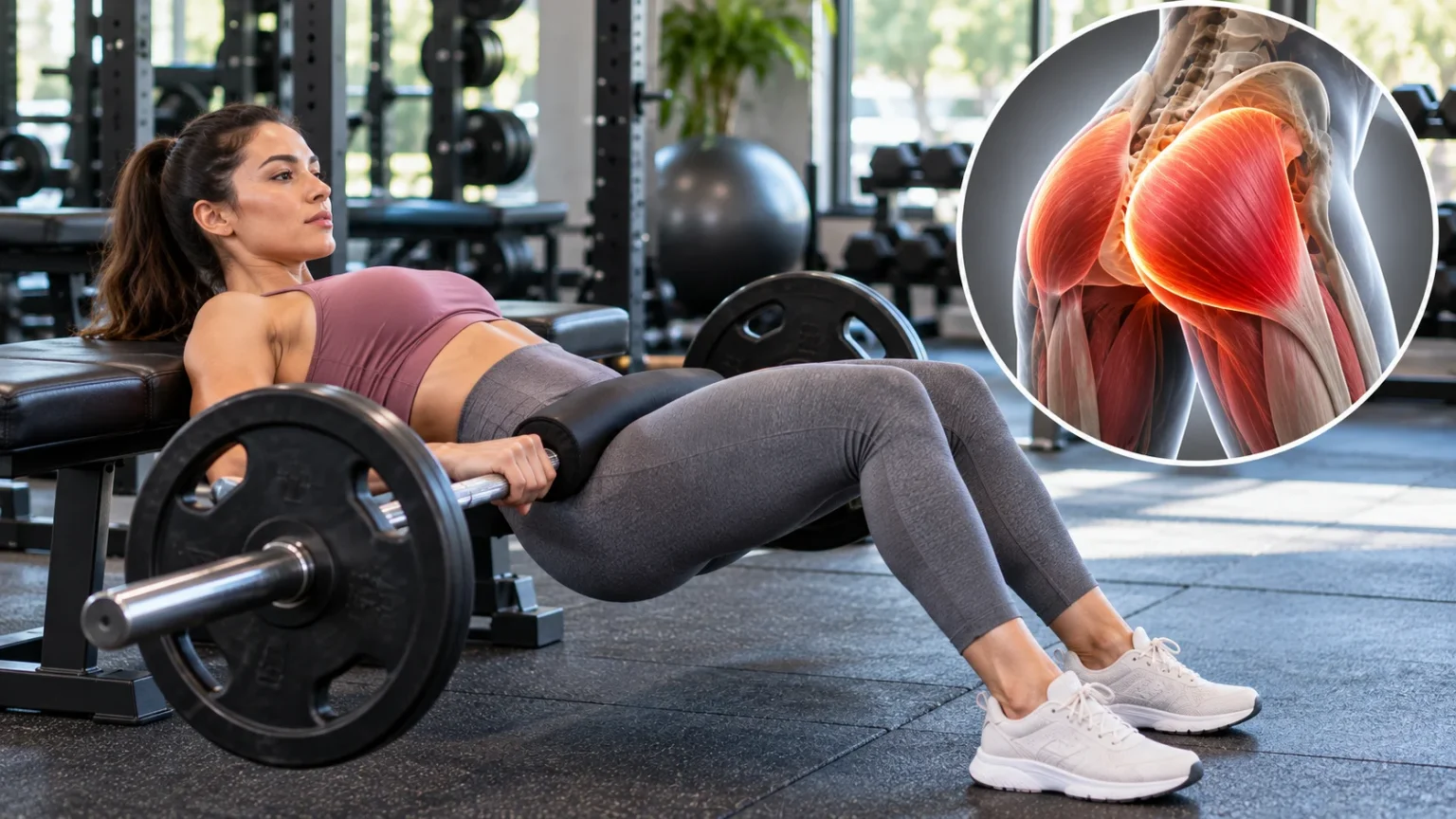

Hip thrusts are one of the most popular lower-body exercises for building strength and muscle around the hips and glutes. The movement is especially known for targeting the gluteus maximus, but several other muscles also help stabilize and control the exercise. When performed correctly, hip thrusts can support stronger hip extension, better lower-body power, and improved movement during both workouts and everyday activities.
Unlike some compound leg exercises, hip thrusts place a strong emphasis on the hips while allowing the knees and lower back to play supporting roles. This makes them useful for people who want to train the glutes directly without relying only on squats or deadlifts. They can be performed with body weight, a resistance band, dumbbells, or a barbell depending on your experience level.
This guide explains the main muscles worked during hip thrusts, the benefits of the exercise, proper technique, common mistakes, useful variations, and practical ways to include hip thrusts in a workout routine.
What Muscles Do Hip Thrusts Work?
The primary muscle worked during hip thrusts is the gluteus maximus. This is the largest muscle in the buttocks and one of the main muscles responsible for hip extension. Every time you drive your hips upward during a hip thrust, the gluteus maximus contracts to move the pelvis into a fully extended position.
The hamstrings also assist during the exercise, although they usually play a secondary role compared with the glutes. These muscles run along the back of the thighs and help extend the hips while also contributing to knee flexion. Their involvement may vary depending on your foot position, range of motion, and the way you perform the movement.
The core, hip abductors, and smaller stabilizing muscles also contribute. Your abdominal muscles help keep the torso stable, while the gluteus medius and other hip muscles support pelvic alignment. Together, these muscles help maintain control so the movement comes mainly from the hips rather than excessive motion through the lower back.
Gluteus Maximus: The Primary Muscle Worked
The gluteus maximus is the main muscle responsible for producing force during hip thrusts. It becomes especially active near the top of the movement when the hips approach full extension. This strong contraction is one reason hip thrusts are widely used in glute-focused strength programs.
The gluteus maximus supports many everyday movements, including standing from a chair, climbing stairs, walking uphill, and rising from a bent position. It also plays a major role in athletic actions such as sprinting and jumping. Strengthening it can therefore support both general movement and sports performance.
To target the glutes effectively, focus on controlled hip extension rather than simply lifting the bar as high as possible. The hips should reach a strong but comfortable finish without excessive arching through the lower back. A brief pause at the top can help reinforce glute engagement and improve control.
Role of the Gluteus Medius and Minimus
The gluteus medius and gluteus minimus are smaller muscles located around the outer hip. During hip thrusts, they help stabilize the pelvis and prevent excessive side-to-side movement. Their contribution becomes especially important when you perform single-leg or banded variations.
These muscles also support hip abduction, which is the movement of the leg away from the body’s midline. Strong hip abductors can help maintain better alignment through the hips and knees during many lower-body exercises. They are especially useful for activities that require balance or movement on one leg.
Adding a resistance band around the thighs can increase the demand on the outer glute muscles. However, the band should not cause your knees to move excessively outward. The goal is to maintain stable alignment while keeping the feet grounded and the hips moving smoothly.
How the Hamstrings Help During Hip Thrusts
The hamstrings assist the glutes by contributing to hip extension. They run from the pelvis down the back of the thigh and work together with the gluteal muscles during many lower-body movements. In hip thrusts, their involvement is usually noticeable but not as dominant as the gluteus maximus.
Foot placement can influence how much the hamstrings contribute. If your feet are positioned too far away from your hips, you may feel more tension in the back of the thighs. Moving your feet slightly closer may increase glute emphasis, although the exact position should still feel comfortable and stable.
If you experience hamstring cramping during hip thrusts, review your setup and reduce the load if needed. Cramping can happen when the hamstrings are taking on more work than expected or when fatigue is high. Slow, controlled repetitions can help you find a more effective movement pattern.
Quadriceps Involvement During Hip Thrusts
The quadriceps also contribute to hip thrusts, although they are not the main target. These muscles are located at the front of the thighs and primarily extend the knee. During hip thrusts, they help stabilize the leg and maintain knee position while the hips move.
Foot placement affects quadriceps involvement as well. When your feet are positioned closer to the body, the knees bend more, which may increase the contribution of the quadriceps. Moving the feet farther away may reduce their involvement while placing more demand on the hamstrings.
The goal is not to eliminate quadriceps activity completely. Instead, you want the movement to remain balanced and controlled while the glutes stay the primary driver. Keeping the knees aligned over the feet can help distribute force effectively and reduce unnecessary stress.
Core Muscles and Hip Thrust Stability
The abdominal muscles play an important stabilizing role during hip thrusts. They help prevent excessive extension through the lower back as the hips rise. Without adequate core control, some people compensate by arching the spine instead of fully contracting the glutes.
A gentle abdominal brace can improve the quality of the movement. Think about keeping your ribs stacked over your pelvis rather than allowing them to flare upward. This position encourages the hips to move while the spine remains relatively stable.
You do not need to contract your core as hard as possible. Instead, use enough tension to maintain control throughout the repetition. Good core stability can make the movement feel smoother and may help you use the glutes more effectively.
Benefits of Hip Thrusts for Glute Strength
One of the main benefits of hip thrusts is their ability to strengthen the glute muscles through hip extension. This can be useful for people who want to improve lower-body strength or develop more balanced muscle around the hips. The exercise can be scaled easily by changing resistance.
Hip thrusts also place the glutes under tension near the top of the movement. This shortened-position loading makes the exercise different from movements such as Romanian deadlifts, which challenge the glutes more in a stretched position. Using both types of exercises can create a more complete strength routine.
Stronger glutes can support many other lower-body movements. Squats, lunges, deadlifts, step-ups, and running all involve the hips to some degree. Building strength with hip thrusts may therefore complement other exercises rather than replacing them.
Hip Thrusts for Athletic Performance
Hip extension is an important part of many athletic movements, including sprinting, jumping, and accelerating. Because hip thrusts directly train this movement pattern, they are often included in athletic strength programs. They can help develop force production around the hips when used alongside other exercises.
However, strength in one exercise does not automatically transfer to every athletic skill. Sprinting and jumping also require coordination, timing, technique, and speed-specific practice. Hip thrusts are best viewed as one tool for building strength rather than a complete athletic training solution.
Athletes often combine hip thrusts with squats, deadlifts, lunges, plyometrics, and sport-specific drills. This provides a broader range of movement patterns and loading positions. A well-rounded program is generally more useful than relying heavily on one exercise.
How to Perform Hip Thrusts Correctly
Begin by sitting on the floor with your upper back against a sturdy bench. Bend your knees and place both feet flat on the ground about hip-width apart. If you are using a barbell, position it across the front of your hips with appropriate padding.
Drive through your feet and raise your hips until your torso and thighs form a relatively straight line. Keep your chin slightly tucked, ribs controlled, and knees aligned with your feet. Squeeze the glutes at the top without pushing the hips so high that your lower back arches.
Lower your hips slowly toward the floor while maintaining control. Do not let the weight drop or bounce at the bottom. Repeat for the desired number of repetitions while keeping the same setup and movement quality throughout the set.
Common Hip Thrust Mistakes to Avoid
One common mistake is overextending the lower back at the top of the movement. This happens when someone tries to push the hips higher after full hip extension has already been reached. The extra motion usually comes from the spine rather than the glutes.
Another mistake is using the wrong foot position. Feet that are too close may shift more work toward the quadriceps, while feet that are too far away may increase hamstring involvement. Adjust your stance until you can drive through the feet while keeping the shins relatively vertical near the top.
Using too much weight can also reduce movement quality. Heavy loads may cause shortened range of motion, bouncing, or loss of control. It is usually better to use a manageable resistance and perform full, controlled repetitions before increasing the load.
Best Hip Thrust Variations
Bodyweight hip thrusts are a good starting point for beginners. They allow you to learn the movement pattern without worrying about balancing extra resistance. Once the technique feels natural, you can gradually add a dumbbell, resistance band, or barbell.
Single-leg hip thrusts increase the challenge by requiring one side to work more independently. They also demand greater pelvic stability and core control. This variation can be useful for identifying side-to-side strength differences, but it may be more difficult to perform with perfect alignment.
Banded hip thrusts can increase tension on the outer glutes when the band is placed above the knees. Barbell hip thrusts are commonly used when the goal is progressive strength or muscle growth. Choose a variation that matches your current ability rather than selecting the hardest option immediately.
Hip Thrusts vs Glute Bridges
Hip thrusts and glute bridges use a similar hip extension movement, but the setup is different. In a glute bridge, your upper back remains on the floor. In a hip thrust, your shoulders are elevated on a bench, which usually allows a greater range of motion.
Because of the larger range, hip thrusts can provide more movement through the hips and are often easier to load heavily. Glute bridges can be more accessible for beginners or people who prefer a floor-based exercise. Both movements can strengthen the glutes effectively when performed with good form.
There is no need to treat one exercise as automatically superior. The better option depends on your goals, equipment, comfort, and training experience. Some people include both movements at different times within the same program.
How Many Hip Thrusts Should You Do?
Beginners can often start with two or three sets of 8–12 controlled repetitions. This range gives you enough practice to learn the movement while creating a moderate training challenge. Focus on consistent form before increasing either the number of sets or the amount of resistance.
For muscle-building goals, moderate repetition ranges with progressive resistance are commonly used. You might perform 8–15 repetitions depending on the load and variation. The final repetitions should feel challenging while still allowing you to maintain proper technique.
If strength is the main goal, lower repetitions with heavier resistance may eventually be appropriate. However, heavier training requires strong technique and good setup. Progress gradually rather than adding large amounts of weight before you can control the full range of motion.
How Often Should You Train Hip Thrusts?
Many people can include hip thrusts in their routine one to three times per week depending on their overall training plan. Your ideal frequency depends on exercise intensity, total volume, recovery, and the other lower-body movements you perform. More sessions are not always better.
If you already perform heavy squats, deadlifts, lunges, and similar exercises, your glutes are receiving considerable training. Hip thrust volume should fit around those movements rather than simply being added on top. Pay attention to soreness, fatigue, and performance when deciding how often to train them.
Allow enough recovery between challenging sessions. If your glutes remain very sore or your performance drops, reducing volume may help. Training consistently with manageable workloads is more useful than repeatedly pushing to exhaustion.
Can Beginners Do Hip Thrusts?
Beginners can perform hip thrusts, but learning the movement with body weight is usually a good place to start. This allows you to practice hip extension, foot placement, and core control before adding external resistance. A sturdy bench and comfortable setup are also important.
If a full hip thrust feels difficult, glute bridges may offer an easier entry point. You can gradually progress from bridges to elevated hip thrusts as strength and coordination improve. Other low-impact movements can also support basic lower-body conditioning, including simple chair exercises when appropriate for your fitness level.
There is no reason to rush toward heavy barbell hip thrusts. Build confidence with the movement first and increase resistance gradually. Good technique should remain consistent whether you are using body weight or a heavily loaded barbell.
When to Modify or Avoid Hip Thrusts
Hip thrusts should feel challenging in the muscles rather than painful in the joints or spine. If you experience sharp lower-back, hip, or knee pain, stop and review your technique. Reducing the load or changing your foot position may help, but persistent pain should not be ignored.
Bench height can also affect comfort. A bench that is too high or unstable may make positioning awkward and place unnecessary stress on the upper back. Choose a secure surface that allows you to move smoothly while keeping your shoulders supported.
People recovering from surgery, significant injuries, or diagnosed hip or spine conditions may need individualized guidance. A physical therapist or qualified healthcare professional can help determine whether hip thrusts are appropriate and which variation best matches your current abilities.
Conclusion
Hip thrusts mainly work the gluteus maximus, with support from the hamstrings, quadriceps, gluteus medius, gluteus minimus, and core muscles. The exercise is especially effective for training hip extension and can be adjusted for beginners, experienced lifters, and many different training goals.
Proper technique matters more than the amount of weight you lift. Keep your ribs controlled, drive through the feet, align the knees, and finish the movement with the glutes rather than excessively arching the lower back. Controlled repetitions usually provide better results than rushed or overloaded sets.
Hip thrusts can be a valuable addition to a balanced lower-body program when combined with squats, lunges, hinges, and other strength exercises. Progress gradually, allow enough recovery, and choose variations that match your experience and comfort level.
FAQs
What muscles do hip thrusts work the most?
Hip thrusts primarily work the gluteus maximus. The hamstrings, quadriceps, outer glute muscles, and core also contribute by assisting hip extension and stabilizing the body during each repetition.
Are hip thrusts better than squats for glutes?
Hip thrusts place strong emphasis on the glutes, while squats train a broader range of lower-body muscles. Both exercises can be useful and often work well together in a balanced program.
Do hip thrusts work the hamstrings?
Yes, the hamstrings assist with hip extension during hip thrusts. However, the gluteus maximus is usually the primary muscle, especially when foot placement and technique are properly controlled.
How many hip thrusts should beginners do?
Beginners can start with two or three sets of around 8–12 repetitions. Bodyweight hip thrusts or light resistance are useful while learning proper form and building confidence with the movement.
Why do I feel hip thrusts in my lower back?
Lower-back discomfort may occur if you overextend at the top, use too much weight, or lose core control. Reduce the load, keep your ribs down, and focus on moving through the hips.