
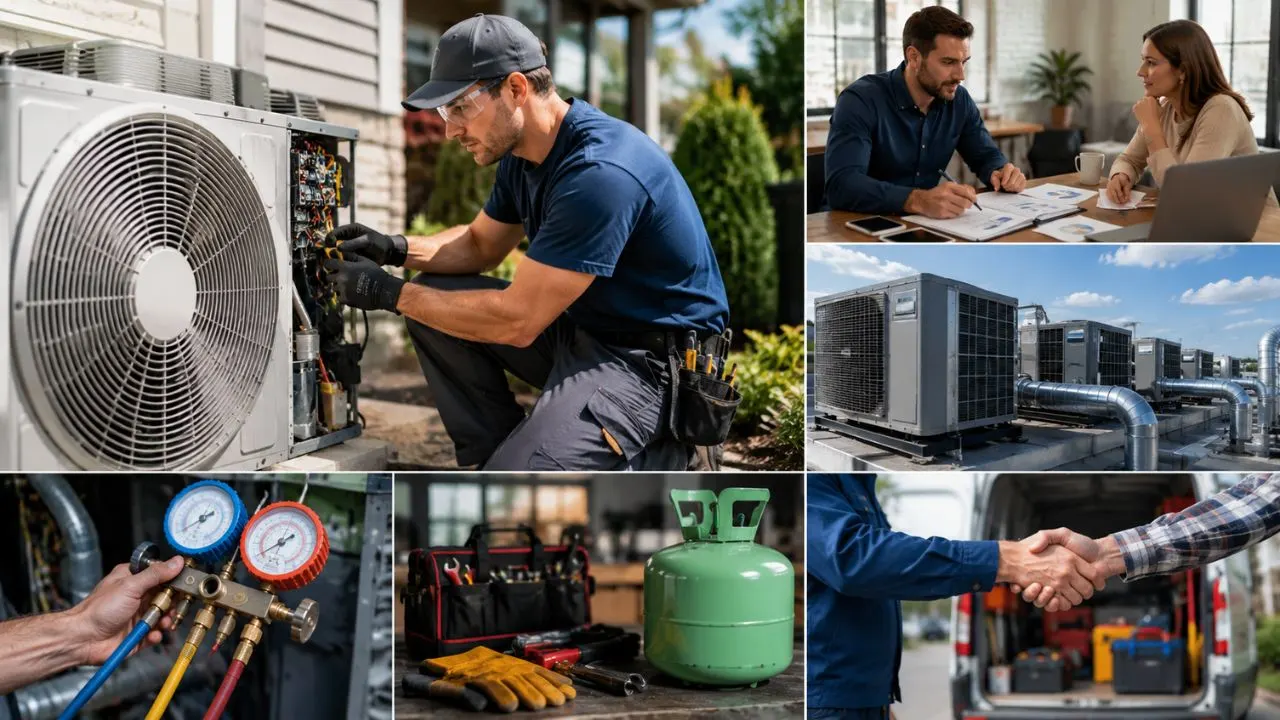

Starting a heating and air conditioning business can turn technical HVAC experience into a valuable local service company. Homes, offices, restaurants, stores, and industrial facilities depend on reliable heating, ventilation, air conditioning, and refrigeration systems. When equipment fails during extreme weather, customers need trained professionals who can respond quickly, diagnose the problem accurately, and complete safe repairs.
However, knowing how to repair an air conditioner is not the same as knowing how to run a profitable HVAC company. A business owner must manage licensing, insurance, tools, vehicles, pricing, scheduling, taxes, customer service, marketing, inventory, and cash flow. Ignoring any one of these areas can create problems even when the owner is an excellent technician.
This guide uses Texas as a practical example because HVAC contractor requirements differ by state. In Texas, businesses offering air conditioning, refrigeration, heating installation, maintenance, modification, or repair must operate through the appropriate Texas Department of Licensing and Regulation framework. An ACR contracting company must also employ a licensed ACR contractor at every permanent business location.
The following steps explain how to start an HVAC business legally and build it around real customer needs. You will learn how to choose a profitable service model, obtain an HVAC contractor license, calculate startup costs, buy equipment, set prices, generate local leads, hire technicians, and create recurring revenue through preventive maintenance agreements.
Quick Answer: How Do You Start an HVAC Business?
Begin by confirming that you have enough technical experience to qualify for the required contractor license. A Texas ACR contractor applicant generally needs either 48 months of qualifying practical experience within the previous 72 months or a Texas technician certification held for the preceding 12 months plus 36 months of supervised experience within the previous 48 months.
Next, choose your business structure, register the company, obtain an Employer Identification Number, and open a dedicated business bank account. A Texas LLC is created by filing a certificate of formation with the Secretary of State and must maintain a registered agent and registered office. The IRS provides EINs directly and without charge.
You must then complete the appropriate TDLR application and examination process, select the correct license class and endorsement, and obtain the required commercial general liability insurance. Anyone who services equipment in a way that could release regulated refrigerants must also hold the appropriate EPA Section 608 technician certification.
Finally, purchase the essential tools and service vehicle, create a pricing system, establish supplier accounts, and launch a focused local marketing campaign. A lean owner-operated heating and cooling business should begin with a limited service area and a small number of profitable services rather than trying to serve every customer and install every type of equipment immediately.
Is Starting a Heating and Cooling Business a Good Idea?
An HVAC company solves an urgent and recurring problem. Air conditioners, furnaces, heat pumps, ventilation systems, thermostats, and refrigeration equipment all require inspection, cleaning, repair, and eventual replacement. This provides several revenue opportunities instead of making the company dependent on one-time equipment installations.
The business also has strong local characteristics. Most customers search for an HVAC contractor near their home or commercial property, which means a smaller company can compete within a carefully selected service area. A professional response, accurate arrival time, clear estimate, and dependable repair can be more important to the customer than the size of the contractor’s advertising budget.
The opportunity is attractive, but the work carries financial and operational risk. Emergency demand can be seasonal, replacement equipment can tie up working capital, and poor installations may produce expensive callbacks. Technicians also work around electricity, pressurized refrigerants, ladders, hot environments, moving equipment, and customer property.
A good HVAC business is therefore built on more than demand. It needs qualified technical leadership, strong safety procedures, disciplined pricing, reliable suppliers, and enough working capital to survive slow periods. The business becomes more stable when it combines emergency calls and installations with recurring HVAC maintenance plans.
Step 1: Choose Your HVAC Business Model
The first decision is whether you will focus on residential HVAC, light commercial systems, refrigeration, new construction, replacement installations, maintenance, or emergency repairs. Each business model requires different tools, training, vehicles, inventory, customer acquisition methods, and financing. A focused company is easier to market and operate than one promising every possible service.
Residential repair and maintenance can be a practical starting point for an experienced owner-operator. The jobs are relatively frequent, the service cycle is shorter, and customers can often approve work during the visit. However, residential customers expect clear communication, clean work, transparent pricing, and convenient scheduling.
Commercial HVAC and refrigeration can produce larger contracts and recurring maintenance revenue. These customers may include offices, restaurants, retail stores, property managers, warehouses, and healthcare facilities. Commercial accounts often require more documentation, longer payment terms, additional insurance, and the ability to provide service outside normal business hours.
New construction and full system replacement can produce higher invoices but require more working capital. Equipment may need to be purchased before the customer pays the complete balance, while permits, labor, ductwork, subcontractors, and scheduling add complexity. Many new HVAC businesses are safer beginning with service and maintenance before expanding into larger installations.
Step 2: Define a Clear Target Market
Avoid describing the target customer as everyone who owns an air conditioner. Choose a geographic area, property type, and primary service need. A useful target might be homeowners with systems more than eight years old within a 20-mile radius, or independent restaurants needing commercial refrigeration maintenance.
Your location affects travel time, fuel costs, competition, property types, and seasonal demand. A wide service area may appear to create more opportunities, but long journeys reduce the number of calls a technician can complete each day. Dense routes usually improve response times, technician utilization, and customer satisfaction.
Research the contractors already serving the area. Study their services, customer reviews, response promises, financing options, warranties, and business hours. Do not copy their websites or pricing. Instead, identify customer frustrations such as missed appointments, unclear estimates, unanswered calls, weak communication, or poor follow-up.
Build your service promise around a problem you can solve consistently. Examples include same-day residential diagnostics, preventive maintenance for small commercial buildings, heat pump expertise, indoor air quality improvements, or dependable refrigeration support for restaurants. A specific position is easier for customers to remember and recommend.
Step 3: Meet the Texas HVAC Contractor License Requirements
Texas issues Class A and Class B Air Conditioning and Refrigeration contractor licenses. A Class A license allows work on units of any size. A Class B license is limited to cooling systems of 25 tons or less and heating systems rated at 1.5 million BTUs per hour or less.
Applicants must also select an endorsement matching the work they intend to perform. Environmental Air Conditioning covers systems used for human comfort, including central heating and air conditioning. Commercial Refrigeration and Process Cooling or Heating covers equipment such as coolers, freezers, ice machines, and production-related temperature control.
A new contractor applicant must be at least 18, document the required supervised experience, submit the application, pay the current $115 application fee, and pass the appropriate TDLR examination. The application and examination requirements must be completed within one year of filing, and the issued contractor license is valid for one year.
Texas contractor license holders must complete eight hours of approved continuing education before renewal, including one hour covering state laws and rules. TDLR also announced that certain initial and renewal applicants may be required to provide documentation establishing lawful presence in the United States beginning January 26, 2026.
Step 4: Obtain EPA Section 608 Certification
An HVAC contractor license and EPA refrigerant certification are separate requirements. EPA regulations require technicians who maintain, service, repair, or dispose of covered equipment that could release ozone-depleting refrigerants to hold Section 608 certification. The requirement also applies to equipment containing most substitute refrigerants, including HFCs.
Technicians earn certification by passing an examination administered through an EPA-approved certifying organization. The available certification categories relate to the types of equipment serviced. A Universal certification is commonly valuable for technicians who expect to work across multiple equipment categories.
EPA Section 608 certification credentials do not expire, but technicians must continue following current refrigerant handling, recovery, recordkeeping, and disposal requirements. Certification should not be treated as the end of refrigerant education because equipment designs, safety procedures, tools, and commonly used refrigerants continue to change.
A new HVAC company should maintain copies of technician credentials and verify certification before assigning refrigerant-related work. The EPA requires technicians to keep proof of certification at their place of business. Training should also cover recovery equipment, leak testing, cylinder management, ventilation, ignition risk, and manufacturer-specific service procedures.
Step 5: Write an HVAC Business Plan
An HVAC business plan should explain what the company sells, who it serves, how it attracts customers, and how it earns a profit. It does not need to be a complicated document filled with unrealistic projections. It should be detailed enough to guide spending, pricing, hiring, and financing decisions.
Start with the service mix. Estimate how many diagnostic calls, repairs, maintenance visits, installations, and service agreements you expect to sell each month. Assign an average invoice value and realistic gross margin to each category. Separate emergency demand from recurring work so the plan does not depend entirely on unpredictable breakdowns.
Create an operating plan covering service hours, dispatch, suppliers, parts ordering, vehicle use, warranties, payment collection, and customer follow-up. Decide which work you will perform personally and which services require employees or subcontractors. Document how after-hours calls will be handled before advertising 24-hour availability.
Add a financial forecast containing startup expenses, monthly overhead, technician labor, materials, marketing, taxes, and owner compensation. The SBA recommends separating one-time and monthly expenses and including categories such as equipment, licenses, insurance, salaries, advertising, and website costs.
Step 6: Calculate HVAC Business Startup Costs
The cost of starting an HVAC company depends on the business model. A technician using a reliable used van and focusing on repairs may launch with much less capital than a company buying a new vehicle, installation equipment, warehouse inventory, and multiple employee uniforms.
For planning purposes, a lean owner-operated HVAC service business may require approximately $40,000 to $80,000. A more heavily equipped company with a newer vehicle, broader inventory, employees, and installation capacity may require $90,000 to $180,000 or more. These are illustrative planning ranges, not vendor quotations.
The budget must include more than the vehicle and tools. Licensing, examination preparation, insurance deposits, branding, software, communications, fuel, uniforms, professional fees, inventory, and marketing all require money before revenue becomes predictable. Working capital is essential because customers, contractors, or commercial accounts may not pay immediately.
The SBA recommends calculating startup expenses before launching so the owner can estimate profitability, conduct break-even analysis, and determine funding needs. It also advises adding one-time expenses to recurring monthly costs rather than budgeting only for the initial equipment purchases.
| Startup Category | Illustrative Planning Range |
|---|---|
| Business formation, professional fees, and permits | $1,000–$4,000 |
| Licensing, examinations, and technical training | $500–$2,500 |
| Used or newer service vehicle | $15,000–$50,000 |
| HVAC tools and diagnostic instruments | $8,000–$22,000 |
| Initial parts, refrigerants, and consumables | $5,000–$18,000 |
| Insurance deposits and first premiums | $2,500–$10,000 |
| Software, phone, website, and branding | $2,500–$12,000 |
| Launch marketing | $2,000–$10,000 |
| Working capital reserve | $15,000–$45,000 |
Step 7: Register the Business and Organize Taxes
Choose between operating as a sole proprietorship, partnership, LLC, or corporation with advice from a qualified accountant or attorney. Many contractors consider an LLC because it separates the business entity from its members and provides management flexibility, but entity protection does not replace insurance or responsible business practices.
A Texas LLC is formed by filing a certificate of formation with the Secretary of State. It must maintain a registered agent and a physical registered office address in Texas. The Texas Secretary of State specifically recommends consulting legal and tax professionals when choosing a business structure.
After forming the entity, apply directly to the IRS for an EIN. The IRS provides EINs free of charge, and businesses can use the number for activities such as opening a bank account and applying for licenses. The IRS advises forming the legal entity with the state before requesting its EIN.
Texas sales-tax treatment can differ according to the property type and contract. For example, nonresidential real-property repair and remodeling is generally taxable on the total charge, while new construction and residential work may follow different contractor rules. Obtain professional tax advice before building tax calculations into estimates and invoices.
Step 8: Buy the Right Business Insurance
Commercial general liability insurance is not optional for an active Texas ACR contractor serving the public. A Class B license requires at least $100,000 per occurrence, $200,000 aggregate for bodily injury and property damage, and $100,000 aggregate for products and completed operations.
A Class A license requires at least $300,000 per occurrence, $600,000 aggregate for bodily injury and property damage, and $300,000 aggregate for products and completed operations. TDLR requires insurance from a provider authorized to sell liability coverage in Texas.
The legal minimum may not be enough for every business. Commercial clients, landlords, general contractors, and property managers may demand higher limits. An HVAC company should also discuss commercial auto, tools and equipment, property, cyber liability, employment practices, and umbrella coverage with an experienced insurance professional.
Private Texas employers can generally choose whether to purchase workers’ compensation insurance, although employers without coverage have notification obligations. HVAC work presents meaningful injury risk, so carrying workers’ compensation can protect employees and reduce uncertainty after a workplace accident.
Step 9: Purchase Essential HVAC Tools and Equipment
Begin with professional tools required for the services you intend to sell. Common categories include hand tools, cordless tools, multimeters, clamp meters, manometers, psychrometers, vacuum pumps, recovery machines, refrigerant scales, leak detectors, combustion analyzers, nitrogen regulators, and evacuation equipment.
Do not buy every specialist tool before the company has customers for the related work. Divide equipment into three groups: required on every service vehicle, needed occasionally, and required only for a future service expansion. This protects working capital while ensuring technicians have the tools required to complete core jobs correctly.
Diagnostic accuracy should receive more attention than tool quantity. Replacing parts without confirming the cause creates callbacks, warranty expenses, and lost customer trust. Budget for reliable instruments, regular maintenance, calibration where required, and training on how to interpret measurements rather than depending entirely on automated recommendations.
Create a tool-control system from the beginning. Record serial numbers, assign equipment to technicians, inspect safety items, and track loss or damage. Tools left at a jobsite or stored without protection can quickly become a major hidden business expense, especially as the company adds more service vehicles.
Step 10: Choose a Service Vehicle and Inventory System
A service vehicle is a mobile workshop and an important part of the customer’s first impression. It should be mechanically dependable, easy to organize, and suitable for carrying tools, recovery cylinders, parts, ladders, and safety equipment. Vehicle downtime can cancel an entire day of appointments.
Buy based on the current business model rather than appearance alone. A residential service company may need less cargo capacity than an installation crew carrying ductwork and large equipment. Compare financing cost, fuel consumption, maintenance history, payload, shelving requirements, and insurance before selecting a van or truck.
Stock frequently used parts that help complete common repairs during the first visit. Depending on the equipment in your market, this may include capacitors, contactors, relays, transformers, drain components, fuses, wire, connectors, filters, thermostats, and approved motors. Avoid tying up cash in slow-moving inventory.
Use minimum and maximum stock levels for each vehicle. Parts should be issued to specific jobs and replenished according to actual use. A simple inventory discipline reduces emergency supplier trips, missing materials, inaccurate job costing, and the tendency to purchase the same part repeatedly because no one knows what is already available.
Step 11: Create Profitable HVAC Pricing
Every price must cover direct labor, payroll burden, travel, materials, overhead, warranty risk, and profit. Copying a competitor’s service-call fee is dangerous because that contractor may have different wages, insurance, debt, productivity, supplier discounts, and marketing expenses. Your pricing must reflect your company’s costs.
Calculate the true cost of one billable technician hour. Include wages, payroll taxes, benefits, nonbillable travel, training, meetings, holidays, callbacks, uniforms, vehicle costs, and administrative support. A technician paid for eight hours may produce only four or five hours of chargeable work after travel and other activities.
Choose whether to use time-and-material pricing, flat-rate pricing, or a combination. Flat-rate pricing can make approval easier because customers see the total repair price before work begins. Time-and-material pricing may be more suitable for unusual commercial work where the final scope cannot be identified during the initial diagnosis.
Review gross margin by job type rather than looking only at revenue. A large installation can produce an impressive invoice but weak profit after equipment, labor, permits, financing fees, and callbacks. Maintenance visits may produce smaller invoices while generating repeat business, future repairs, and replacement opportunities.
Step 12: Build Recurring Revenue With Maintenance Plans
Preventive maintenance agreements make revenue more predictable and give the company a legitimate reason to contact customers before equipment fails. A residential plan may include seasonal inspections, cleaning, priority scheduling, repair discounts, and reminders. Commercial plans may include filters, belt inspections, coil service, documentation, and planned visits.
The agreement must clearly define what is and is not included. Avoid promising unlimited repairs or emergency service unless the price supports that responsibility. State the number of systems covered, visit frequency, customer obligations, renewal terms, cancellation process, discounts, and any exclusions.
Maintenance should provide genuine value rather than functioning only as a sales visit. Use a documented checklist, measurements, photographs, and clear recommendations. Customers are more likely to renew when they can see what was inspected, what changed, and which problems may require attention later.
Track plan profitability separately. Measure renewal rate, service cost, repairs generated, replacement opportunities, and customer retention. A heavily discounted plan can create a busy schedule without producing enough margin, while a well-designed membership can stabilize demand during slower months and reduce the cost of acquiring future work.
Step 13: Create a Trustworthy HVAC Brand
A professional brand should make customers feel confident inviting the technician into their home or business. Choose a name that is easy to pronounce, spell, and remember. Confirm that the business name, domain, social profiles, and required assumed-name registrations are available before ordering signs or uniforms.
Your visual identity does not need to be complicated. Use a readable logo, consistent colors, professional uniforms, clear vehicle graphics, and well-designed estimates. The brand should communicate reliability and technical competence rather than relying on exaggerated claims such as being the cheapest contractor in the state.
Trust is also created through operational details. Answer calls professionally, confirm appointments, send technician information, wear shoe coverings where appropriate, protect work areas, explain findings, and clean the site before leaving. Customers often remember these actions more clearly than the model number of the installed component.
Use truthful marketing language. Do not advertise licensed, insured, certified, 24-hour, same-day, or guaranteed services unless the company can support those claims. Display the appropriate contractor license information where required and make sure employees understand which work they are legally authorized and technically qualified to perform.
Step 14: Market the HVAC Business Locally
Start with a fast, mobile-friendly website explaining the company’s services, service area, contact methods, qualifications, and operating hours. Create separate pages for core services such as air conditioning repair, furnace repair, heat pump service, HVAC maintenance, commercial refrigeration, and system replacement.
Search engine optimization should reflect real customer questions. Useful content may explain why an AC system is not cooling, when to replace a furnace, how much maintenance includes, or what to do before an emergency visit. Each page should be written for customers rather than filled with repeated city names and unnatural keywords.
Build a complete Google Business Profile with accurate contact information, service areas, hours, photographs, and service categories. Ask satisfied customers for honest reviews after the work is complete, but never buy reviews or pressure customers to leave only positive feedback. Respond professionally to both praise and complaints.
Diversify lead generation. Local SEO can be combined with search advertising, referral partnerships, maintenance reminders, direct mail, community sponsorships, property-manager outreach, and relationships with plumbers, electricians, real estate professionals, and general contractors. Track which source produces booked and profitable work rather than counting clicks alone.
Step 15: Use HVAC Software From the Beginning
Field service software can organize calls, customer records, estimates, invoices, photographs, equipment history, recurring maintenance, and payment collection. Even a one-truck company benefits from keeping this information in a structured system instead of spreading it across paper forms, messages, and personal notes.
Choose software that matches the company’s current scale. Essential functions usually include scheduling, dispatch, customer communication, estimate approval, invoice creation, payment processing, and reporting. Complex inventory, fleet, and call-center features can be added when the business genuinely needs them.
Create a standard workflow for every call. Record the customer’s complaint, equipment details, arrival and completion times, diagnosis, readings, recommended options, approved work, parts used, photographs, warranty status, and payment. Consistent documentation protects the business and improves future service.
Use reports to make decisions. Monitor booking rate, average invoice, gross margin, technician productivity, callback rate, maintenance renewals, unpaid invoices, and lead sources. Revenue alone cannot show whether the business is efficient, profitable, or becoming dependent on one unreliable marketing channel.
Step 16: Hire and Train HVAC Technicians
Do not hire simply because the schedule is busy for one hot week. Confirm that demand can support wages, payroll taxes, insurance, uniforms, tools, vehicle costs, training, and management time. A new employee becomes a long-term expense even when seasonal call volume declines.
In Texas, anyone working as an ACR technician must be appropriately registered or certified through TDLR and work under the required supervision. A new registered technician must be at least 16, pass the relevant background process, submit an application, and pay the current $20 registration fee.
Technical ability is only one hiring factor. Evaluate communication, documentation, cleanliness, driving behavior, reliability, and willingness to follow diagnostic procedures. A technician who completes repairs but creates complaints, unsafe conditions, or inaccurate paperwork can damage the company’s reputation and profitability.
Provide ongoing education in electrical diagnosis, airflow, combustion safety, heat pumps, refrigerant handling, customer communication, and new equipment. Create clear limits defining which tasks each person may perform independently. Quality-control reviews and ride-alongs are valuable before assigning a new technician to unsupervised customer calls.
Step 17: Protect Cash Flow
Cash flow problems can destroy a profitable HVAC company. The business may need to pay for equipment, wages, fuel, and materials before receiving the customer’s final payment. Commercial accounts may also have slower payment cycles than residential customers, increasing the amount of cash tied up in completed work.
Collect diagnostic fees promptly and require appropriate deposits for installations or special-order equipment. Written contracts should define payment stages, change orders, cancellation rules, financing costs, and ownership of uninstalled equipment. Do not finance customers informally without understanding the legal and financial risk.
Maintain a dedicated working-capital reserve. The amount should reflect payroll, insurance, vehicle payments, rent, software, debt, and other fixed costs. A reserve gives the company time to survive slow weather, vehicle repairs, delayed commercial payments, or an unexpected decline in lead volume.
Review accounts receivable every week. Contact overdue customers early, correct invoice disputes quickly, and stop extending additional credit when agreed payment terms are repeatedly ignored. Strong collection procedures are easier to establish at launch than after customers become accustomed to paying whenever they choose.
A Practical 90-Day HVAC Business Launch Plan
During the first 30 days, confirm your license eligibility, business model, target service area, and startup budget. Select the entity structure, register the company, obtain the EIN, open banking accounts, speak with insurance providers, and begin the contractor application or examination process.
During days 31 to 60, finalize insurance, vehicle, tools, supplier relationships, pricing, service agreements, contracts, and software. Build the website, create the Google Business Profile, order uniforms and vehicle graphics, and test the complete customer journey from incoming call to payment receipt.
During days 61 to 90, launch within a controlled service area. Begin with a manageable schedule so every call can be documented and reviewed. Ask early customers for feedback, monitor job profitability, improve estimates, and correct operational weaknesses before increasing advertising expenditure.
At the end of the first 90 days, compare actual results with the business plan. Review lead cost, booking rate, average ticket, gross margin, callback frequency, and available cash. Expand only when the existing process produces consistent quality and profit.
Common HVAC Startup Mistakes
The first mistake is launching without the correct contractor authority. A person may have years of technical experience but still lack the license, endorsement, insurance, or business affiliation required to offer services independently. Confirm the rules before signing contracts or advertising regulated work.
The second mistake is underpricing. New contractors sometimes charge enough to cover the part and technician wage but forget travel, insurance, software, administration, callbacks, taxes, training, and replacement tools. Busy schedules do not guarantee profit when the price excludes the complete cost of delivering the service.
The third mistake is spending too much on equipment before proving demand. A new vehicle, warehouse, extensive inventory, and expensive software package can create heavy monthly obligations. Start with the assets necessary for the selected services and invest further when revenue supports the expansion.
The final mistake is growing before the owner has created repeatable systems. Adding technicians multiplies existing strengths and weaknesses. Standardize diagnostics, estimates, customer communication, inventory, documentation, payment collection, and quality control before adding more vehicles and service areas.
Final Verdict: How Should You Start an HVAC Business?
The safest path is to begin with technical qualifications and licensing. In Texas, that means meeting the experience requirements, selecting the correct ACR class and endorsement, passing the examination, maintaining required liability insurance, and ensuring refrigerant work is completed by EPA-certified technicians.
Next, choose a focused service model and create a realistic budget. A new heating and air conditioning company does not need to offer residential, commercial, refrigeration, construction, and emergency work simultaneously. Starting with a defined customer and profitable core service reduces operational complexity.
Build the company around reliable customer service and disciplined financial management. Clear appointments, accurate diagnoses, written options, professional behavior, fast invoicing, and consistent follow-up can differentiate a small HVAC contractor from larger but less responsive competitors.
Finally, pursue steady growth rather than maximum growth. Establish recurring maintenance revenue, measure job profitability, maintain working capital, and train technicians carefully. A sustainable HVAC business is not simply a company that receives many calls; it is one that completes safe, profitable work and earns customers’ long-term trust.
Frequently Asked Questions
How much does it cost to start an HVAC business?
A lean owner-operated HVAC service company may require roughly $40,000 to $80,000. A company with a newer vehicle, larger inventory, employees, and installation capacity may need $90,000 to $180,000 or more.
Do you need an HVAC license to start a business in Texas?
Yes. A company offering regulated air conditioning, refrigeration, or heating contracting services must operate through an appropriately licensed Texas ACR contractor. The required class and endorsement depend on the equipment and services offered.
Can I start an HVAC company without being a technician?
You may own the business, but the company must meet state licensing and supervision requirements. In Texas, an ACR contracting company must employ an appropriately licensed ACR contractor at each permanent location.
Is EPA 608 certification required for HVAC work?
EPA Section 608 certification is required for technicians who service, maintain, repair, or dispose of covered equipment that could release regulated refrigerants. The certification is separate from state contractor licensing.
How can a new HVAC company find customers?
Start with local SEO, a complete Google Business Profile, honest customer reviews, referral partnerships, service reminders, and focused advertising. Fast communication and reliable service can turn early customers into repeat business and referrals.